Eye… Eye Who Have Nothing…

eyeball

It’s somewhat ironic that, less than 48 hours after stating how I’ve not been to the doctor for anything meaningful in almost twenty years, I found myself being driven to the ER at the local hospital, just after midnight. Things began to unravel as I finished up on the ‘puter and, wearily, rubbed my eyes. [Ping] The vision in my left eye grew blurry, as my rubbing had knocked the contact lens off the center of the eyeball. No big: this kind of thing happens two or three times a week, and is a peril of wearing lenses. Go to the bathroom, push lens back to center of eye, blink ferociously for a bit – problem solved.

Except, this time, I couldn’t find the lens.

Oh, it was in my eye somewhere. Of that I was fairly sure. But normally, it’s just tucked up in the corner somewhere. Or at least, visible on my eyeball, with the aid of a mirror. Now, not so much. I rubbed, prodded, tweaked, pried, massaged, manipulated, squeezed and thesaurused my eyeball: nothing. Maybe it wasn’t in there at all? My eye was feeling pretty icky, and looking kinda grim, but given I’d just put it through the opthalmic version of eight rounds with Mike Tyson [and the bad Tyson, not the coke-snorting, strip-club patronizing parody of himself he turned into], that was no surprise.

There followed a brief period of crawling on hands and knees around the floor of the office, with a flashlight, hoping to catch the glint of something small and shiny. 38 cents richer, and with fluffy knees, I emerged, still in a state of contactlessness. Even the intervention of Chris, armed with a maglite torch, failed to reveal anything in the depths of my eye, and the decision was made to fling myself on the mercies of the American healthcare system. Now, we did so with some trepidation, a) possessing no health insurance [frankly, there are many better things to do with the $250 per month it costs] and b) having seen Sicko, in which Michael Moore shows how health-care in the US for the uninsured is abysmal, and far better in places like Cuba, Canada and the UK, where it’s “free”.
maddoctor

While, for the purposes of this story, I’m being driven to the ER at Paradise Valley Hospital by Chris, I’d like to go on a rant. The National Health Service in the UK costs over 100 billion pounds per year. Where the hell does Michael Moore think that comes from? Donations by Janeane Garofalo? No: there is no such thing as ‘free’ health care, contrary to what he claimed, approximately one million times in the course of Sicko. There is only health care funded by taxation, so that the rich or healthy [and I fall into the latter category much more than the former] are forced to pay more than their share, subsidizing the sickly. Here in America, rather than having National Insurance taken out of your pay before you see it, you are at least given the choice of rolling the dice and taking your chances. Which is how we came rolling into the car-park at PVH.

It was quiet. Eerily quiet, compared to my previous trip to casualty, which happened after I went down while in the mosh pit at a Brixton Academy Cramps concert, and ended up needing stitches put in my lip. I still have the bump to remember that night at King’s College Hospital by, back in – and I’m going by Google here – February 1990. I do recall having to wait a while, and the med. student who sewed me up very clearly not believing that I was actually sober. No such issue here – not, not the question-marks over my sobriety, the waiting. Up to the front desk, fill in the basic paper-work and get taken into the back where a rather dykey looking nurse took my blood-pressure. Not that there’s anything wrong with that, of course, but let’s just say when you Google Image search for nurses, that isn’t what you get. [Link very NSFW – like you expected anything else?]

Then it was off into the depths of the hospital – the eerie quiet continued, to the point where I expected to go past a room and catch a glimpse of some unspeakable atrocity, or zombies munching down on a patient, that kind of thing. We were finally parked in a room, and cooled our heels gently waiting for the medical professional to show up. A cleaner mopped the hall outside – until her pager went off, and we debated whether a cleaner in a hospital made a good wage or not. Chris didn’t seem to think so, but I reckon, given the “stuff” they are going to be involved in cleaning up, they would deserve a good deal more than someone cleaning an office. The speculation was brought to an end by the arrival of Dr. Geares. Or George. Or Geesas. Look: it was a doctor signing my release slip – you really think it’s going to be legible?

qtip

The actual medical procedure part of the evening was, to be honest, an anti-climax. Some numbing drops in the eye, and Doctor Whatever began to operate. Well, it was more a question of peeling back the eyelid and getting me to look in various directions. That allowed the offending contact lens to be located [phew – at least it was in my eye], and removed with the most precise of surgical instruments: a Q-Tip. My saviour was thanked effusively, and he swept out to the next stupid idiot emergency case awaiting him on the night shift.

More documentation followed, with an orderly asking me my medical history, etc. – which seemed like it was a little too late, but there you go. My blood pressure was taken once again too, and we filed out, towards the most painful and tricky part of the procedure: paying for it. Chris’s estimate was three to four hundred dollars, but it turned out they give you a hefty discount for paying on the night. I imagine they have a lot of “undocumented immigrants,” whom they are obliged to treat, but from whom they have some difficulty extracting payment – me, not so much. You take credit-cards? Perfect. Total cost $140, which is about what two weeks of medical insurance for Chris and I would cost.

Final tally: one hour. 30 minutes hanging around; 25 minutes bureaucracy of some form; five minutes actual medical treatment. Still, I felt a great deal better leaving than coming back, though it took a couple of weeks before I was brave enough to put my contact lenses back in. All told, my first experience of the American medical system was a pleasant surprise: efficient, effective, and you pay for what you need, not a penny more. And that aspect certainly appeals to the libertarian in me.

Incredibly Bad Film Show: Shock Treatment

Dir: Jim Sharman
Star: Cliff De Young, Jessica Harper, Richard O’Brien, Patricia Quinn

shock2

In the early 80’s, it became clear to the makers of The Rocky Horror Picture Show that their creation was not quite the box-office bomb it initially seemed, but was developing, literally, a life of its own at midnight screenings. Inevitably, they saw the opportunity to cash in and do the same kind of thing again. After all, what was Rocky, except a bunch of cheesy songs, OTT acting and lurid content: how hard can it be to put that sort of thing together?

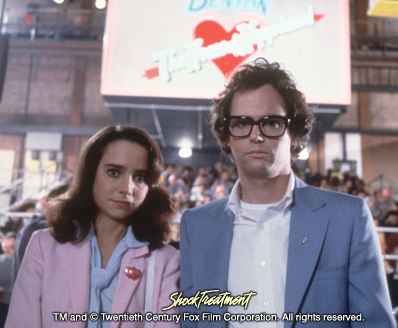
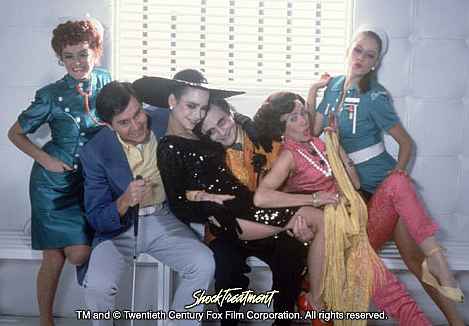
Well, if ever anyone thinks it’s possible to go out and deliberately make a cult movie, they should be strapped down and forced to watch this abomination, Clockwork Orange style. Which is pretty much the only way anyone will be able to get through it: our tolerance for bad films is near-unparalleled, but inside about 10 minutes, Chris was suggesting we should cut our losses and bail out. The setting is Denton, the small town in which Rocky opened, but centers on Brad (De Young) and Janet (Harper), now not-so-happily married. Matters come to head when they attend a TV taping of The Marriage Maze, a game-show hosted by the blind Bert Schnickt. He “wins”a stay in Dentonvale, the local loony bin run by siblings Cosmo and Nation McKinley (O’Brien and Quinn), while she is turned into a singing star by Farley Flavors, the head of a local fast-food company. He’s also played by De Young because, it turns out, he’s actually Brad’s long-lost twin, with designs on Janet, and the whole things is a set-up to this end.

shock1

Technically, the above would be a spoiler, but when the original product is as rancid as this, there’s not much that can possibly be spoiled. In the documentary accompanying the recent DVD release, several people make the claim that the film was simply ‘ahead of its time,’ foreshadowing the rise of reality television and shows like American Idol, which manufacture celebrities. Even granting that may have been the case (and it’s a stretch), it has achieved the remarkable feat of going from ahead of its time, to past its sell-by date, without ever actually passing through “relevant” at any point. Every aspect of the script now seems completely toothless, the satirical equivalent of a bout of constipation: there’s a great deal of straining going on, with nothing to show for it.

Certainly, it’s no Rocky Horror, with the key difference being the cast. Instead of future Oscar-winner Susan Sarandon, and Tim Curry bestride the entire movie like a corsetted Colossus, we get a Who’s Who – or more likely, just Who? – of eighties B-list British celebs. Barry Humphreys! Ruby Wax! Rik Mayall! Where’s Roger De Courcey and Nookie Bear when you need them? [In fairness, Curry was offered the role of Farley Flavors, but declined, apparently due to being unsure about whether he could do the necessary American accent] Jessica Harper looks particularly out of place, and appears to be be rather less comfortable than when she was being stalked round a school in Suspiria. One can hardly blame her: crawling through a room filled with razor-wire would probably be as pleasant an experience as watching this film.

Then there’s the songs. Oh, dear: yes, then there are the songs. Here is one particular lyrical nugget which stood out, from the all-time classic, Bitchin in the Kitchen:

Dear knife drawer
Now won’t you help me to face life more
Oh, trashcan
Don’t you put the dirt on me
Oh percolator, why are we always sooner or later
Bitchin’ in the kitchen or crying in the bedroom all night

I have known eight-year olds who could come up with better doggerel than that. O’Brien has certainly done his fair share of genuine classics: not just Rocky and The Time-Warp, but also the wonderful Name Your Poison, sung by Christopher Lee in Captain Invincible. As a contrast, here’s a sample of its lyrics: “There’s nothing sicker in society / Than a lack of liquor and sobriety / So, down the hatch / Here’s mud in your eye / Take a bracer with a chaser / Wash it down with rye!” In contrast, the songs from Shock Treatment feel, at best, half-finished, as if they had gone straight from the back of a napkin onto the soundstage [the entire film was shot in the UK, a strike in the US having prevented any location work there].

shock3

So, the story is uninteresting, the performances poor and the songs utterly forgettable at best. Is there anything that salvages proceedings? Well, the look of the film is somewhat interesting: the set and costume designers were the same as in Rocky Horror, and do quite a good job of capturing the hyper-realistic feel of the televisual world. That’s it. Otherwise, it’s almost impossible to agree with the participants who claim this was not a “prequel” or a “sequel” to Rocky, but an “equal.” That’s a completely ludicrous claim, without any merit: this is a shameless cash-grab, possessing none of the sense of fun and transgression that propelled the original into immortality. Rocky Horror was as clear an example of capturing lightning in a bottle as could be imagined, and this misguided attempt – complete with painfully-obvious pauses for ‘audience participation’ – should have been strangled at birth.

The other kind of “shock treatment,” the one involving electrodes and high-voltages, would be a good deal more enjoyable.

E

The Days of Swine(Flu) and Roses

swineflu

There’s nothing the media likes more than a good pandemic panic. I recall the one that swept Britain back in 1994, about necrotising fasciitis – the ‘flesh-eating bug’ that was going to make the legs of everyone in the United Kingdom fall off. Needless to say, I type this with a count of fully-functioning limbs that does not stop at three, and that’s pretty much the way these panics work. A disease gets its 15 minutes of fame, far out of proportion to the threat it poses to the general population, and then fades back to the obscurity from which it came. See also SARS, which reached Illness of the Month status in early 2003, but worldwide killed under 800 people. To put that number into perspective, that’s rather less than die each year from being struck by lightning. Anyone remember West Nile Virus? Thought not.

And so we turn to the latest candidate: swine flu, which at the start of the week, was being promoted like with all the fervour befitting the viral equivalent of Susan Boyle [who is also viral in her own way, I suppose]. Here in Arizona, we are in a state of near-panic, being on the front-lines, and right next door to the epicenter in Mexico City. Er, ok: so Mexico City is actually over 1,250 miles away from Phoenix, and we are in fact closer to Medicine Hat in Canada. But Mexico is just over the border. And all those illegals who sneak over the fence at night, as well as bringing in crime, anchor babies and leafblowers, are now also infected with something that borders on Ebola? Little wonder the talk-radio attack-dogs on the right-wing are frothing. Witness this quote, from probably the worst of them, Michael Savage, on April 24:

Make no mistake about it: Illegal aliens are the carriers of the new strain of human-swine avian flu from Mexico. If we lived in saner times, the borders would be closed immediately… Could our dear friends in the radical Islamic countries have concocted this virus and planted it in Mexico knowing that you, [Homeland Security Secretary] Janet Napolitano, would do nothing to stop the flow of human traffic from Mexico?

Now, even as someone who favours immigration controls [dammit, I went through the proper channels to get my Green Card, so have little tolerance for those who opt to ignore the law], that’s pure bullshit, and is just being used by rabble-rousers like Savage to whip up xenophobia. There are many things for which illegal immigrants can be blamed [the inability to scan FM radio without hearing mariachi music, for one], but swine flu is not one of them. It’s reminiscent of the way, in medieval Europe, Jews were blamed for the Black Death – with the resulting pogroms also conveniently canceling the money owed to them. What brought swine flu to the US was tourism, not immigration: the infected aren’t thinking about starting a new life, they would be quite happy just to hang on to the one they’ve got, thank you very much.

There is, admittedly, a good deal of truth to the idea that immigrants carry diseases, and potentially lethal ones at that. Just ask the Native Americans: a decade after HernĂ¡n Cortez arrived in Mexico, some sources estimate that the native population had been reduced, mostly through smallpox, by almost three-quarters, from 25 million to 6.5. Things were little better further North, with smallpox – whether deliberately or unconsciously – a major factor in clearing large tracts of land for colonization. Frankly, in the unlikely event that Jose and Raul are responsible for the ‘flu, it’d hardly register a tick on the Karmic Payback scale. Thus far, Montezuma’s Revenge it ain’t.

swineflu2

Yes, technically, swine flu is a pandemic – since that just means an infectious disease that spreads through populations across a large region. Basically, in the modern world, just about any infectious disease will qualify, since with modern travel, the chances of any kind of quarantine being successful are slim to note. As a result, what was lurking in Kowloon Harbor on Sunday afternoon can be getting coughed up in your local pub 24 hours later. However, modern technology has also brought us much better weapons with which to fight such diseases: anti-virals such as Tamiflu and, of course, a vaccine can also be developed against the particular strain. That’s where catching this in its early stages is very helpful.

On the other hand, Vice-president Joe Biden…not so much. Here’s his quotes from the Today show on Thursday: “I would tell members of my family – and I have – I wouldn’t go anywhere in confined places now. It’s not going to Mexico, it’s you’re in a confined aircraft when one person sneezes, it goes all the way through the aircraft. That’s me. I would not be, at this point, if they had another way of transportation, suggesting they ride the subway… If you’re out in the middle of a field and someone sneezes, that’s one thing. If you’re in a closed aircraft or a closed container, a closed car, a closed classroom, it’s a different thing.” Way to maintain a sense of proportion, Biden – it’s almost enough to make you wish Sarah Palin was the Veep instead. The truth is, “deadly” and “easily transmittable” tend to be mutually exclusive, for good evolutionary reasons. It’s just not in the virus’s interest to kill the host, or do anything that stops them from being mobile and capable of spreading the disease.

Despite the basically trivial nature of the ‘pandemic’ to date, the media has been all over it, because there’s nothing they like more than generating hysteria and fear in the population. Something like, “After the break: it’s coming from Mexico, and it can kill you. We’ll be right back,” keeps people watching, in an increasingly-fragmented media world, where there is more competition for eyeballs than ever before. But, let’s be honest: what kills people in Mexico is not what kills people in the United States. Studies have conclusively shown that, there, it’s spiders, drug cartels and breathing air with the consistency and organic content of chunky salsa. Here, it’s obesity, spree killers and NASCAR accidents. And if you go into an American hospital with the belief you have swine flu, you may well die – but it’s more likely to be medical malpractice that’s to blame, rather than the virus.

Look, folks. I am a card-carrying hypochondriac. Even though I haven’t visited a doctor since graduating college in 1987, save required medicals for mortgage and Green Card purposes, I have at varying times convinced myself I am suffering from: multiple sclerosis, AIDS, diabetes, and three different kinds of cancer (skin, colon and lymph node). And I still don’t find myself in the slightest bit concerned about swine flu. Really. You people…

Incredibly Bad Film Show: Talaash

Dir: Suneel Darshan
Star:
Akshay Kumar, Kareena Kapoor, Pooja Batra, Raj Babbar

talaash1

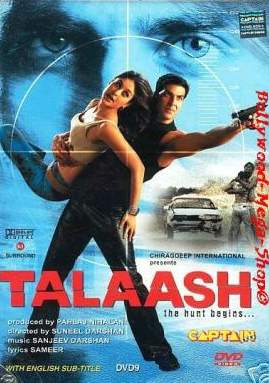
Bollywood films are all the rage now, with the Oscar-winning success of Slumdog Millionaire – even if was directed by the very un-Indian Danny Boyle. However, it is safe to say that not every product pumped out by the Mumbai studios over the years can quite claim to have been unjustly overlooked by the Academy, and Talaash is certainly one such case. Now, we are generally fond of the bright and breezy style favoured by film-makers on the Asian sub-continent. Three hours long? Not a problem. Enlivened by colourful dance numbers at regular intervals? Bring it on. Serve that sucker up with a keema naan and we are so there.

However, there are just some kind of films that do not suit this kind of treatment. Bollywood horror movies, for example, are a) pretty rare, and b) crap, for very good reason. When the participants are breaking out impeccably-choreographed moves, it’s almost impossible to sustain a mood of fear and abject terror. [Unless you’re watching Dancing With the Stars] Talaash is in exactly this category. It’s the kind of story which needs a completely different, non-musical approach. Chan-wook Park, director of Oldboy, would probably have been a great choice to take the story here in the proper direction. Which would be bleak, nihilistic, and everyone dies. Without bursting into song at any point, I should stress. To prove my point, here’s the synopsis.

Babu works for three underworld dons, and when arrested, refuses to talk, in the knowledge they will take care of his wife and children. But when he finally gets home, he finds his family near-destitute. Enraged, he betrays his bosses: their revenge is to take his young daughter Pooja, and raise her to sell as a sex slave, with the chilling phrase, “She’ll be married every night, and widowed each morning.” When Babu tries to fight back, he is beheaded in front of his wife, and Pooja is abducted. His wife goes insane and spends years in a mental hospital. His son, Arjun, becomes a high-profile vigilante, and is now ready to find the killers, in their new identities, and face the many obstacles keeping him from rescuing Pooja and restoring his mother’s sanity.

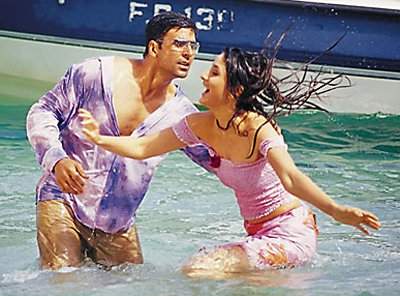
Now, don’t know about you, but I’m not exactly whistling a merry tune after reading that little storyline. However, the makers insist on treating it exactly as if it were the usual ‘boy meets girl’ fluffiness, so when Arjun finally discovers Pooja’s location, rather than – oh, I dunno, going therehe and Tina break into a musical number [below right] involving, for no readily apparent reason, a horse and a speedboat. Or, going the other way, another musical number is immediately followed by an attempted rape on Tina, still wearing the same costume in which she was happily bouncing around, not minutes before. The words “unevenness of tone’ don’t even begin to describe how all over the place this is. If you randomly spliced together I Spit on Your Grave with The Sound of Music, you’d be getting there.

talaash2

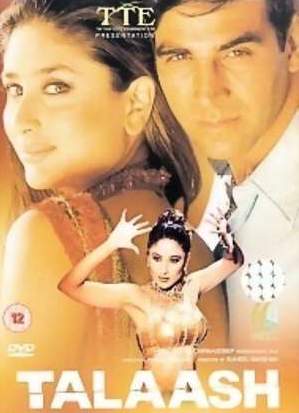
Ah, yes. Tina. I completely forgot to mention her massively botoxed self. She is the daughter of one of the bosses involved in wrecking Arjun’s life, and for a long time we thought she was going to end up being Pooja. As a result, we spent the first two hours with our flesh crawling every time she and Arjun made doe-eyes at each other; it was like watching Princess Leia kissing whom everyone knows now is her brother, multiplied by a factor of about 1,000. At least they never sang about their love for each other. I’m not sure whether it’s a good thing or not that this potentially incestuous subplot doesn’t develop – though I guarantee you, it would have done in the Chan Wook-Park version.

The hero is played by Akshay Kumar, who is one of our favourites and is well-suited to this role, since he can bring the appropriate level of angst to proceedings. However, once again, this carefully-constructed brooding intensity is completely derailed when Arjun starts busting out moves like he was Marky Mark and the Funky Bunch. Any hopes for sustained gritty realism are completely dashed the first time we see Arjun as an adult, where he leaps off the seat of a speeding motorcycle, flies through the windshield of an oncoming truck and then proceeds to beat up the arms-smuggling occupants. This does set the scene for the grand finale where he is shot twice in the chest, beaten up and still then manages to get up and fight the villain.

Credit Kumar for apparently doing a good deal of his own stunts, not least a sequence outside a train which is all the more impressive because you know there’s no blue-screen involved. That scene involves him having to race along the roof, and stop the train before it crashes into a school-bus stuck on a level crossing. This is because Tina – for a jape – has fed everyone on it save Arjun, including the driver, opium-laced candy balls. Oh, how the long winter evenings must just fly past. Fortunately, Indian trains have brakes that allow them to stop dead, inside about fifty feet, with a decorative shower of fireworks from their wheels. That’s part of a lengthy chunk set on the “palace on wheels”, which includes some of the most unfunny comic mugging I’ve ever seen. And I have sat through most of Wong Jing’s lesser works. Maybe it’s cultural, and Mumbai audiences were rolling in the aisles. If so, then this “we’re all the same really” is palpable nonsense.

talaash3

Arjun discovers he needs to go to South Africa, where he is helped by a former senior detective in the Mumbai force – now a South African taxi-driver, which must say something about the salary earned by an Indian cop. There he meets a ‘hostess’, and we were now convinced she was going to be his sister, forcing Arjun to commit suicide after committing incest. We really must stop watching Aki Kaurismaki films. In a thoroughly implausible twist, he convinces Tina her father is a villain, and she then makes her father see the error of his ways, and ‘fess up where Pooja is being held. Arjun goes there to rescue his sister, only to be caught, beaten and forced to watch as Poona is auctioned off since he arrived the day of the sale. This is remarkably lucky, since an entire decade has passed since her kidnapping. I’m impressed with the bad guys’ restraint, feeding, clothing and keeping a young girl for so long, before selling her. Such charitable dedication can only be applauded.

Their lair is simply fabulous, with the auction taking place somewhere that looks more like a Vegas show-lounge, though lacking the taste and restraint you’ll customarily find in the decor at such places. It also includes a fire-pit, inside which Arjun is chained and forced to watch proceedings. Inevitably the sale takes the form of a fabulous dance number, which does much the same for sex trafficking as Pretty Woman did for street prostitution. The hero breaks free and snatches his sister; sudden cut to them on a motorcycle being chased through the South African streets. Quite why a 160-minute long movie couldn’t apparently be bothered to show any more than this, escapes me. The showdown between him and the lead villain [played by the same guy who was Gobindar in Octopussy] then follows, with entirely the expected resolution. Refreshing to find a director who refuses to counter the audience’s expectations in any way, it would appear.

The entire thing is available on Youtube: it really doesn’t do the epic, sweeping scale of the movie’s awfulness justice, You do however, get to see the most painful example of blackface since The Black and White Minstrel Show went off the air. Enjoy.

C-

The Middle Ages: Sanitized for your Protection

joust

One thing I’ve noticed in my eight years here is the fondness the United States has for taking history and re-inventing it, in order to make it ‘better’ – which can mean anything from ‘more palatable’ to simply ‘more fun’. A simple if unscientific study shows what I mean here: if you Google the term ‘America lost in Vietnam’ you get just over six million hits. If, however, you search for ‘American won in Vietnam,’ that number soars to somewhere above thirty-eight million. Looks like Arizona native John Rambo was right when he asked, “Do we get to win this time?” though perhaps even more disturbingly, “America won World War Three” gets 693 million hits.

The Renaissance Fair, while not uniquely American, is certainly largely so, and seems to me another example of that strange trait. We in Europe have little or no interest in recreating the Middle Ages as a group. We’ve been there, done that, lanced the buboes. But America didn’t exist at that point – okay, I know a few Native Americans would argue with me on that, geographically, but I mean as an independent country. It’s as if the United States feels the need to make up being late to the national party, by going back and rehashing all the centuries on which they missed out. Historical accuracy is more an afterthought at a Renaissance Fair: suspension of disbelief is rendered almost impossible, when the crowd are less likely to be dressed in tights and chain-mail than jeans and chain-mall attire.

baebes

What started as a class activity at the home of a Los Angeles schoolteacher, Phyllis Patterson in the early 60’s, has become a good deal more. Patterson’s backyard endeavour is now the Renaissance Pleasure Faire, which has over two thousand costumed performers, seven parades per day, fourteen stages of entertainment and around 150 artisans. Who knew the Middle Ages were so much fun? [It’s also helped spawn quite a few names. Charlie Sheen, Rosanna Arquette and Penn Jillette are among those who have worked at it]

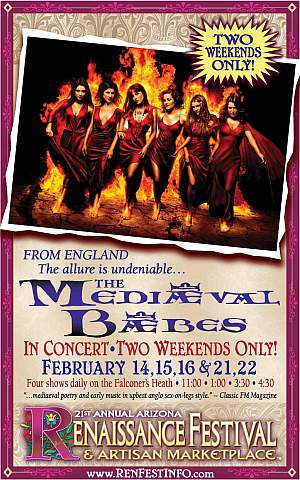
And it’s far from being the only such event. Virtually every state in the country – even Alaska – now has them in a variety of shapes and sizes, from one-day events all the way to monsters like the Texas Renaissance Fair. That takes place over the best part of October and November, and has pulled in more than 370,000 visitors. Right up in the top rank – probably among the five biggest, nationwide – is the Arizona Renaissance Festival, which first took place in 1989 and now occupies a 30-acre site so far out to the south-east, it’s beyond even the suburban sprawl of Phoenix. It’s clear that entertainment comes first and foremost: the official press release describes the festival as “a Monty Python movie come to life.” And they clearly don’t mean the one about Brian, either. It goes on: “enjoy the pleasures of a simpler time in a storybook town… continuous music, dance and comedy shows, shop for wonderful arts and crafts, plus games, rides and a feast of exotic food and drink.” What? No killer rabbit? Not very like a Monty Python movie after all then, is it?

We had free tickets this year, including the Pleasure Feast, a six-course banquet, which was as much a variety show as a culinary experience, but worked pretty well as both. The food was certainly better than the average dinner theatre, I found myself thoroughly entertained – though any show where they keep coming past and filling up your tankard with more beer, is likely to skip fairly easily through the doorway of my critical acclaim. Stuffed to the gills, we rolled out of the banquet hall and began wandering around the fair. Or faire. Or fayre. For antiquated spelling is just about mandatory, with “Ye Olde [insert product] Shoppe” being par for the course.

Inhabiting the grounds are a large number of characters, though it was hard to be sure who were actually employees and who were paying customers, being a bit more extrovert than they should. This is where I begin to find things a little creepy: an interest in the past is fine, but when you feel the need to take on an entire independent character from a different time period… Here, the RenFest begins to occupy much the same ground as the Society for Creative Anachronism which, curiously enough, also started during the 60’s in a Californian backyard [likely not a coincidence: as they say, if you lived in California and remember the sixties, then you weren’t really there], who re-create the Middle Ages “as they ought to have been.” Chris used to be a member, and attended Pennsic War, their central event which draws 10,000+ each yet to Pennsylvania. She, however, opted to stay in hotels, an eminently sensible choice and is no longer a member – our review of the film Darkon gives some more insight into this general field of human activity, if you’re interested.

kingqueen

I have a theory about such groups and those who choose to inhabit an alternative persona: basically, it’s because they’re more or less unhappy with their actual lives. I don’t really want to go into this in depth, since I recall getting into a lot of flak in the anime community when I put forward much the same hypothesis about those who take part in cosplay. Though if I recall, I was somewhat less diplomatic about expressing myself. [The line was somewhat alcohol-fuelled, and went something like “I stopped playing dress-up when I was eight.”] I certainly acknowledge the importance of escapism as a release-valve, but the principle expressed by Roman playwright Terence in the second century B.C. applies: Ne quid nimis or, “Moderation in all things.” But if you’re not a professional actor, then it seems a legitimate question; what exactly are you escaping from, by turning yourself into another person? However, it’s been a long time since I saw so much cleavage in one place, though the quantity was not necessarily matched by the quality, it has to be said.

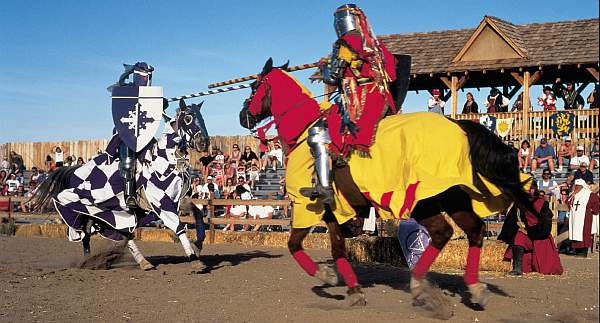
Thoroughly unqualified psychological analysis aside, and back at the RenFest, we headed over to the jousting, being big fans of theatrical, staged violence. Did they really have cheerleaders in medieval times? They did here, with four knights, each assigned to a section of the crowd, and each with a rabble-rouser – us being the rabble – to ensure that we gave full support to the knight of our choice. Was this historically accurate? Or more something inspired by A Knight’s Tale? Painstaking research – literally, minutes spent on Google – were unclear on this. And what the hell was a pirate doing taking part in the joust? Johnny Depp has a lot to answer for, but since there are a couple in IZW too, we are hardly in any position to be critical.

Sadly, we had to leave before the Fight to the Death, scheduled for 5pm. Still, having got our fix of senseless mayhem, we headed back, passing the giant turkey leg stall [obvious question: what do they do with the rest of the giant turkey?], the belly-dancers and the ax-throwing, as well as less traditional features such as the photo booth or ATM – sorry, Ye Olde ATME – and returning to the modern world in the thoroughly authentic recreation of a 20th-century car-park. While amusing enough, I can’t say I’m too sorry to be back and definitely prefer the land of high-speed Internet, satellite television and microwave popcorn to the Middle Ages. Or even the Middle Ages as they ought to have been…