Listen to the Band: The Charles Band Full Moon Horror Roadshow

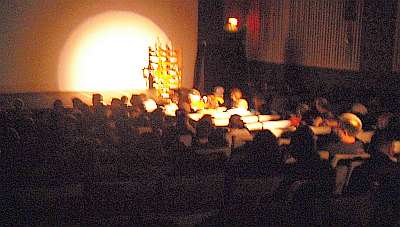
On Thursday, Trash City hosted the Charles Band Full Moon Horror Roadshow at the MADCAP Theaters in downtown Tempe, and a crowd of about 150 enthusiastic fans enjoyed an evening of anecdotes, clips, props, audience participation and rampant consumerism. It’s the third time we’ve been involved with the event: after hosting it the first time Band came to Phoenix in September 2006, Chris was brought on board to find other venues, nationwide, for the tour in both 2008 and 2009.

I can’t come up with anything that’s quite like it. It seems to hark back to the early days of carnival cinema, when a showman would travel town-to-town, setting up his tent and showing some luridly-exploitational title such as Sex Madness, with separate showings for men and women, naturally! He’d sell some merchandise to make additional cash, then leave town before the authorities could react to the potential moral corruption in their midst. While other directors have done one-man shows – Kevin Smith and John Waters come to mind immediately – they don’t bring quite the same sense of showmanship. Think of it as a one-night FullMoonapalooza [next year, we would perhaps like to tie it in with some movie screenings in the afternoon]
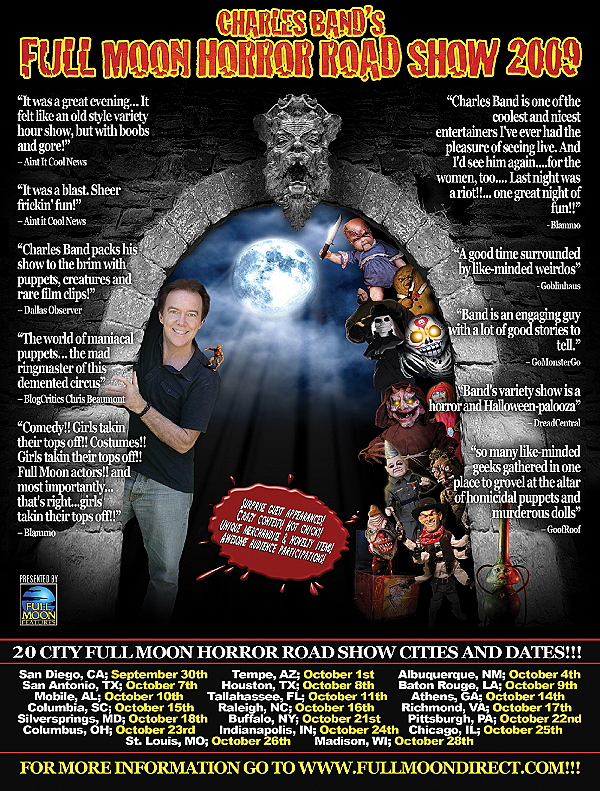
Band is among the most prolific film-makers of his time, and the son of Albert Band, who made films in his own right, including the marvellously-titled I Bury the Living. Charles has 241 production credits on his IMDb page at time of writing, going back to his debut in 1973 with Last Foxtrot in Burbank. He gave Demi Moore her first starring role in in 1982’s Parasite, and has been involved with the likes of Klaus Kinski, Lance Henriksen, Bill Maher and Oscar-winner Gary Busey. Sci-fi, horror and soft-porn have been his bread and butter for over 30 years, and he survived the implosion of his theatrical venture, Empire Pictures, in the late 1980’s.

Long-running franchises like the Puppet Master series have been the staple of video-store shelves forever. The upcoming Puppet Master: Axis of Evil will be the tenth film to bear the name since the original came out, two decades ago, and if there’s a horror movie with dolls, puppets or other tiny terrors in it, there’s a good chance Band is involved. We’re not talking great art, let’s be honest. However, they can be great fun, and are a refreshing blast of nostalgia from a kinder, gentler genre era, before the advent of torture-porn. Much like Troma head Lloyd Kaufman, Band has stuck to doing what he wants, has survived and is still in the business. Such tenacity can only be respected.


Like any showman, Band makes full use of a good title. Here are my favorites from among the 200+ in his career:

  1. Gingerdead Man 2: Passion of the Crust
  2. Cannibal Women in the Avocado Jungle of Death
  3. Teenage Space Vampires
  4. Virgins of Sherwood Forest
  5. Mutant Hunt
  6. Sorority Babes in the Slimeball Bowl-O-Rama
  7. Evil Bong II: King Bong
  8. Robot Holocaust
  9. Test Tube Teens from the Year 2000
  10. Kraa! The Sea Monster

As you can imagine, there’s no shortage of anecdotes available to him for the Roadshow, and that forms the focus of the show. He’ll sometimes bring special guests with him, such as Tim Thomerson, star of the Trancers series: at the first Phoenix event, we met Phil Fondacaro, a 3’6″ tall actor, perhaps best known for playing the only Ewok to die on screen in Return of the Jedi [“It’s a start…” mutter many Star Wars fans on reading that!]. The second show was also notable for the full-size guillotine on stage, used to carry out the live decapitation of an audience member, complete with severed head flying into the crowd. Cool. There was also the Boner-Meter, an eight-foot phallic-shaped piece of pseudo-scientific equipment; in 2009, it was an electric chair, complete with sound effects and flashing lights – I’ll get to its purpose in a moment.

Participation is a vital part of the show, not least when he gets attendees up on stage to act out a scene. This involves “auditions” for the various roles – straightforwardly described as Hero, Monster, Damsel in Distress, etc. – with the title [in 2008; I missed that section this year] generated by pulling random words from slips of paper supplied by the audience. It usually ends up as being Revenge of the Teenage Zombie Cheerleaders, or something of that ilk. The requirements are straightforward: the largest guy who can roar loudest, is the monster, while the female roles similarly go to those with the most convincing scream. Oh, and especially those prepared to take their tops off in exchange for merchandise. Ah, yes. The usual Mardi Gras cry of “Beads for boobies!” was supplanted by  “Box-sets for breasts!” here – and surprisingly effective it proved, too.
Of course, this was strictly nudity necessary to the plot: this time, it was because exposed bosoms were the only thing which could calm the savage killer after he escaped from his electric chair [See? I told you I’d get to its purpose!], because they reminded him of his childhood. Brilliant! Makes perfect sense to me, anyway. And that, ladies and gentlemen, is why the silver-tongued Band has been producing movies in Hollywood for more than thirty years. Mind you, this year’s show was a great deal more restrained than last, where there was at least one participant who had to be talked into keeping her clothes on until the appropriate moment. That’s likely because this time, it was  taking place in a cinema rather than a bar, with a selection of alcohol limited to Bud and Bud Light. To quote a work colleague, why is American beer like having sex in a canoe? Because they’re both fucking close to water. We will be correcting this shameful omission next year. Trust me.

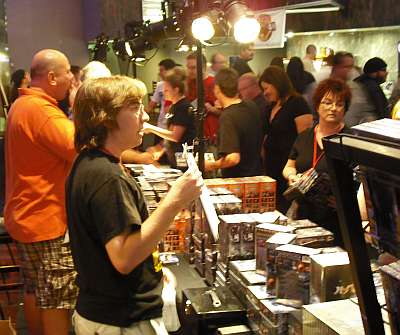
Merchandise is also an important part of the event – I would say between the DVDs, CDs, prints, T-shirts and the models which are offered for sale, it probably generates more income for Full Moon than the ticket sales. I worked the stalls at the first two shows, and can attest to the feeding frenzy which erupts after the show is over. We had learned from this, and had recruited minions from Full Moon fans prior to the event to help out Scott, Brent and Harlan (the last being Charles’s son), the roadies for the tour.

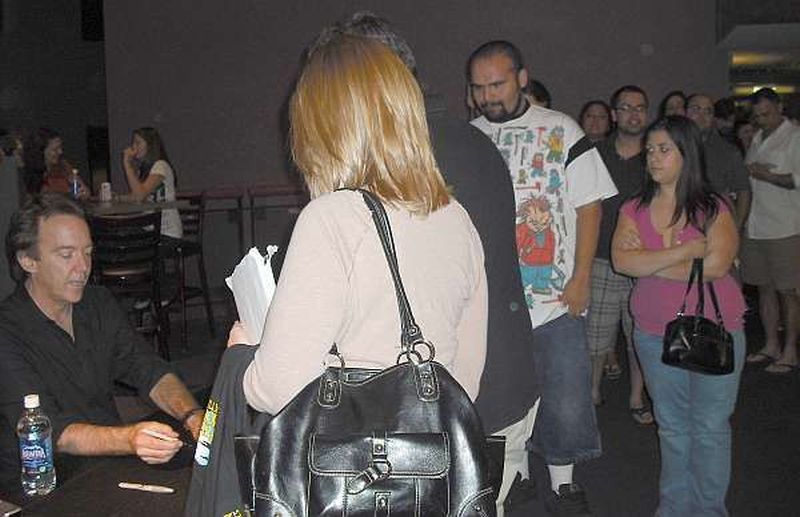
Charles sat at one of the end tables and patiently signed anything put in front of him, chatting with a long line of fans, as shown in the picture atop this article. I’ve seen other celebrities show up at these kind of events, and it’s more like a production line, as they hurry you through, so the star can escape the unwashed masses as soon as possible. That wasn’t the case here at all, and kudos to Band for his unhurried patience: he didn’t leave until the last fan in the line had been met, greeted and dispatched on his or her happy way. Indeed, Band was one of the last to leave the venue – we know this, because we drove him back to his hotel on our way home.

Like most such events, the work involved behind the scenes is (or should be!) invisible to the participants. We dodged a bullet this time, as last year’s venue closed abruptly last month – fortunately, our Spidey senses had been tingling, and we had already moved the show to a new location in downtown Tempe. When it’s over, the reaction – as with all such events – is inevitably, “Thank God.” But it’s the kind of event we would love to attend as a fan, and when it’s a success, the sense of satisfaction which results is all the greater. We look forward to being a part of the Horror Roadshow again in 2010. Just as long as we can sort the whole beer thing out.

Is pro wrestling art?

We went to WWE Smackdown here in Phoenix on Tuesday night, and had a thoroughly good time – over four hours of entertainment, accompanied by pyrotechnics so loud they had Chris covering her ears. The televised main event saw straightedge bad-guy champion CM Punk (left) beat fan favourite Matt Hardy, in a ‘loser leaves WWE’ steel-cage match. The result wasn’t a surprise to us – previous events had made it fairly clear Punk would be fighting the iconic Undertaker at the next pay-per-view, so it seemed very unlikely he’d lose. But when we watched the show on TV on Friday, we were surprised to see some fans in the audience crying after Hardy lost.

Now, it’d be easy to mock those fans, going the cheap route and rolling out the tired old cliches about them not believing that wrestling is staged [I use that word carefully, and would never call wrestling “fake” – especially not the same week a wrestler we know died, apparently the result of taking too much pain medication]. However, that would also mean those who cry at sad movies should be similarly criticized for failing to distinguish reality from entertainment: despite what Titanic might say, Leonardo DiCaprio is not really dead. A capacity to produce the emotional reaction desired by the creator is one of the key definitions of an art-form, even if that emotion perhaps comes from the lizard part of the brain, such as when you get 15,000 people to chant “You suck!” in unison.

It’s somewhat similar to the long ongoing debate about whether video games should considered as ‘art’ or not, which has been a topic for discussion since Jack Kroll wrote in a 2000 issue of Newsweek that “Games can be fun and rewarding in many ways, but they can’t transmit the emotional complexity that is the root of art.” That was almost a decade ago, and technology has certainly advanced massively since. However, many remain unconvinced: there’s an interesting debate between Roger Ebert and Clive Barker on this topic, and I do have to say, I have never had any significant reaction to a video-game. A certain poignancy in the middle of Final Fantasy VII; some slight dread while engrossed in Doom. Then again, I have never had any significant reaction to sculpture either.

Computer game designer Tim Schafer said, “Art is about creatively expressing thoughts or emotions that are hard or impossible to communicate through literal, verbal means,” and that’s a definition that could well be applied to the largely non-verbal world of professional wrestling. Sure, the cutting of a promo is part of the medium, but it’s what happens after the bell rings that really matters. Then, you’re watching a morality play unfold, a struggle between good and evil for supremacy – though evil may triumph over good, or ‘normal’ notions of what is “good” may be reversed. See Punk vs. Hardy for an example: Punk doesn’t smoke, drink or abuse medications, but by putting across a “better than you” in-ring persona, he has become the ‘heel’.

Like all media, it’s probably necessary to accept that there is a spectrum in effect. Not all films can be truly considered as art – or at least, successful art. Movies like Plan 9 From Outer Space certainly provoke emotions in the viewer, but you can’t really claim that Ed Wood was aiming for derisive laughter in his audience.  Similarly, you can’t lump together all pro wrestling as a whole, but need to accept that there is good and bad. You also need to realize that no match happens in isolation: they are pieces in a carefully-constructed storyline laid out episodically over the preceding weeks and months. Like any good soap opera, the more you watch, the more you get out of it. The casual viewer simply won’t be able to appreciate it anywhere as much.

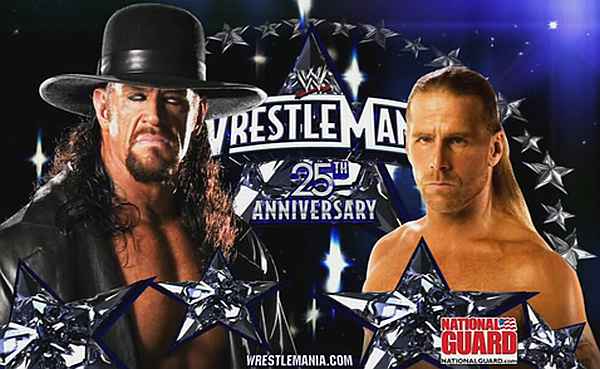
An example of the best kind of wrestling would be the match at the last Wrestlemania, in Houston, between the Undertaker and Shawn Michaels (left and right respectively, above). A knowledge of the back-history involved was crucial. Undertaker had a remarkable record of 16-0 in previous Wrestlemanias [sure, we’re talking pre-determined results, but the mere fact that he has been deemed a credible winner every time since his debut in 1991, is still hugely impressive] On the other hand, he had never beaten Michaels, one-on-one. We’re also talking two of the most unquestionably charismatic performers in the field – I’m not sure why WWE have never tried to use Undertaker in a horror Western, as he’d be perfect.

Their struggle on this night was a marvelous example of story-telling through physical theatre, the pace of the encounter ebbing and flowing over forty minutes as well as any movie could hope to do, even though there were no titles at stake here.  It built to a crescendo where each man pulled out their signature moves, only to see the opponent refuse to succumb. Finally, the Undertaker delivered a second Tombstone Piledriver [a move you’d better hope is staged, because if you don’t do it right, you will break someone’s neck] and took the victory, running his Wrestlemania record to 17-0.

Britannica Online defines art as “the use of skill and imagination in the creation of aesthetic objects, environments, or experiences that can be shared with others.” If not a classical art, there’s no doubt that, by this definition, professional wrestling  qualifies: the skill involved certainly cannot be questioned, and if the imagination shown in the storylines is occasionally…well, let’s just say ‘somewhat excessive’, it’s equally undeniable. If you want a shared experience, then a wrestling show is more interactive and less passive than almost any other. Indeed, without the fans there would be no show; the spectators become part of creating the art, their reactions becoming part of the collective artistic experience.

Wrestlemania 26 comes to Phoenix next March. I’m not expecting any art critics from the local papers to attend alongside us, but it’s going to be an experience which we certainly wouldn’t miss for anything.

Torchwood: Children of Earth

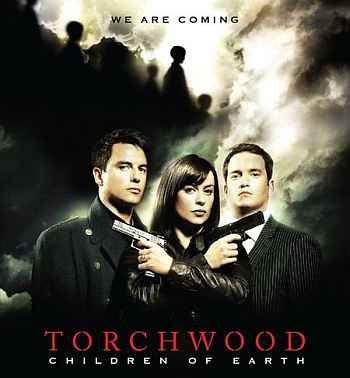
And Doctor Who did begat Torchwood…and between those two and Primeval, Saturday nights on BBC America were pretty well packed, and verily, did we praise Tivo to the heavens. While we started somewhere in the middle of the fourth season of Who – leading to a fair amount of “Well, that would probably make sense if we’d seen all the previous series” – we were lucky enough to begin Torchwood at the beginning, which certainly helped. Two series of tracking the near-immortal Captain Jack Harkness (John Barrowman) and his team followed, as they battled aliens and alien technology from their secret base, the “hub”, in the center of Cardiff [which is basically the UK version of Buffy‘s Hellmouth, where all the weird shit happens. Makes sense to me].

It took a little while for the series to find its feet and become its own master, but it got there, and in time for the five-night event which was Children of Earth, with only a couple of weeks between its broadcast in the UK and here in Arizona. Quite long enough, unfortunately, for Twitter spoilers to provide more information than I would rather have had, but such is media life in the 21st century. It’s hard to imagine anything like, say, The Sixth Sense, being so successful today – by mid-Saturday afternoon, the twist would be all over everyone’s Facebook wall. Well, those who have a Facebook, which still excludes me, I am pleased to report. If you want to ‘friend’ me, you need to do it to my face, dammit.

Anyway. Children of Earth starts with every child in the world simultaneously stopping, repeating “We are coming” for a couple of minutes, then resuming as if nothing had happened. Needless to say, this freaks out the adults, and things get worse as the incident repeats – adding first the word “back”, then “tomorrow” to the message. The Torchwood team swing into action, but it turns out that the British government know more about this than they are prepared to let on, and Torchwood’s offer of help is rudely rebuffed. And that’s “rudely” as in “we’re going to implant a bomb inside Capt. Jack, and let him blow up the hub, then terminate with extreme prejudice any survivors.” Terribly un-British, actually.

The government have received instructions from “the 456” – an entity? a group? an alien race? – on the construction of an apparatus, and are building it on the thirteenth floor of a Whitehall building. There’s also a single adult who is affected, and appears to be a survivor of a mass abduction of some kind that happened forty years ago. So, what the heck is going on? What do the 456 want? Why are Torchwood – the people best equpped to handle the crisis – apparently now targeted for execution? It makes for an effective combination of 24 and The X-Files, combining the running around and political shenanigans of the former, with the extra-terrestrial/supernatural aspects of the latter.

Holding it all together is Harkness, a man for whom the phrase, “You cannot stop Captain Jack, you can only hope to contain him,” appears to have been designed. He cannot be killed, due to an incident in a previous Doctor Who episode, which left him “a fixed point in time and space.” This kind of thing could be lethal to any tension – when death loses its sting, where’s the threat? – yet, the writers still found ways to imperil Jack, as noted above. Returning from that was an impressive feat, with our hero at one point looking more like skinless Frank out of Hellraiser. His immortality is also in contrast to the very real mortality of his team – half of which didn’t make it out of the second series and here… Well, let’s just say, I wouldn’t sell them any life insurance.

Less successful is the gay relationship between Jack and Ianto (Gareth David-Lloyd). While not a problem in itself (hello – Xena fan!), in the first episode in particular it seemed forced and self-conscious: “Look at us! We’re gay!” As in Xena, when the writing drifts from what makes the show successful – and this is an action/SF show, not a soap opera – it weakens things.  While likely inevitable, with both Barrowman and creator Russell T. Davies being cheerfully out of the closet. I tend to think that when you make entertainment for the public at large, it’s self-indulgent to put your own sexual preference, shared by perhaps 5% of the population, to the forefront. It’s notable that the series episodes not written by Davies are less inclined to take this approach.

It didn’t help that Ianto came over as, in many ways, irritating and clingy – quite the opposite of the kind of person, male or female, with whom you’d expect Jack to take up. Say what you like about the ambivalent Capt. James Hart – and Barrowman sucking face with Spike from Buffy was certainly one of the more memorable images of recent genre TV – you could see the attraction. Ianto basically makes the tea for Torchwood. It’s another echo of Xena, where the relationship between the heroine and Gabrielle was fundamentally wrong – not because the characters were the same sex, but purely because Gabrielle was a whiny little bitch. Ianto also stretched our credulity to the limit, when he somehow outruns the British army in a fully-laden bulldozer.

Fortunately, the rest of the script largely makes up for it. In Gwen (Eve Myles), you have perhaps the closest British TV has got to an action heroine since Joanna Lumley in The New Avengers. Flying through the air, gun in each hand…and did I mention she’s pregnant? While not a ‘classical beauty’, you can easily see why her husband is utterly-devoted to her [much as I am to Chris…]. Much credit must also go to Frobisher (Peter Capaldi), a civil servant who finds himself at the center of the storm; the decisions which he makes end up turning him into a victim, in the most bleak way imaginable.

Indeed, the show is particularly chilling in its bureaucratic plausability. When it becomes clear what the 456 want – it’s horrific, both for what they want, and the reasons why they want it – and that there’s no way out of delivering it, what results is the kind of conversation that must have happened in Nazi Germany. How do we get the Jews to the camps? How do we dispose of the bodies? Something unthinkable – not just being discussed, but reduced to its banal practicalities. The 456 may be the villains, but the politicians don’t exactly come out of this smelling like roses.

The deeper a hole a plot digs for its characters, the harder it is to climb out of it – and the hole here was bordering on the Grand Canyon-sized. The machinations required to get out did have an air of deus ex machina in their convenience – not as bad as, say, Independence Day, Signs or War of the Worlds, because there was a price which had to be paid for them, and it was not at all negligible. It may be the end of the series – the team gutted, their headquarters destroyed and their leader…well, he won’t be doing any leading for a bit, let’s just say – but if so, it’s an entirely fitting way to go out.

In the late seventies, I remember watching Quatermass on ITV, and being totally gripped, albeit as a 13-year old kid. Thirty years later, Children of Earth had almost the same impact, an impressive feat after three more decades of cynicism have gone under the bridge. It certainly ranks among the most gripping, effective short series of genre television to come out of Britain in a very long time.

Incredibly Bad Film Show: The Mystical Adventures Of Billy Owens

Dir: Mark McNabb
Star:
Dalton Mugridge, Christopher Fazio, Ciara O’Hanlon, Roddy Piper

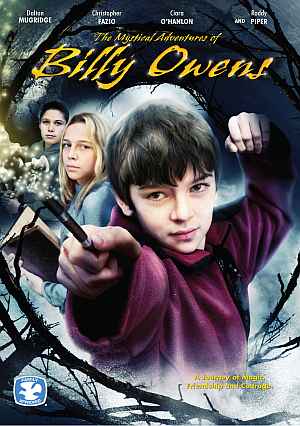
It’s a surprise that it took so long for someone to produce a shameless rip-off of Harry Potter. While such things have been done in the literary world [most infamously, Russian series Tanya Grotter], even the Asylum – creators of such works as Transmorphers, I am Omega and the all-time classic, Snakes on a Train – haven’t ventured into the boy-wizard arena. It took the unlikely combination of a pro wrestling legend and, it appears, a community theatre group, for this to be realized.

I kid not. While one can understand the children not having much cinematic experience, the official website for the movie reveals that most of the adults are not exactly professionals. For example, one is a telephone engineer; another “pursued a career in human resources”; a third is a police sergeant. Rarely has a the phrase “don’t give up your day job,” applied to virtually the entire cast of a movie. Few have any other film experience listed in the IMDB, except for a couple who appeared in McNabb’s previous films Study Hell and Blind Eye.

Worth mentioning those movies because, while they weren’t very good by most objective standards, they seem like Lord of the Rings when put beside Billy Owens. This seems to show that the issue is not necessarily McNabb, so much as a script which is a babbling mess. If you took all six Potter films to date, added The Goonies, and assigned a monkey to select 70 minutes of scenes from them at random, you’d get something which would be a tower of coherence compared to this. It’s generally a rule of thumb that the more voice-over you need to explain your film, the worse your script. This probably sets an all-time record for the amount of expository monologue: it’s more like an audio-book with pictures than a ‘proper’ film.

It’s delivered by Hermione, sorry, I mean, Mandy. Such confusion is understandable, since Barry Hopper, er, Billy Owens, has two friends with whom he hangs out. One is a boy and largely forgettable, the other is female and a know-it-all. In other words, exactly like JK Rowling’s hero. What are the odds? The performances are exactly the level you would expect, and mainly serve to make you realize how good – or, at least, non-irritating – Daniel Radcliffe et al are in their roles. As noted, you really can’t blame them: if I’d been asked to star in a film at age 11, I’d not have been found touting my inexperience.

For the adult actors, the Potter saga has Oscar-nominees like Richard Harris, Ralph Fiennes and Maggie Smith. This has… Roddy Piper – and unlike the kids, he is old enough to know better.  We have always had a lot of time for Mr. Piper, even outside the wrestling ring. They Live is probably John Carpenter’s second-best film [behind The Thing and – Rob Dyer’s going to kill me for saying this – ahead of Halloween], and we’ve seen a number of other B-movies where he has been the finest thing about them, most recently, Ghosts of Goldfield. But he is wildly miscast as the owner of the mystical shop where Gary Kotter Billy Owens finds the magic-wand, which sets the plot in motion. It’s a role made for a veteran Brit with presence, someone like the late Peter Cushing. So what the hell is Piper doing in the part?

The most likely explanation is that he lives locally, because it seems everyone else from Sarnia, the Ontario town where this was shot, gets to appear. This is apparent from an end-credit sequence which lasts around ten minutes, listing individually and on a line of their own, each person who had the slightest thing to do with the movie, right down to the extras. Now, as a community building project, this is a cool concept and by no means a bad idea. However, that does not mean that anyone outside Sarnia gives a shit. The credits do have a positive impact, in that they shorten the running time of the actual movie significantly. This can only be a good thing.

700 words in, and I haven’t mentioned the plot. There’s a good reason for this: I am actively avoiding it. But I’ll try my bet. It’s the eleventh birthday of Larry Wotter Billy Owens, and while running away from a school bully, he ends up in the shop owned by William Thurgood (Piper). There, he finds himself strangely attracted to a wand, on which he spends his birthday cash, and discovers it indeed has magical powers. This is fortunate, since he’s the only one who can save the town of Spirit River from the dragon buried underneath the river, which the evil Mr. Mould is trying to release. He has to make his way past… mystical guardians and… a bunch of other stuff, in order to ensure that… doesn’t happen.

Yeah, not quite my finest synopsis. However, I’d rather be vague than wrong, and this storyline is so badly put-together I would be guessing if I were to be more specific. However, must say, the climactic encounter with the dragon is extremely memorable – albeit for all the wrong reasons. You remember the Windows 3.1 screen-saver with a logo bouncing off the edges of the screen? That’s how the dragon moves, and is a good approximation of the graphics quality too. Just a thought: when you are obviously incapable of delivering anything even approximating to a dragon, it might be a good idea, oh, not to put one as a key element in your script.

The child actors see the script for the first time

In its defense, some elements are not taken from Potter. They are, instead, lifted from a pre-pubescent version of Buffy the Vampire Slayer. Billy has to come to terms with his new found ability, while his parents live – apparently – in blissful oblivion. And, just like Buffy found unlikely allies at her school, so does Billy. As Joss Whedon showed, this could be a source of well-crafted drama, blended with action and comedy into a delicious, frothy frappe. However, as Brian McNabb shows, it can also be an incoherent lump, littered with WtF? moments that are the main source of entertainment (thankfully copious), performances less delivered than carved from the finest mahogany, and possessing production values your local panto production of Peter Pan would reject.

JK Rowling should sue. Not for any particular legal reason, just with the aim of stopping the makers from producing the threatened sequel [which, to my horror, the IMDB reports as being in post-production, and the official website says premiered last November]. The world would thank her for this, at least as much as for any of her books.

[Billy Owens is released by MTI through Artist View Entertainment on July 21st – hey, less than a week after the latest Harry Potter film came out! What are the odds… It’s in widescreen, and the black bars at the top and bottom of your television set are probably more entertaining to watch. For more information, please visit the MTI website.]

E

A Moving Experience

“Hell is other people.” – Jean-Paul Sartre

With the deepest respect to Mr. Sartre, he is clearly mistaken. For the reality is – to misquote Euripides – that those whom the gods would destroy, they first make…move house. Sartre must have stayed in the same home all his life, for otherwise, his definition of hell would have involved Rubberware tubs, moving vans and an eternity spent trying to squeeze a quart into a pint-pot. Yes: for the first time since 2000, I’ve moved. I’d forgotten quite how awful an experience that is. And even though this one involved about a hundredth of the distance in the London-Phoenix one, I can see why it’s regarded as third most stressful life experience, behind the death of a spouse and… Oh, I dunno, maybe marginally behind abduction by a particularly-peeved Al Qaeda splinter faction.

It’s not until you try and move it all, that you realize just how much crap you have. I use that word after careful consideration, though perhaps the term ‘cruft‘ might be more appropriate, since we’re largely talking about things that you don’t necessarily want to keep – they just accumulate over the course of time. In my case, that’s approaching nine years; for Chris, it was fifteen or so. It was necessary to be brutal: take a look and say, “What are the odds of me using this in future?” In the case of things like, say, multiple boxes of PAL videotapes, the answer could only be “Er… Well… Oh, look! Wedding pictures!” Sadly, such diversionary tactics were not enormously successful, and there is a significant chunk of Phoenix landfill that is now 50 Hz.

It was amazing the stuff which surfaced, providing a history in objects and ephemera of my life. For example, my membership card for the Scala Cinema (below), and a poster for the Chow Yun-Fat festival that was the last event held there. [The card expired sometime in 1994, some time after the venue got sued by Stanley Kubrick and went under. I am probably not the only Scala fan, whose response on hearing of Stan’s death was, “Serve the fucker right.”] The original masters for most of the early issues of TC. An copy of Deep Red magazine, autographed by Dario Argento. Man, I had some cool stuff. It took most of an afternoon just to go through the movie posters: memo to self, next house must have more walls.

All told, however, I was ruthless. Ok, mostly I was ruthless with Chris’s stuff – it would probably have made sense for her to go through my possessions, and vice-versa. Still, we ended up throwing out a massive amount of stuff: almost the entire length of the drive-way was filled with garbage bags and unwanted items, from monitors to swing-sets. It wasn’t enough. We originally ordered a 16-foot pod, in the expectation it would be large enough for almost everything. But we needed to add another, similarly-sized truck, and even after that, there were still several van-loads which needed to be moved down to the new house. For days, it seemed it was an apparently endless job; no matter how much we packed, another cupboard would be discovered, and the amount remaining seemed no less.

We were basically cut off from the outside world for the last couple of days: we’d unplugged the ‘puters and TVs and moved them down there, for a scheduled install of cable and Internet there on the Monday. However, Cox unilaterally shifted that to the previous day, and were surprised when there was no-one there. This was not unexpected, since they had also disconnected things at the old house at 8pm on a previous Saturday night, the fact that we hadn’t quite left there yet having escaped them. Despite being called within ten minutes, it took them 48 hours to reconnect us, and if Chris hadn’t threatened a fatwa, it would have been three times as long. Really, if we didn’t have about forty hours of stuff on the Tivo, we’d have probably told them exactly where they could stick their cable. And they might have had difficulty picking up a signal thereafter.

Finally, the great day dawned, with the truck packed up and the contents delivered to the new location. Now, all we had to do was find somewhere to put it all. For part of the problem is that we moved to a smaller house. This made logical sense, in that one child had already flown the coop [albeit at her third attempt – however, does look like this one has stuck], so her bedroom was providing the dogs with accommodation. However, I think the key difference was forgetting that we had an entire two-car garage, basically stuffed to the gunnels with beads…and no garage in the new place. As a result, the only way it was all going to fit, was if the new house was also capable of travelling through time and space, and came with a companion and a sonic screwdriver.

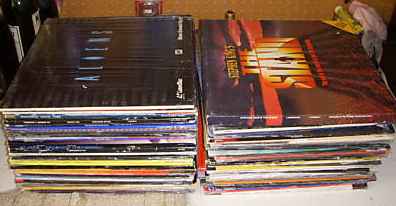
We have adopted a pragmatic approach to this point, working on the principle that we should only unpack stuff likely to be used. Laserdiscs, for example, will remain in their current boxes, pending a move to a permanent location in a couple of years [once it’s just me and Chris, we can find a place from where we will be the ones being carried out in boxes…] However, there is just no way the number of books, for example, can be fitted on to the available shelfspace, or the clothes in the closets. Especially when both will likely been co-opted for beads by the time we’re done, since the corridor outside the room where I’m typing is currently reduced to half its width, due to bead cabinets. It doesn’t help that the dogs like to sleep there too, meaning that a trip to the bathroom is fraught with furry anti-personnel devices, ones which get up off the floor just as you step over them, just in case of the unlikely event that you might,  at three in the morning, be going to the kitchen to feed them.

So it’s still very much a work in progress: at this moment, Chris is putting up blinds in the bedroom, to prevent a 5am wake-up call from Mr. Arizona Sun. However, it does feel like home, with the living-room, office and bedroom now in a state of acceptable habitability: it may still be quite some time before there be enough room for a house-warming party, never mind the inclination!