Badass to the Bone

bruce_campbell_ash

MTV announced its top ten list of ultimate movie badasses earlier in the week, headed by Clint Eastwood as Dirty Harry. It wasn’t as much of an abomination as most such selections go, though quite what Diablo Cody – one of the panel – knows about the topic of badasses, it’s hard to say. However, the list still had some notable omissions, and in that spirit, I offer the following alternative top ten. I humbly submit, this selection would collectively leave the original in the dust, if there were ever some kind of Badass Survivor Series.

I suppose it does perhaps depend on how you define the credentials. Wiktionary says a badass is “A person whose extreme attitudes and behavior are admirable,” but I think there’s more to it than that. I’d be hard-pushed to actually write anything down: however, much like pornography, it’s usually pretty clear when you see it. However, after coming up with ten, Chris and I kept right on going, with a little help from Robert too. Through dinner, on a restaurant napkin, back home and on into the next morning with everyone in the house lobbing suggestions to me like hand-grenades. It became abundantly clear that one list of candidates was not going to be enough.

The MTV list is weakened considerably by an almost complete reliance on Hollywood films, with Mad Mel the token non-American included. Being badass does not require you speak English. Or even speak at all. Indeed the less you say, the better. Which is why Quentin Tarantino will never, ever qualify, and Samuel L. Jackson is also not to be found here. Just as you don’t need to speak to be a badass, you don’t need to spell aluminium without an “i”. Hence, in addition to the American top ten list (which, dammit, we expanded to a top 20, simply because we can), we also include section for British and Asian candidates, as well as a list combining all those from the rest of the world.

For this purpose, every man, movie and character on the MTV list is excluded from consideration. Even though Eastwood could well have made this list, for The Man With No Name, and I wouldn’t argue with John McClane either. That restriction was not applied to the women, as a list without Ripley on top of it would be unthinkable. A more fully-detailed article on the ladies, incidentally, will be appearing separately, over on girlswithguns.org later in the month. And I’ve limited actors to one nomination. Otherwise, the entire top ten could be filled with the works of Rutger Hauer, who was badass in just about every movie he made for a decade after Blade Runner: The Hitcher; Wanted Dead or Alive; Blind Fury; Split Second; Wedlock; Salute of the Jugger; Flesh + Blood; Ladyhawke; even Buffy the Vampire Slayer. I rest my case.

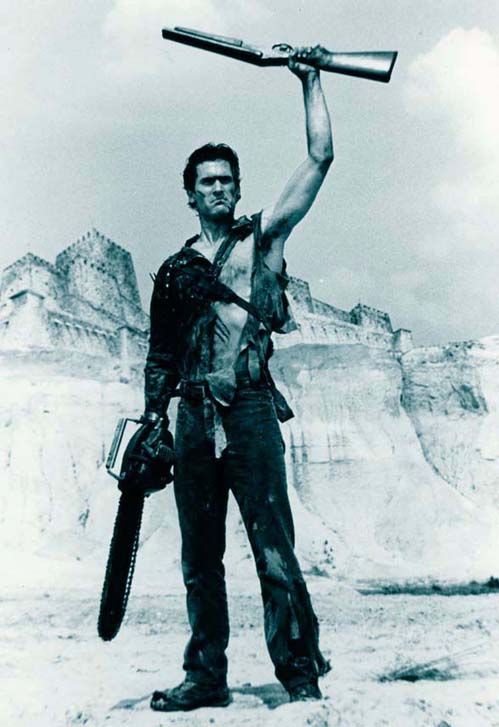
  1. Ash in Army of Darkness [Bruce Campbell]
  2. Riddick in Pitch Black [Vin Diesel]
  3. Snake Plissken in Escape from New York [Kurt Russell
  4. Luke in Cool Hand Luke [Paul Newman]
  5. Simon Phoenix in Demolition Man [Wesley Snipes]
  6. Tony Montana in Scarface [Al Pacino]
  7. Creasy in Man on Fire [Denzel Washington]
  8. J.J. McQuade in Lone Wolf McQuade [Chuck Norris]
  9. John Shaft in Shaft [Richard Roundtree]
  10. Sgt. Harman in Full Metal Jacket [R. Lee Ermey]
  11. Gabriel in The Prophecy [Christopher Walken]
  12. Seth Gecko in From Dusk Till Dawn [George Clooney]
  13. Nada in They Live [Roddy Piper]
  14. The Lieutenant in Bad Lieutenant [Harvey Keitel]
  15. The Kurgan in Highlander [Clancy Brown]
  16. Tyler Durden in Fight Club [Brad Pitt]
  17. Aragorn in The Lord of the Rings [Viggo Mortensen]
  18. Jason Bourne in The Bourne Ultimatum [Matt Damon]
  19. Micky Knox in Natural-Born Killers [Woody Harrelson]
  20. Johnny-23 in Con Air [Danny Trejo]

British badasses
caine
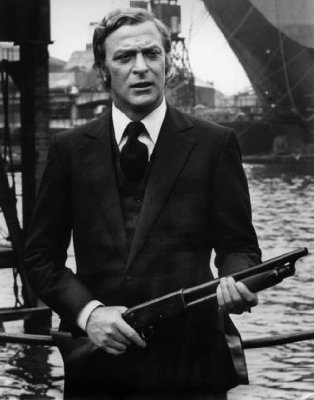
  1. Jack Carter in Get Carter [Michael Caine]
  2. Hannibal Lecter in Silence of the Lambs [Sir Anthony Hopkins]
  3. Count Dracula in Dracula [Christopher Lee]
  4. Don Logan in Sexy Beast [Ben Kingsley]
  5. Cleric Preston in Equilibrium [Christian Bale]
  6. Big Tony in Snatch [Vinnie Jones]
  7. James Bond in Dr. No [Sean Connery]
  8. Alex in A Clockwork Orange [Malcolm McDowell]
  9. Smith in Shoot ‘Em Up [Clive Owen]
  10. Stansfield in Leon [Gary Oldman]

Honourary mentions: Ray Winstone (Beowulf); Bill Nighy (Underworld); Jason Statham (The Transporter); Gerard Butler (300).

Eastern badasses

  1. Mark in A Better Tomorrow 1+2 [Chow Yun-Fat]
  2. Kai San in The Ebola Syndrome [Anthony Wong]
  3. Kakihara in Ichii the Killer [Tadanobu Asano]
  4. Ricky in The Story of Ricky [Siu-Wong Fan]
  5. Dae-su Oh in Oldboy [Min-sik Choi]
  6. Lee in Enter the Dragon [Bruce Lee]
  7. Azuma in Violent Cop [Takeshi Kitano]
  8. Sky in Hero [Donnie Yen]
  9. Prisoner KSC2-303 in Versus [Tak Sakaguchi]
  10. DCP Hari Om Patnaik in Aan: Men at Work [Akshay Kumar]

Foreign-born badasses

  1. Roy Batty in Blade Runner [Rutger Hauer]
  2. Don Lope de Aguirre in Aguirre, Wrath of God [Klaus Kinski]
  3. Leon in Leon [Jean Reno]
  4. Dutch in Predator [Arnold Schwarzenegger]
  5. Jef Costello in Le Samouraï [Alain Delon]
  6. Maximus in Gladiator [Russell Crowe]
  7. Anton Chigurh in No Country for Old Men [Javier Bardem]
  8. Wolverine in X-Men [Hugh Jackman]
  9. Jean Rasczak in Starship Troopers [Michael Ironside]
  10. Joseph in Sheitan [Vincent Cassel]

Female badasses

  1. Ripley in Aliens [Sigourney Weaver]
  2. Varla in Faster, Pussycat! Kill! Kill! [Tura Satana]
  3. Alice in Resident Evil: Apocalypse [Milla Jovovich]
  4. The Bride in Kill Bill [Uma Thurmann]
  5. Jade Fox in Crouching Tiger [Cheng Pei-Pei]
  6. Mallory in Bloody Mallory [Olivia Bonamy]
  7. Ilsa Koch in Ilsa: She-Wolf of the SS [Dyanne Thorne]
  8. Inspector Ng in Yes, Madam [Michelle Yeoh]
  9. Ruger in LA Bounty [Sybil Danning]
  10. Coffy in Coffy [Pam Grier]

Honorary mentions: Franka Potente (Run Lola Run); Aya Ueto (Azumi); Anne Parillaud (Nikita); Carrie-Anne Moss (The Matrix); Leslie Andrews (Sick Girl); Brigitte Lahaie (Fascination); Michelle Rodriguez (Girlfight); Zoe Tamerlis (Ms.45); Christina Lindberg (Thriller: A Cruel Picture); Sharon Stone (Basic Instinct); Katherine Isabelle (Ginger Snaps).

Who’s the Boss

drwho2

Like most people of my age, Doctor Who was one of my favourite shows while I was growing up. My earliest memories of it involve Jon Pertwee, the fourth doctor, and his car Bessie, but to me, the show’s golden era followed in the wake of Tom Baker, who reigned supreme over Saturday evening television in the late seventies and early eighties. [If you want to get specific, the peak was probably Season 17 in 1979-80, with Douglas Adams acting as script editor and Lalla Ward as Romana – the latter being an early schoolboy crush of mine, I vaguely recall]. Interest faded slowly thereafter, though I have some fond memories of Sylvester McCoy, the last before the series went on hiatus at the very end of the eighties.

While I watched the 1996 attempt to relaunch the series, starring Paul McGann, I was supremely underwhelmed, and so didn’t pay any attention to the revival of Doctor Who when it came back to the Beeb in March 2005. Some things are best left to be remembered solely through the rose-tinted glasses of childhood nostalgia, where the bravely limited – and that’s being kind – effects are not such a distraction. Yes, I’m looking at you, Blake’s 7. However, over the festive season, BBC America scheduled a marathon of all the Christmas specials; by chance I stumbled onto the 2007 Voyage of the Damned. I didn’t realize at the time that, when originally screened in Britain, the episode was the second most-watched program of the year, and gave the show its highest ratings in almost thirty years. Having nothing much better to do, I simply gave it a chance, not expecting much at all.

For once, I was wrong and popular culture was resoundingly right. The episode took the standard disaster movie – most obviously, The Poseidon Adventure – and twisted the clichés into strengths, located in a futureverse with imagination oozing from ever scene. The writing and performances were both superb, even Kylie Minogue managing to be more convincing than irritating, and the justly-maligned effects from the original show were gone, in favour of high-quality CGI. The body-count was surprisingly high, but what really mattered were that these were deaths that you cared about, even of characters we’d never seen before. Death is something rarely shown with such harshness on American TV (except as a desperate ratings ploy), but the poignancy of the final moments, where the Doctor thinks he can save someone, only to have the hope snatched away… Okay, I’m hooked. Can the regular series live up to this?

Short answer: yes. Albeit with the caveat that this is based only on what we’ve seen, which is most of Season Four. Led by Russell T Davies and Steven Moffat, the creators have crafted a marvellous body of work, which takes the strengths of the original show, but doesn’t attempt to slavishly ape it, acknowledging that television and culture have both changed radically since the previous incarnation. Gone are the multi-part episodes with cliffhangers at the end of each segment, replaced by stories which generally stand alone, though with occasional over-riding arcs. There are occasionally ones which spread over two parts, but the flexibility this offers, in contrast to the previously-fixed format, allows the writers more scope. I would pit the two-part “Silence in the Library / Forest of the Dead” up against any SF feature film of the past decade, and it would stand up well.

drwho1

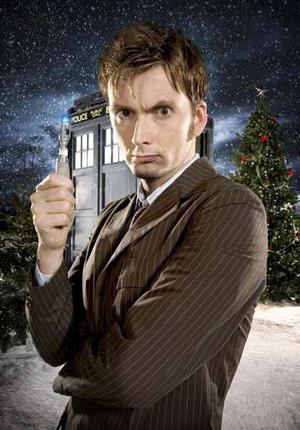
At the core is David Tennant, who is absolutely pitch-perfect, capturing the essential humanity of the Doctor and his absolute alien-ness, both of which are required for the role. Striking the balance is hard [even Tom Baker probably leaned towards the latter], but Tennant does it with effortless ease. You can see why his assistants would follow him, literally, to the ends of the universe, and his benign nature, along with his vastly superior intellect, are never in doubt. It’s a beguiling combination. The companions are a good deal less passive than they used to be too – I seem to recall them spending a lot of time being rescued in the original series, but the new breed are generally competent, self-reliant and smart. Let’s face it, if the show can turn the previously-irritating Catherine Tate into a sympathetic and likable character as Donna Noble, they’re clearly doing something right.

Yet neither Doctor nor companions are mandatory. Consecutive episodes in the fourth season had first one, then the other, all but removed – first, the Doctor went on a solo sightseeing expedition, which went horribly wrong after a presence possessed one of his fellow passengers. then Donna was diverted into an alternate universe, where she turned left instead of right at a junction, and never met the Doctor. That way led to disaster befalling the entire universe, for reasons which became clear in the season finale. It helps that backing up the main characters are just about every famous British actor you can think of, from Felicity Kendall through to Sir Derek Jacobi. I was particularly pleased to see Bernard Cribbins [once I got past the ‘Is he still alive?’ reaction], as I remember him playing an assistant to Peter Cushing in one of the two movies made in the sixties, more than 40 years previously. It’s another way in which the show is aware of its history, without being a slave to it.

dalek1

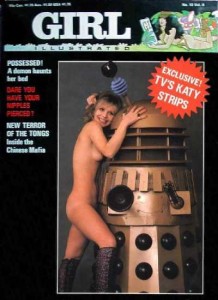
However, I have to admit that some of the monsters and adversaries no longer have quite the chill which they created in my childhood. When I heard the phrase, “Ex-TER-min-ate!”, for the first time in forever, I immediately flashed back to a seven-year old kid, peering out from behind a cushion at the TV. I had to explain to Chris the sheer impact of the creatures on my fragile young psyche. However, it’s fair to say that they did not quite live up to my fevered rememberings, and Chris was notably unimpressed, describing them as being more like irritated vacuum-cleaners than anything. I can hardly argue with this as an assessment, despite the upgrades which meant that their plans to conquer the universe would no longer be defeated – as depicted in a famous cartoon – by a flight of stairs. While it’s hard to imagine Doctor Who without them, this is probably one aspect of the show that would perhaps have been best left concealed in the midsts of time. [The image, right, of former companion Katy Manning, suggests I wasn’t the only one for whom Daleks hold no terror…]

All told though, the finale of the series more than lived up to expectations – you have to admire an arch-villain whose plan involves not just the destruction of Earth, or even the entire universe, but also of all parallel universes as well. Think big, that’s what I always say. It’s probably not giving away much to say that the plan was eventually foiled, though with enough of a twist on it to prove largely satisfactory. We’re not just looking forward to season five, we’re already seriously contemplatin splashing out for the first three series on DVD. Though a dark cloud on the horizon is the departure of Tennant as the Doctor after the filming of four specials this season: it’s hard to imagine anyone else taking over the role. However, if the writing remains as consistently excellent as we’ve seen, then we’re confident the series will continue going from strength to strength. I certainly wouldn’t bet against the show enjoying its 50th anniversary, in 2013.

Comments
Mike L: Only *thinking* of getting the first three series on DVD? Rush! Rush to your nearest stockist! I say that as a confirmed hater of old style Who, but the revival has been magnificent. The first series really converted me, it was respectful to the old show but happy to modernise at the expense of the fanboys. Best episodes:

  • Dalek – Series 1.
  • The Empty Child/The Doctor Dances – Series 1
  • The Girl in the Fireplace – Series 2
  • Human Nature/Family of Blood – Series 3.
  • Blink – Series 3

Most of those are Steven Moffat episodes, which bodes well for the future of the show. I think Eccleston was easily the match for Tennant – without spoiling things too much, there was a deep inner sadness to the Series 1 doctor and by the time you get to “Dalek”, you know why. Although Eccleston is a Serious Actor, he played it perfectly especially considering the pressure they were under bringing it back. He teams up perfectly with… ah, that would be spoiling the fun.

That series and series 2 really show off the Doctor/Rose relationship – plus the fact that Billie Piper is actually a decent actress rather than a teen pop flash in the pan.

The Death of Laserdisc

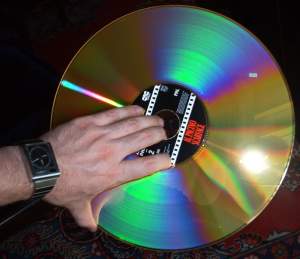
It came quietly at the start of the year – not with a bang, followed by weeping, wailing and gnashing of teeth. Just a two-line notice in the Akihabara Times, quoting a press release on the Pioneer website [I presume, anyway – the second link is in Japanese, so I’m going on faith with that one]:

This is a sad day for all LD (Laser Disc) fans… Pioneer is stopping the production of their three latest LD players, the DVL-919, DVK-900 and DVL-K88… For your information, Pioneer sold over 3.6 Million LD players in Japan from 1981 to 2002.

disc

I must confess, my first thought on this was not dissimilar to my first thought on hearing about The Wrestler: “I didn’t know he was still alive.” If asked, I’d probably have said that the last player rolled off the production lines in Japan at least five years ago, probably longer. But no: though the release of software pretty much petered out not long after the new millennium, laserdisc lasted for over three decades, with more than 360 million units sold. Do you think we’ll still be watching DVDs thirty years after their arrival? I sincerely doubt it.

LDs were for the truly hardcore cinephile. Hell, I started buying discs before I even owned a player: I think the first one I got was Cat People, and had to get Lino to dupe it down to tape for me. Even though it was widescreen, this did somewhat negate the point. The 420 lines of resolution they offered may seem weak now, compared to Blu-Ray’s 720, but they kicked the arse of VHS’s 250. However, there was a price to pay for this, and it came in the form of cold, hard cash. Very few laserdiscs were made in Britain, so you almost inevitably had to rely on imports, mostly from the US, but occasionally from Hong Kong or Japan. Those movie fairs held at places like the Electric Ballroom in Camden, were goldmines for these, but some of the shops on Tottenham Court Road had a few, and there were also the Cinema Store, Psychotronic Video and Eastern Heroes, who all had their moments.

These were of extremely dubious legality, since none of the imports had been passed by the BBFC; even if there were no cuts, the higher frame-rate for NTSC made the running-time different, ergo they were uncertificated. Most stores got around this by slapping stickers on them, though I vaguely recall the late, unlamented [due to their horrific over-pricing] Tower Records getting into trouble for adopting this technique. And, like most things illegal, they weren’t cheap: the most I recall paying for a single disk, was 65 quid for a copy of Flying Daggers, though there may have been a Yellow Magic Orchestra LD – from Tower, natch – that was a little higher. If you paid less than twenty pounds for a movie in Great Britain, you were doing really well.

YouTube Video

Devo do a commercial for the joy of laserdisc, 1984

As a result of these cost and availability issues, there were overseas buying trips – most commonly to the USA, but I also recall trips to Paris, and raiding stores such as FNAC. Back in 1998, on the final leg in New York, I spent an entire afternoon in the Virgin Megastore, going through their complete stock. I ended up with so many discs, that I had to take a taxi back to the hotel. No matter the haul, all these shopping-sprees ended in basically the same way. Who can forget the ripple of fear as you approached HM Customs at Gatwick, staggering under the weight of uncertificated material? Or the thrill as you exited the ‘Nothing to Declare’ channel to freedom, intent on subverting the very fabric of British civilization with your uncut copy of Teenage Mutant Ninja Turtles? Of course, you could order discs by mail, and enjoy the delightful game of Postal Roulette that followed. Would they arrive intact? Would they arrive at all? To this day, one of the highlights of my life remains getting HM C+E to cough up compensation, after they badly scratched a disc during one of their Naziesque inspections.

Laserdiscs were simply so much cooler than videotapes, coming as they did with extra features – again, this is now something we take for granted with DVD [“No in-depth interview with the costume designer? Wot kind of ‘special edition’ is this?”], but it opened up a whole glorious vista of experience, since VHS rarely had anything apart from the movie. The director’s commentaries were the bomb: a good one would be like having the people concerned sitting beside you, drinking a beer and telling you about the movie. Escape From New York, with Kurt Russell and John Carpenter pointing out each other’s ex-wives, would be a classic example. And much as I hate Quentin Tarantino, his and Robert Rodriguez’s chat on From Dusk Till Dawn, with input from Greg Nicotero, is another that highlights the possibilities offered by the medium.

I still watch my discs occasionally – most recently, Basic Instinct, only a couple of weeks back [Paul Verhoeven is another commentary master]. I have to admit, the video quality does look a bit dodgy, especially on a large screen, which are much more common now than they were at the time. But there’s something about a laserdisc which is more physical than a DVD, in much the same way that a vinyl LP offers more scope for design than a CD. Some of the box-sets that were released were simply phenomenal: Toy Story and Hellraiser are the first couple that come to mind, and occupy an honoured spot on the bookshelves in TC Towers. Criterion also did some impressive work, but their sets always seemed over-priced, even by the standards of the medium; I think the only one of theirs I ever got was Hard Boiled.

Laserdisc never became more than a fringe market in the West; in echoes of the VHS/Betamax battle, the technically-inferior videotape won. Though to be honest, it was never much of a battle, LD failing to capture more than a couple of percent of the market, due to various criticisms, valid or otherwise. “You can’t record on it.” “What? Turn the disc over in the middle?” “They keep falling off my record-player.” And when DVD arrived – much though I tried to deny it – I knew in my heart that it sounded the death-knell for laserdisc. However, with two bookcases, still stacked more or less floor to ceiling with the damn things, they may be gone but certainly aren’t forgotten, at least hear in TC Towers. Let’s just hope our player soldiers on for the next thirty years.

[Thanks to Alex M for being the bearer of these sad tidings!]

Incredibly Bad Film Show: The Terror of Tiny Town

Dir: Sam Newfield
Star:
Billy Curtis, Yvonne Moray, ‘Little Billy’ Rhodes, Bill Platt

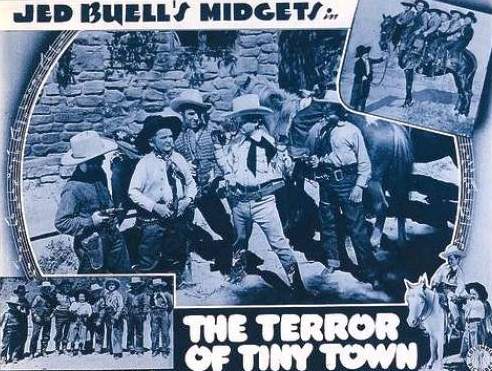
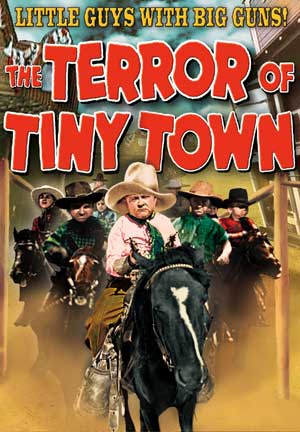
Ladies and gentlemen and children of all ages, we’re going to present for your approval a novelty picture with an all midget cast, the first of its kind ever to be produced. I’m told that it has everything. That is, everything that a western should have. It’s a soul stirring drama, a searing saga of the sagebrush, and it’s called “The Terror of Tiny Town.”

More than seventy years have now passed since this film forged a whole new genre: the all-midget Western. And when you’ll see it, you’ll understand why it’s a field of cinema that has remained dormant for seven decades, with so many aspects which are, from a 21st-century perspective, politically incorrect to a jaw-dropping degree. Not least would be the opening title which declares the film to star “Jed Buell’s Midgets.” And there was I, thinking that the ownership of other people had been abolished in America after the Civil War. Perhaps there’s a sign somewhere in Washington which says, “You must be THIS tall to have civil rights.”

tinytown1

As the opening announcement quoted above says, apart from the short stature of the cast, it’s a 1930’s Western in just about every other way, with all that implies. The plot has Bat Haines (Rhodes) scheming to set two ranchers against each other in a range war, anticipating being able to clean up in the aftermath. It helps he has the sheriff in his pocket, but he reckons without the son of one, Buck Lawson (Curtis), falling for the niece of the other (Moray). But did I mention it’s also got some musical numbers? These vary from the somewhat cute to the downright creepy: I’m pretty sure the performer in the saloon is less little person, and more pre-pubescent young girl. As a result, seeing her making eyes at the miniature adult performers is probably up there with the wedding in Freaks, among the more grotesque sequence in pre-war cinema.

The acting is all over the place – you’d probably expect this, given that I imagine casting was almost entirely based on height, rather than actual talent. Some of the performances are not bad: Moray is decent enough as the heroine, and Nita Krebs vamps it up nicely as a dance-hall floozy. On the other hand, Joseph Herbst, playing the sheriff, delivers his lines with all the passion and intensity of someone on Valium reciting the phone book, and ‘Otto’ the comedic chef is little better. He gets upstaged by a duck walking backwards – even though the feat is obviously accomplished by running the film in reverse [this is especially apparent, as they use the same footage three times in the same scene].

tinytown2

Speaking of animals bring us to another essential aspect of any Western: the horses. On here, of necessity, Shetland ponies – except for the gargantuan beast shown at the blacksmith’s in the opening scene – and their little legs fair whizz along, particularly during the chase sequence. One trusts some undercranking was involved, or their already-short legs will have been worn down to bloody nubs by the end of shooting. Finally on the animal front, even though this is somewhere in the middle of the land-locked, dusty, bone-dry desert, the barber-shop has a penguin. Let me just repeat that, for fear you skimmed over it.

The barber-shop has a penguin.

This is for absolutely no reason. There is one shot of said flightless avian, and nobody mentions it, even in a “What the hell is that doing here?” kind of way. There is also a miniature barber-shop quartet, performing close harmony tunes [though I suspect lip-synching is involved], but it does at least make some sense for them to be in a barber-shop. A penguin: not so much. One also wonders who the heck built this town. Some aspects are sized to fit the inhabitants, but it’s clear the sets are just your average Hollywood back-lot. This is most apparent in that a lot of the actors have to reach up to open the saloon swing-door, and we were perpetually holding our breath for fear one would get smacked on the back of their little heads by the return swing. Similarly the curb from the main street reaches up, almost to the waist on certain performers, and requires from some of them a degree of exertion better suited to Ninja Warrior.

It all builds to an exciting conclusion, where Lawson and Haines go at it in a cabin fist-fight, after the fuse is lit on a bundle of dynamite. It would probably be somewhat more tense if the fuse did not apparently only burn while the camera was turned on it. But as brawls go, it’s actually by no means bad – and we speak as connoisseurs of midget mayhem – with the two trading blows and rolling around the cabin with a lot of verve and energy. No particular surprise as to the ending, but the final five minutes are probably the best thing the movie has going for it.

Even with the opening [edited out in some TV screenings], it barely runs sixty minutes. So this will hardly tax the patience of even the shortest attention span, and it probably counts more as a short film than a feature, hohoho.  Originally an indie movie, the rights were bought and the film was re-released by Columbia, though I can’t find any information on whether or not it was successful. Jed Buell supposedly planned to use the same cast in a film version of the Paul Bunyan story, with a non-midget playing Bunyan, but nothing ever came of that. However, many of the cast would go on to much greater renown the following year, appearing as Munchkins in The Wizard of Oz. One imagine Buell gave MGM some kind of package-deal… Hero Curtis lived to the age of 79 [Krebs lived even longer, reaching 85], and had a solid career, including a significant role in High Plains Drifter.

The odd thing is – and this is presumably entirely unintentional – is that in many ways, this is remarkably progressive. No-one even mentions the size of the protagonists after the introduction, and you cease to notice the size of the performers, except occasionally when forced on you, by things like the saloon doors. When everyone is the same height, no-one is a midget, and no-one is a giant – they’re all just people, and the result is, it’s a perfect demonstration of the wide spectrum of lives that the undersized can play. Good or bad, young or old, this is the ultimate expression of little people being depicted purely as human beings – nothing more, nothing less.

C+

In Praise of Narwhals

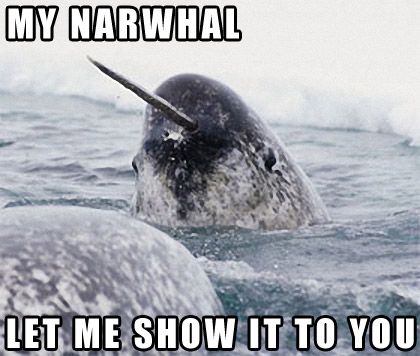
lolwhal

I don’t normally hold much common ground with the ‘Intelligent Design’ crowd, but even I have to admit that evolution is hard-pushed to explain the existence of the narwhal – to me, it seems not just proof of the existence of god, but that he/she possesses a twisted sense of humour. It’s the kind of animal that could only have been invented at the tail-end of a long college party, when it seemed like a good idea to outfit a marine mammal with a corkscrew on its nose. Narwhals should consider themselves fortunate that their creator apparently fell asleep, before deciding to add a can-opener and a pair of scissors to their other end.

While initially merely amused by narwhals, the more I learned, the more I realized that they fall into the category of “unjustly overlooked.” Dolphins get all the cetacean press, but all they really have to offer is a smile like Lindsay Lohan leaving court after a ‘not guilty’ verdict. Narwhals are much, much cooler, truly equipped to be the ultimate party animals (far surpassing dolphins, and their bottle-noses). That horn can be over nine feet in length., and when Queen Elizabeth I was presented with one in 1588, by privateer Martin Frobisher, she placed on it a value of ten times the horn’s weight in gold. Suck on that, Flipper.

Actually, it’s not a ‘horn’ as such, but a tooth that grows through a hole in the narwhal’s upper lip. The narwhal has two; almost always, it’s the left-hand one that expands out, but occasionally, the right tooth won’t get that message, leading to a rare, bi-pronged narwhal. The British Museum reportedly has one – no word on whether this leads to some kind of tusk envy among others of its pod. [Hence the saying, “As happy as a narwhal with two horns.”] The actual purpose of it remains a mystery, which is part of the animal’s appeal: obvious uses like fighting or punching holes through the Arctic ice, just don’t seem to happen.

However, in 2005, scientists from Harvard and the National Institute of Standards and Technology took a look at it through an electron microscope. They discovered 10 million nerve endings going from the core outward, and believe the horn is basically a massive sensory organ, that can detect changes in temperature, pressure, etc. It’s almost like the tooth is built in reverse, with the nerves on the outside, causing The New York Times to call the appendage, “one of the planet’s most remarkable.” When the whales break the surface, waving their horns around, it may be the equivalent of us licking a finger to tell which way the wind’s blowing, to help predict the weather.

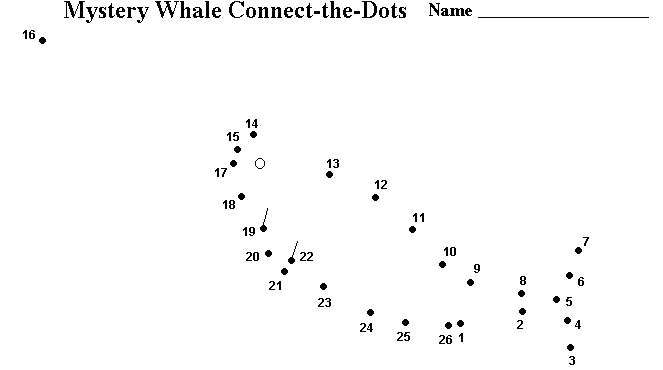
Really, not much of a “Mystery” Whale, is it?

The name translates from Old Norse as “corpse-like whale,” describing the whale’s mottled black and white skin – those Old Norsemen were clearly not exactly observant, apparently managing, when naming the beast, to miss that whole F-sized tusk thing. The Inuits got it right, calling the narwhal Qilalugaq qernartaq – no, I didn’t just fall asleep on the keyboard – which translates to mean, “the one that points to the sky.” It’s generally thought that narwhals are involved in the unicorn myth. This is somewhat hard to swallow: I mean, if I was cruising the arctic seas and saw one, my first thought would hardly be, “Look! A horse with a horn on its head. We need a virgin to catch it.” However, these were the same sailors who apparently confused manatees with Darryl Hannah, when Rosie O’Donnell would have made more sense. So I suppose anything is possible.

One thing is certain. Narwhals combine style and function, mystery and grace, intelligence and strength, in a way that lesser species would kill for. They may, arguably, be quite the coolest animals on the planet.

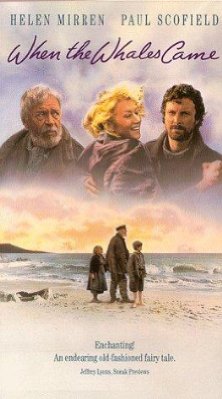
When the Whales Came

whales_came_02

Dir: Clive Rees
Star: Max Rennie, Helen Pearce, Paul Scofield, Helen Mirren

Narwhal fans are not exactly well-served by the cinema. As in most of culture, it’s damn dolphins that get all the coverage, going back to the 1916 silent film, The Fate of the Dolphin. Since then, we’ve had Flipper, Day of the Dolphin and even Touched by a Bleedin’ Dolphin. In contrast, the most well-known cinematic moment for the poor narwhals, is a ten-second cameo in Elf. But this 1989 film, while less renowned, contains significantlyl more tusky goodness – though it takes its time getting there. We were drawn in by a two-line synopsis that mentioned two of our favourite things: narwhals, and mobs of villagers. However, that really only occupies a small part of the film, albeit the climactic moments.

It’s set around World War I on the Scilly Isles, off the coast of Cornwall, on an island where the inhabitants largely survive by scavenging from whatever the sea throws up on the beach. Two children, Daniel and Gracie (Rennie and Pearce), befriend a reclusive old man (Scofield), whom the rest of the local treat with a mix of fear, suspicion and derision, because of his trips to the cursed, now-deserted nearby islet of Samson. He’s known as “The Birdman”, because he carves exquisite birds out of driftwood. That’s what attracts Daniel, who wants to learn the art partly as an escape valve from his abusive father. Gracie has no father at all, since he went off to join the navy, so she’s being brought up by her struggling mother (Mirren).

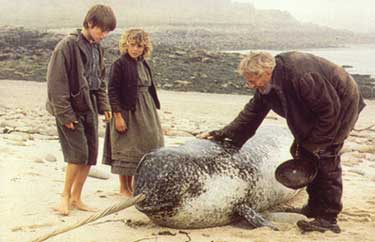
An ill-fated fishing expedition by the kids lands them on Samson, where they find a narwhal tusk over the fireplace in one of the abandoned houses. Back on their own land, they find some locals suspect the Birdman of being a German spy, because of the beacon fires he sets, and set out to make him pay. However, he is more pre-occupied with a narwhal which has beached itself on the shore, and tells Gracie and Daniel it must be returned to the sea, before it brings the rest of its pod ashore behind it – an act that would bring doom to this island, as it did to Samson. Which is where the mob of villagers comes in…

whales_came_01

In the interests of accuracy, it should be noted that, I believe, narwhals are very rarely stranded on the British coast [only four instances have been recorded since the days of Good Queen Bess], so the concept here is probably, ah, on thin ice, zoologically-speaking. Though the massacre of narwhals in large numbers, sadly, still goes on: late last year, up in Canada, at least 600 were killed by locals after getting hemmed in by ice. I’d be more inclined to take claims of this being a native tradition seriously, if snowmobiles and semi-automatic weapons weren’t apparently involved, and the media kept away. Happy to use the tools of modern civilization; not so willing to leave your questionable “harvests” behind, or face public opinion when the world sees what’s going on.

Back to the film. It’s an idea that works very nicely, both as a metaphor for the war – we note the prominence given to a narwhalesque spiked German helmet in the local school – and as a reverential acknowledgment that narwhals have a mystical quality, perhaps more so than any other aquatic mammal. The movie is certainly helped by a strong performance from Scofield, and very natural ones by the two children, against a marvelously scenic backdrop. The pace is relaxed, to say the least – those, like us, lured in with the promise of narwhals, will likely find themselves looking at their watches. But as an unhurried, Sunday morning kind of a film, it certainly has some charm.

B-