Avatar: or, Earth First – we can rape the other planets later

Dir: James Cameron
Star:
Sam Worthington, Zoë Saldaña, Stephen Lang, Sigourney Weaver

We saw Avatar on Tuesday night, in IMAX 3-D. Well, I did, anyway – the relentless camera motion made Chris’s motion-sickness kick in, and she spent much of the moving trying to fight back her nausea. I know how she feels: as the storyline unfolded, I had to restrain my own rising tide of vomit – though in my case, this was triggered by the yawning chasm between the stunning technical aspects, and the storyline that was not only a cobbled together hodgepodge, it was a two-hour forty-minute anti-technology, anti-human, screeching polemic, which we will forever refer to as, Dances With Blue Things.

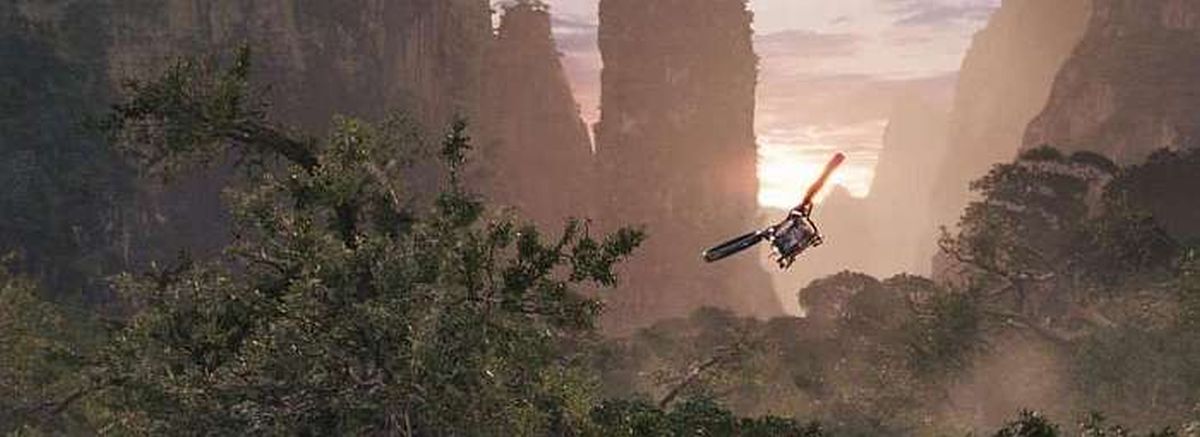
Before getting into the pitiful excuse for a plot, let me first say, as a technical achievement in whizzbangery, it’s quite magnificent. The alien world of Pandora is realized in an incredible way, populated with alien creatures and a landscape that, from the ground up, makes it clear, to quote one character, “We’re not in Kansas anymore.” [a line that, like much of the movie itself, was cynically lifted from another, superior film] If you’re going to see the film, make sure you see it on the biggest screen possible. Because, then, there’s a chance the visuals might help distract you from the story-line.
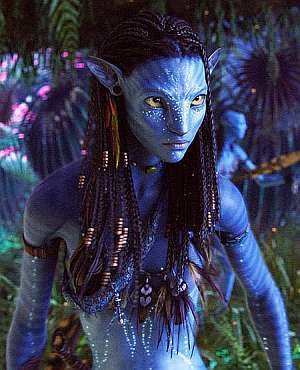
Quick summary.  Humanity, having screwed up Earth, has now moved on to Pandora, a lush, forested moon in the Alpha Centauri system. Arriving there is Jake Sully (Worthington), a paraplegic ex-Marine who is taking over for his deceased brother as an avatar pilot. These avatars are vat-grown hybrids between humans and the native Na’vi population and are used to explore the planet, in the hopes of fostering peaceful interaction with the somewhat combative Na’vi. The pilots are linked remotely to the avatars during their waking hours, experiencing what they do and controlling their bodies. On his first mission, Jake becomes separated from his team and is rescued by Neytiri (Saldaña, left).

Which is where the wheels fall off the plot, and it becomes mired in a combination of painful predictability and pretentious pomposity. As Jake learns more about the Na’vi – who resemble eight-foot tall Smurfs with USB connectors in their pigtails – he inevitably grows to love and appreciate their native culture. His original mission was, in part, to find a way to get the tribe of Na’vi to move so we could use the valuable mineral on which they are sitting. When he realizes this will never happen, it triggers an attack by the industial-corporate forces under Colonel Quaritch (Lang), and Jake completely rejects his humanity, becoming the leader of the Na’vi forces in his avatar body, and taking them into battle against the invaders.

Even Sully at one pont calls the philosophy of the Na’vi “tree-hugger crap,” and it’s a rare moment of honesty, because that’s exactly what it is, propagating the myth of the noble savage. For example, one core aspect of the Na’vi lifestyle appears to be that it’s okay to slaughter other animals in the forest – as long as you apologize to them afterwards. Well, I bet that makes feel alien Bambi, whose twin hearts you just stabbed with your large knife, feel a lot better as their life ebbs away. The Na’vi come across as the kind of smug, hypocritically pious jerks who insist that everyone has not only to respect their way of life, but bend over backwards to fit in with it – yet still need a human to solve their “time of great sorrow”. Add in the fact that it looks like all the CPU cycles went on the landscapes, with the Na’vi looking less than convincingly alive than the local lichen, and you have a gaping hole at the heart of the movie.

It’s almost as if Cameron is trying to make up for Aliens, a film which, if you think about it, basically had the somewhat questionable moral that genocide is sometimes a pretty good idea. There, the humans were the good guys and the alien creatures the villains, with no shades of grey. Here, the roles are completely reversed, and the problem is, it’s a much harder task trying to get me to empathize with blue, cat-like alien hippies, who would be really good in the NBA. I’m sure it’d bring audiences around Alpha Centauri to their feet though. At the end, Quantich asks Sully, “How does it feel to be a traitor to your race?” and he’s right, as Sully abandons his body entirely, in favour of the avater. However, it’s a question that should probably also be posed to James Cameron, whose opinion of the bulk of humanity is clearly that of a Hollywood liberal, isolated from everyday reality.
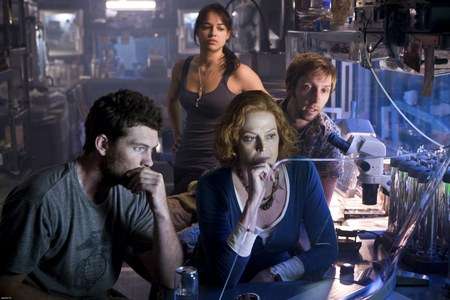
The humans try to make sense of the script

It doesn’t help that the rest of the storyline is equally ham-handed. Clunky metaphors for Iraq abound – or maybe for the colonization of North America, it’s hard to be sure – with characters such as the one played by Giovanni Ribisi, who could be directly channeling Paul Reiser’s corporate drone from Aliens. Other films more or less shamelessly strip-mined include Dances With Wolves, The Matrix, Braveheart, The Emerald Forest and, most obviously of all, Hayao Miyazaki’s Nausicaä of the Valley of the Wind. The last-named covers much the same ecologically-conscious territory, pitting technology against nature, without making the audience feel like a baby Harp seal, or pissing on us, collectively as a species.

Can I also  that the material for which we are plundering Pandora is called – and I kid you not – unobtainium. While this has been a joke name applied by scientists for decades, its conversion into an apparently serious use here provoked a derisive snort. It’s like Cameron thought when writing the script, “Well, I’ll come up with a proper name for the stuff later,”  then promptly forgot all about it. One can imagine him slapping his forehead and going, “Dammit! I knew there was something I meant to do!” at the premiere. It should have been on the list – right below stopping James Horner from writing another crappy song for the end-credits.

There is a definite moral to be drawn from the film. But I should warn you, it probably isn’t the one Cameron wanted. In future, if we find another planet, with resources which we want to have, the human race should not bother trying to negotiate with any local inhabitants – because according to Avatar, this will lead to us getting our butts kicked by the local insurgents. A better, less painful (for us) approach can be found in another Cameron movie. What we should do in order to secure the mineral rights is simple: “Take off and nuke the entire site from orbit.”

After all, it’s the only way to be sure.

C
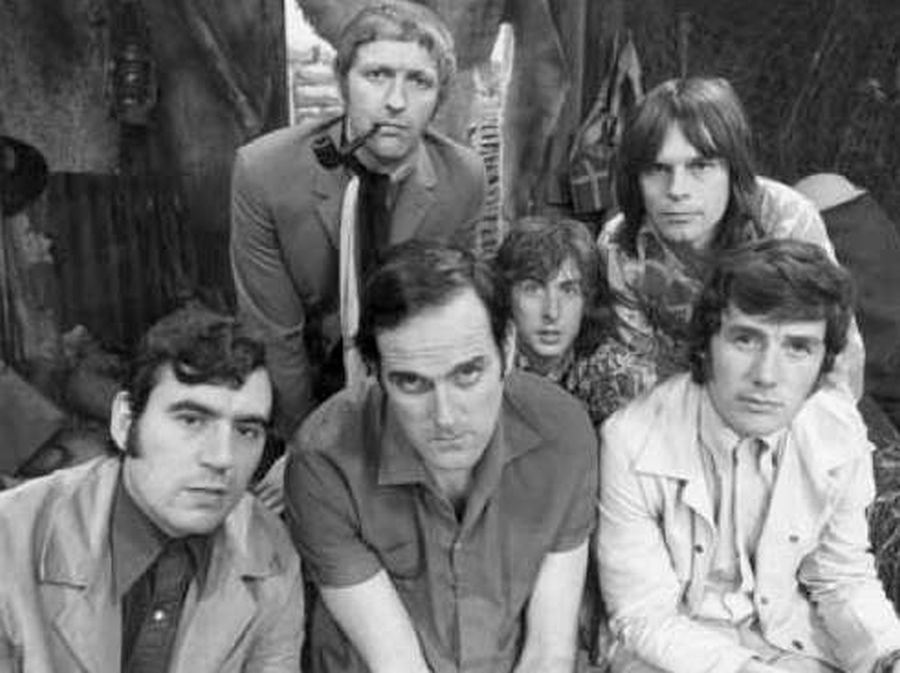
The 10 Greatest Monty Python Sketches of All Time (plus one)

IFC recently ran a six-part documentary series, chronicling the history of the Pythons, from their beginnings in the Oxford and Cambridge revues, through to Spamalot. It was quite a treat, not least realizing how the troupe was a semi-random collection of people, who gelled into a near-perfect whole for three sublime seasons of television, at a rare moment in television history when the opportunity to make a show like that presented itself.

Of course, as with any sketch-based comedy series, it wasn’t all good: it’s a genre that inevitably lends itself to peaks and valleys, rather than the consistency of things like Fawlty Towers or Blackadder. And, especially in the abortive fourth season, there were plenty of valleys – without John Cleese, the show was lost, and those episodes are the Python equivalent of those Eastern Bloc Tom and Jerry cartoons from the early 1960’s. But the peaks were sublime; both in the TV series and the movies, they created timeless moments of comedy which have rarely, if ever, been matched. It spans generations: my father loved Python. Myself and Chris adore Python. And our son is just as much a fan, who will recite The Four Yorkshiremen at the drop of a dead parrot.

Hence, this list of my favourite Python moments – not just from the TV, but the movies as well, which can hardly be denied their significance in comedy’s Hall of Fame. However, I have excluded stuff from The Secret Policeman’s Ball and its sequels. The hard part was restricting it to ten eleven (for reasons explained later): I could easily have doubled the number without blinking. The link for each title will open a new tab where you can view the sketch in question.

I note that my preference is clearly skewed towards the more verbal side of Python comedy, rather than the physical – I think this is because the slapsticky stuff is rather too well-worn a path, from Charlie Chaplin through to Benny Hill. Hence, sketches like Upper-class Twit of the Year, often ranked highly on other, similar lists, are not ones of which I’m particular fond. It’s in word-play and their use of the English language that the true strength of Python can be seen. They manage to be immensely smart (who else would ever base a piece on summarizing Proust?) without getting pretentious (you don’t really need to know who Proust is to appreciate the results), and that’s a lot rarer than you might imagine.

10. Black Knight (Holy Grail)
The Pythons had a love for and appreciation of OTT hyperviolence – see also Sam Peckinpah’s Salad Days. However, this scene, in which John Cleese’s Black Knight is systematically dismembered by Graham Chapman’s King Arthur, yet proclaims “It’s just a scratch” as his limbs go cartwheeling away from their body, is even more memorable. It’s the contrast between the arterial spray – something not seen in cinema at the time, outside a grindhouse screening of Shogun Assassin – and the Black Knight’s completely oblivious attitude that makes this work. Could also have been Castle Anthrax. Or the French taunting. Or the witch-finding.

9. Always Look on the Bright Side of Life (Life of Brian)
Likely my least favorite of the Python movies, it feels to me like it’s a film with only one idea, which as a result doesn’t have enough energy to drive the film for the entire running-time. However, the ending has to remain one of the all-time greatest in cinema, with the men being crucified alongside Brian, led by Eric Idle, breaking out into a cheerful song extolling the joys of optimism. It shows up in the most unlikely places. In 1993, when the Manchester bid for the 2000 Olympics was (thankfully) rejected in favour of Sydney, the crowd watching in Castlefield spontaneously burst into the song.

8. Mr Creosote (Meaning of Life)
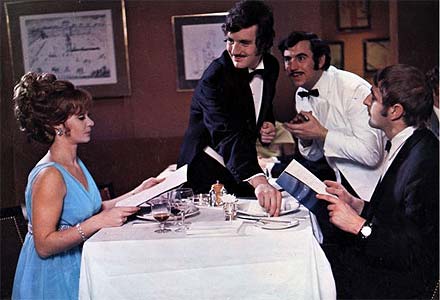
Speaking of “spontaneously bursting”… Perhaps the Python’s deepest excursion beyond the borders of good taste was this hideous sequence, which Chris still has problems watching [she has a thing about vomit, and the sketch has it, by the literal bucket], and which grossed out Quentin Tarantino. Again, it’s the contrast that makes it work: here, between Terry Jones’ obese, obscene restaurant customer, and Cleese’s unflappably obsequious waiter, who is entirely unfazed by Creosote’s behaviour. Again, this is probably more extreme than anything else to pass the BBFC at the time.

7. Argument Clinic
“Is this the right room for an argument?”
“I’ve told you once…”

Thus starts the core of the sketch, which has Cleese duelling with Michael Palin in a pay-per-minute argument, which drifts topic from whether the initial question has answered, over to the very nature of what constitutes an argument. It’s beautifully constructed, though suffers from the frequent Pythonesque problem – they could never work out how to end their pieces, with a punchline apparently being viewed as too traditional. Here, Idle, dressed as a policeman, arrests the show for “simply ending every bleeding sketch by just having a policeman come in.”

6. Spanish Inquisition
Possibly the finest running-joke in the history of running-jokes, it appeared at various points throughout one episode, when a character would proclaim “I didn’t expect the Spanish Inquisition.” This would trigger the arrival of Cardinal Ximenez [Palin] and his useless henchmen, who would attempt to extract confessions with the aid of a comfy chair, after getting all confused when listing the Inqusition’s weapons. The show ends with the inquisitors having to rush across town by bus, to the Dick Barton theme, only to be cut off by the closing credits. Brilliance.

5. Mad Barber/Lumberjack Song
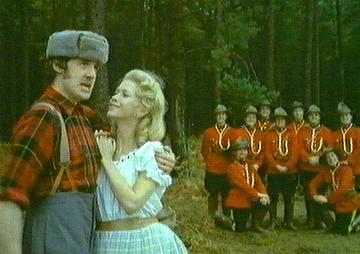
While everyone knows the Lumberjack Song, often forgotten is the lead-in, where Palin’s homicidal barber tries to fake cutting a customer’s hair, for fear it will bring out his psychopathic tendencies (“Cut, cut, cut, blood, spurt, artery, murder, Hitchcock, Psycho…”). He eventually admits, “I didn’t want to be a barber anyway,” which leads to the song. This may be the most famous of all Python ditties, as the lyrics drift from extolling the joys of a life of woodmanship, into the pleasures of wearing women’s clothing – to the disgust of the backing chorus of Mounties.

4. Live Organ Transplants/Galaxy Song (Meaning of Life)
Meaning of Life is the most variable of the Python movies, combining moments of genius with dismal failure. This is the highlight of the film, with paramedics Chapman and Cleese arriving to take the liver of Mr. Jones (Terry Gilliam), even though the donor card says, “In the event of death.” As they respond, “No one who has ever had their liver taken out by us has survived.” His wife (Terry Jones) is asked to sign up, and is convinced to do so by Idle’s Galaxy Song. Most of the litany of astronomical facts it contains, are actually surprisingly accurate.

3. Dirty Fork
One of the few Python sketches with a true punchline – announced, in typical self-referential style with both a voice over and caption saying, “And Now… The Punchline!” Naturally, the punchline is not up to the level of the rest of the sketch, which features an escalating series of absurdity, after a restaurant diner (Chapman) complains about a dirty fork. By the end of the sketch, the restaurant manager (Idle) has committed fork seppuku, the chef (Cleese) has to be restrained from attacking the patrons with a cleaver and the waiter (Palin) is clutching a war wound in his head.

2a. The Four Yorkshiremen
I’d completed the list when I suddenly remembered this one. I refuse, absolutely, to lose the Black Knight, so have just gone ahead and inserted this in the appropriate place. On the other hand, it isn’t technically a Python sketch, since it was written for At Last The 1948 Show, with the writer-performers there including Tim Brooke-Taylor and Marty Feldman, as well as Cleese and Chapman. However, its presence in Live at the Hollywood Bowl and elsewhere has made it part of Python canon, though other enactments have included participants from Rowan Atkinson to Alan Rickman.

2. Nudge Nudge
Eric Idle plays the over-friendly stranger in the pub, who slides up to Terry Jones, enjoying a quiet, solitary half-pint, and proceeds to ask a series of questions about his wife that gradually become more and more innuendo-laden. Idle tries to appear as the man of the world, but the punchline – as in Dirty Fork, a rarity – completely shatters that illusion. It was originally written for Ronnie Barker, but was rejected. The dead-pan delivery by Jones of his responses, as he (deliberately?) refuses to see what Idle is getting at, is what really makes the sketch so memorable.

1. Dead Parrot
Not just the greatest sketch in Python history, but possibly also the greatest sketch of all tine. An it’s not just me who thinks so, as the sketch topped the IFC/Nerve list of the 50 All-Time Greatest, ahead of Who’s on First? and the entire output of Saturday Night Live. It may also be John Cleese’s finest moment, and given the sublime wonder which was Fawlty Towers, that in itself is quite an achievement: he works himself up into a frothing fury, in the face of Palin’s relentless denials that there is anything wrong with the obviously-demised avian. Has been performed in a number of ways by the pair since: for your amusement, here’s a link to one where Palin can’t stop laughing. But, for your amusement, here is the original version, in its entirety. Enjoy.

YouTube Video

Incredibly Bad Film Show: Kinky Killers

Dir: George Lekovic
Star: Michael Paré, Beverly Lynne, Brooke Lewis, Mark Belasco

I can only imagine the conversation which took place in the distribution company’s office, with regard to this movie and its original title:

“I think we can use the film, but Polycarp? What’s that again?
“He was a second-century bishop. In Greece.”
[Long Pause]
“Yeah. Well, actually, no. Here’s what we’re gonna do.”
[Reaches for black marker]
“Oh, and I hope you weren’t attached to the DVD sleeve either…”

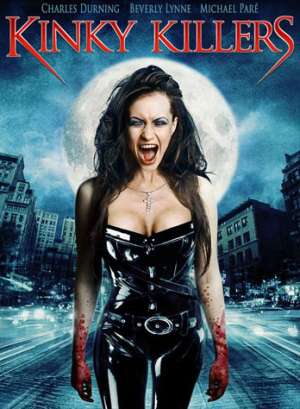
Hey, presto: say what you like about the quality of the actual movie – and we will have plenty to say there before long, trust us on that – whoever was involved with the marketing was a frickin’ genius. We stumbled across this on cable, so the cover (right) wasn’t even a factor. Frankly, if we had, it might have been a warning, because it would have been one of those cases where the sleeve is clearly trying way too hard. As is, the title was sufficient, along with the presence of veteran character actor Charles Durning. He won three Purple Hearts in World War II, taking part in both the Normandy landings and the Battle of the Bulge, and shows up here in one location, to no real purpose. One can only surmise some kind of gambling debt was involved.

This is not impossible: there have been gangster/movie connections elsewhere, and this feels like the same sort of thing, an ill-conceived vanity project, though this has far less sense of any connection to reality. Bodies – mostly of blonde strippers – are turning up in the streets of New Jersey, with parts missing and tattoos on them the victims didn’t have when they were alive, including the mysterious word, “Polycarp”. The police are baffled. What does it mean? I guess the NJPD do not have access to, oh, Google? Detectives Paré and Belasco are “investigating”; quotes used advisedly, since their methodology is not quite straight from the police manual.

Still, it gets them into the right area: that inhabited by Dr. Jill Kessey (Lynne), a psychiatrist who has been giving therapy to a number of the victims. Yeah, because strippers can regularly afford $200/hour therapists, right? Kessey has an ‘open’ relationship with her boyfriend (and his bad case of back acne), and it turns out he slept with the victims. The cops suspect him. Which means they break into their room, interrogate him in the shower, take him away in his underwear then dump him under a bridge in what looks like Brooklyn, according to Chris. That drooling sound you hear is civil rights lawyers thinking about the possibilities. The trail leads from there to another psychiatrist, Dr. Grace Sario (Lewis), who also has an unconventional approach to therapy, if you know what I mean, and I think you do.

The original sleeve with the real Polycarp.
Now, why didn’t they use him?

Ok, so far, it’s been dull in an erotic thriller kind of way, much as you’d expect from Ms. Lynne, the veteran of movies with titles such as The Bikini Escort Company, and the Black Tie Nights series. To describe her as “unconvincing” as a psychiatrist would be putting it mildly, and I needed to convince Chris at the half-way mark to persevere, and had to compromise by re-locating with her from the living-room to the bedroom. I’m glad I did, for it’s only after that point that full-blown religious looniness breaks out. Oh, it had been hinted at, with Pare’s cop found of quoting religious scripture to suspects [probably adding another count to that lawsuit], and if we’d been bothered enough to Google “polycarp,” could have found out its origins before the movie divulged them to us. However, it’s not until the final reel that we discover the truth.

[Spoiler alert, I guess. Though as usual, if you go ahead and watch this one, you should be doing so purely for amusement, rather than the plot.]  The murders are actually being committed by a coven of witches, led by Doctor Sario and Kessey, as part of a ritual with the eventual aim of putting the (very clearly plastic) pieces together, and triggering the coming of Lucifer. As you do. This is all explained in great detail by the perpetrators after they have captured three of the male actors: this is probably necessary, though it has the feeling more of a theology lecture than anything else – if the subjects are tied up, it’s likely to avoid them being bored into unconsciousness by the exposition and toppling off their chairs. Throw in some entirely gratuitous sex scenes before we get to that point, and the movie makes a late surge into incredibly-bad territory.

The entire exercise seems to have been churned out with amazingly little thought, from the basic concept – those with a fondness for T+A will be put off by the religion and vice-versa – all the way through to the casting, where I wouldn’t be surprised if they sold off all the roles at auction, not just this one. In Durning’s long career, which has gained him nine Emmy noms plus a pair of Oscar nods, it’s unquestionably a low-water mark. Even on the considerably less-distinguished resumes of Paré and Lynne, this is something which will be buried and forgotten as nothing but lurid nonsense with few redeeming merits.

D

Phoenix Fear Film Festival 3 – the ‘close, but no cigar’ movies

If you’ve been wondering where we’ve been of late, and why there’s been no reviews posted for three weeks, we’re heading towards the 3rd Phoenix Fear Film Festival on January 23rd. So, our spare time has been spent filtering through the various shorts an features sent in for the consideration of the viewing panel. Submissions came from a variety of sources: we had films directly from the makers, got others passed on to us for consideration by our friends at Brain Damage, and we also reached out to some creators whose work looked like it might be interesting. [You can spend, literally, days trawling round Youtube, watching trailers of all shapes, sizes and qualities of horror!]

This year, I think the quality of the submissions was the highest it’s ever been. I know it sounds like a patronizing cliche, but the decision of what to show was genuinely a difficult one, and we could easily have run the event over two days rather than one. Writing the rejections is not the funnest part of the endeavor, though much credit due to Devi Snively, whose email in reply was surprisingly upbeat and quite made our day [her film, Trippin’, is currently first alternate, in the event that a movie Brain Damage have promised us does not complete post-production in time. Update: and as that proved the case, Trippin’ made it in!].

We have now just about finalized the list of features to be screened there – details of those can be found on the festival site. But I’d like to pay deserved tribute to some of those that didn’t quite make the final cut [as it were], and give them a bit of publicity for their efforts. Hence, the reviews below, which cover some of the contenders in the feature category – please note, these are my opinions alone, and do not necessarily reflect those of the entire festival panel, blah, blah. You know how it works. We’ll be covering the shorts separately, since we’re trying to squeeze as many of those into the festival as possible.

It’s somewhat amusing how some film-makers subtly (or not-so subtly) hint that if we pick their movie, all their friends will show up at the festival. We treat such assurances with skepticism, after years of promoting bands and other shows. Now, we pretty much knock a zero off any predicted claims of attendance – and deduct a further 50%, for those who do show up, and claim they should be ‘on the list.’ From a pragmatic viewpoint, it’d be only a short-term gain, even if their friends did turn up, and pay to get in. Showing crappy films might get a few more arses on seats this year,  but the rest of the crowd will not come back next year.

For some reason, we got an awful lot of late entries this year too – in September, we were wondering if we’d have enough features submitted to fill up the event, hence our decision to see if Brain Damage had any suggestions. However, the last couple of weeks saw a tidal-wave of features and shorts arrive, on almost a daily basis. Which, of course, means that the viewing panel has had to convene on almost a daily basis to watch them. While this has been more of a pleasure than a chore, now we have got the line-up finalized, I think we will likely be taking a break from watching inde horror by choice for a while. So, look forward to our review of The Ugly Truth in next week’s update.

We’re joking. Of course.

Meanwhile, other preparations continue for the event: we did look at the possibilities of bringing in a “big name” star to headline the event, but the finances didn’t quite work themselves out there. I have to say, some do seem to have a rather inflated idea of their own worth, demanding more money for their appearance than we’d take in, if the entire event sold out. And we’re not even talking icons like Bruce Campbell, but fairly minor stars. Perhaps they’re under the impression the PFFF is some kind of commercial event such as Fango’s Weekend of Horrors, when it’s really just Chris and I, doing the work entirely because we love the genre – if we break even, we’ll be happy. However, we are delighted to have inked scream queen Tiffany Shepis, one of the leading horror movie actresses of recent years: she’s been a pleasure to work with.

Stay tuned for a full report on the event, with reviews of the five chosen features, towards the end of January – after we’ve recovered from the event itself!

Reviews

Incredibly Bad Film Show: Swing Vote

Dir: Joshua Michael Stern
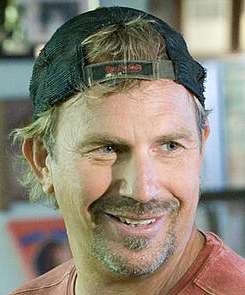
Star: Kevin Costner, Madeline Carroll, Paula Patton, Dennis Hopper

The unacceptable face of democracy

What makes Swing Vote an Incredibly Bad Film is not the acting – no film with Mare Winningham in it will ever get less than glowing reviews in that area from us. No, it’s a story which combines relentless implausibility and extremely dubious morality, that had me wanting to assemble a mob with torches and storm the home of writers Stern and Jason Richman – just as soon as I finish vomiting at the heartfelt sincerity of it all.

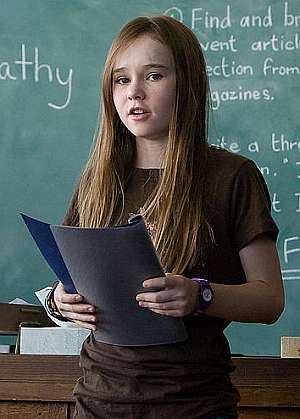
The ‘hero’ – quotes used advisedly – is Bud Johnson (Costner), an alcoholic layabout who just got fired from his job at an egg-packing plant, and who barely functions on any level above survival. He relies mostly on the needling of precocious moppet Molly (Carroll) to get him through the day. She is the brightest in her class and wants to grow up to a vet “or chairman of the Fed.” Never mind the fact that given her parents and environment, she’s a more plausible candidate for an “I’m twelve and pregnant” edition of The Jerry Springer Show. Election day rolls around, and Molly convinces Bud to do his civic duty and vote. He instead, gets drunk and falls asleep, so Molly decides to exercise her father’s democratic right and vote for him.

It’s a massive burst of hypocrisy right there: why would someone so intelligent, yet clearly smitten with the divinity of the electoral process, choose to commit voter fraud? There’s another hole in the film’s philosophy too: while it may be a duty to vote. it’s not an obligation. If you choose not to vote, that’s perfectly fine too; if you’d rather collapse into alcoholic unconsciousness, that is absolutely your right. Go for it. Frankly, it would probably be best for the country if people like Bud are kept out of the process: what we see here is electoral evolution in action. The fewer dumb people that get to vote, the greater weight given to the ballots of those capable of completing the apparently-complex task.

Anyway, back in the polling station, the worker on duty, guarding the previous flame of democratic freedom has, conveniently fallen asleep, allowing Molly to swipe a ballot and enter the booth. In another remarkable coincidence, a rogue vacuum-cleaner knocks out the plug to the voting machine in the middle of the process. A startled Molly pauses only long enough to tear carefully the stub from the ballot, before escaping, her father’s vote now lost in electronic limbo [that sound you hear is the British electoral system sniggering, as we still use the sturdy “X on the ballot paper” method].

The unacceptable face of democracy
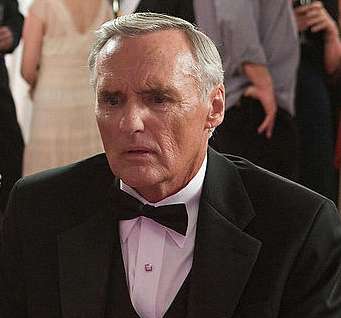
Hopper wonders if he can work with Lynch again

Naturally, in a third strike which doesn’t so much require the suspension of disbelief, as its garroting with piano-wire, that vote turns out to be the deciding one in the deciding count in the deciding state, and because Johnson was ‘robbed’ of his vote, he is given another chance. In ten days, he’ll get to cast the deciding vote. In the meantime, of course, both the Republican and Democratic contenders (Kelsey Grammer and Hopper) are falling over themselves to court Bud. I’ll pause for a moment to enjoy the irony of one of actor behind one of the most iconic rebel performances of all time in Easy Rider (or even Blue Velvet), now playing an establishment lackey.

From here, the film should have gone for dark satire – how far are the parties prepared to prostitute themselves for one man, especially a smart one who knows how to manipulate them? And there are moments when the film does take that route, most notably a lovely ad with the Democrat going pro-life in a playground of exploding kids. It would then have concluded with Bud deciding neither candidate was worthy of his vote – or even more subversively, casting his vote for a candidate outside the two-party system. This alone is something the film steadfastly refuses to acknowledge, even though almost 1.7 million voters selected someone outside the Rep-Dem duopoly in the 2008 election.

Instead, it goes for the sentimental jugular, with Bud undergoing a crash course in everything he needs to know, the night before he hosts a presidential debate. This allows him to deliver, at great length, the sort of heartfelt nonsense he must have insisted on plugging into the script [he helped bankroll this production], in the belief he was still playing Ray Kinsella, rather than a piece of alcoholic trailer-trash who can’t string ten words together.  It feels almost as out of place as the turd-shaped musical number Kevin Bud drops in the middle of a political banquet, though allows him to regain the respect of his daughter. Where the hell are Child Protective Services in all this?

(Democratic) Rebel Without a Clue

The film is nothing if not neutral, even-handedly portraying Democrats and Republicans. In the hands of Stern, this comes across more as bland, commercial-minded cowardice than anything – oh my goodness, let’s not say anything which might potentially offend either side of the cinema-going audience [showing remarkable good taste, the public voted with their wallets, and Swing Vote failed to crack the top five, even on its opening weekend, earning a paltry worldwide total of $17.6m]. Both parties are shown as honest, compassionate politicians who just go a little overboard in their pursuit of victory – let’s hear it for completely toothless satire (Jonathan Swift is spinning in his grave like a Vegas slot-machine reel). At the end, we don’t even find out who Bud picks: for a film all about the importance of exercising your right to choose, this is a complete cop-out.

To summarize, we have a film which glorifies the kind of man most of us would actively cross the street to avoid, proclaims that defrauding the electoral process is noble, condones the media’s collusion in the fraud – a local TV journalist (Patton) discovers what’s going on, but opts to stay silent – and emphasizes the abject failure of democracy in America. The concept that every vote counts is a laudable one, though strained somewhat, say, here in Arizona, which has been Republican every Presidential election bar one for the past sixty years. However, when the vote that really counts belongs to a supposed “everyman” like Bud, it makes me want to break out into a rousing chorus of Tomorrow Belongs to Me.

D-