Border-ing on the Surreal…

Here in Arizona, we have become the center of a political tornado over the past couple of weeks, thanks to the passing of SB 1070. This law says that when police come into contact with people, they must make “a reasonable attempt…to determine the immigration status of the person,” where “reasonable suspicion exists that the person is an alien who is unlawfully present in the United States.” Fairly innocuous, really. Not that you could tell by the reactions of some, who have reacted to the bill with hysterical exaggeration, bordering on the offensive.

marguliesaz

For instance, the cartoon to the right, which drew a sharp rebuke from the Anti-Defamation League. “We are seeing these offensive and inappropriate Nazi and Holocaust comparisons come to the fore in the public debate once again… There is no comparison between the situation facing immigrants, legal or illegal, in Arizona and what happened in the Holocaust.” Not that this stopped Family Guy creator Seth McFarlane from shrieking much the same idiotic nonsense, telling Reuters Television:

“Nobody but the Nazis ever asked anybody for their papers. Walking down the street, a cop can come up to you and say ‘May I see your papers?’ — I think they should be required to ask that question in German if the law sticks around… That’s more shocking and egregious than anything we’ve ever done on the show.”

Insert picture of a quizzical owl here. O RLY? Apparently, as well as McFarlane’s woeful ignorance of history, it seems he has never flown, rented a car or even bought a beer, because all of those would require as much, if not more, showing of ze paperz than the new law, which explicitly says that an Arizona driving license is all that anyone needs to show. As for his last statement, I was watching an episode of Family Guy this week with this exchange:
Lois Griffin: “Peter, you got me a card, ‘I’m sorry for selling our daughter.'”
Peter Griffin: “Do you know how hard it was to find one of those in English?”
Hard to believe the man concerned is sensitive about “racial profiling.”

illegal2

That seems to be the main thrust of opposition; that the bill would open the door to police stopping someone based on the colour of their skin. However, the bill explicitly prohibits this, saying officers “may not consider race, color or national origin”. Now, admittedly, as originally written, was certainly badly-constructed: it could have required police to question, for example, a rape victim about her immigration status. Frankly, I’m a bit disturbed it made its way through the legislature without these obvious holes being spotted. But they were quickly addressed when pointed out.

Yet, the misinformation goes on, to a degree that simple ignorance no longer seems plausible – this feels more likely deliberate deceit, to stir up misplaced anger. Witness the Huffington Post saying, “Arizona has a new immigration law that requires police officers to detain anyone who “looks like” an illegal immigrant and fails to produce proof of American citizenship.” That’s factually wrong on just about every level – beyond “Arizona has a new immigration law” – and gives some sad idea of the tone of the debate. Proponents of the bill are all racists; opponents all illegal-lovers. Even the US Attorney General, who had been sharply-critical, admitted, “I have not read it.”

But is the new law necessary? It’s the product of long years of growing frustration in Arizona over the federal government’s failure to act regarding the problem of illegal immigration. Neither Republicans nor Democrats have done anything to fix it over the past 20 years: one in bed with big-business, who enjoy the flow of cheap, non-unionized labour into the country, the other with no desire to alienate a fast-growing ethnic group who has traditionally been rock-solid support for them. Self-interest rules the day, regardless of the cost to the country.

Certainly, about the only thing all sides agree on is that immigration reform is desperately needed. However, it seems pointless to start passing any new laws, when we are completely incapable of enforcing the existing ones. And that, basically, is what SB 1070 is trying to do. Very little of what is included, is not already part of federal law: however, what it does, is require state law officers to get involved in immigration enforcement, when typically, they have largely turned a blind eye to it. It’s important, because at this point, immigration is something where almost all the work is done at or near the points of entry.

While there’s a lot of talk about “securing the borders,” almost half of all illegals entered the country by legal means – they just don’t go home after their visa ran out, for instance. The odds of them then being caught, due to the current lax approach to the law, is very slim. Once you reach a major city, you’re more or less home free. That’s the reality of the current policy, and any “reform” must certainly address what is otherwise a major flaw. I’m all for a better process to emigrate to the US – god knows, it took us far too much time, money and effort to get me a Green Card – but those who bypassed the law and waltzed across from Nogales on a tourist visa, never to return, can not be allowed to jump the queue. Basic principles of fairness should prohibit that.

Polls have consistently shown a majority of Americans, not just those in Arizona, support the new law, and it has been eagerly seized upon by Republicans as a potential tool against the Democrats. There will be legal challenges, and possibly also a ballot measure to overturn it, and that’s how it should be in a democracy. But I think, in the end, the law will stand, albeit perhaps in an amended form: some people may not like it at all, but it seems to me to be a well-founded piece of legislation, stemming from a genuine societal need. At the very least, even if it falls, it will have focused the federal administration on a topic which they have basically abandoned for too long, and if it leads them to take appropriate action, the bill will have served its purpose.
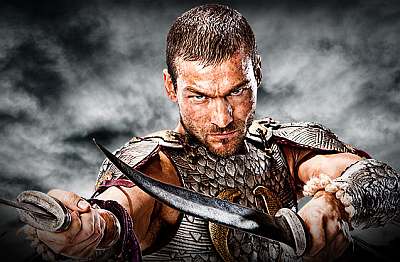

Spartacus: Blood and Sand – Xena for adults…?

Spartacus depicts extreme sensuality, brutality and language that some viewers may find objectionable. The show is a historical portrayal of ancient Roman society and the intensity of the content is to suggest an authentic representation of that period.”
— Pre-screening warning

spartacus

Yeah, “suggest” would be the key word. For, historically, there’s little known about the man – he falls into the same category of neo-legendary characters as Robin Hood or King Arthur. This allows artists to portray him pretty much how they want, without much chance of being proven wrong. Said creator Steven S. DeKnight, “We take the Spartacus legend, we turn it on its side, and we beat the crap out of it” and added, “While we may bend history, we try to never break it.  But I will always opt for what delivers the most dramatic impact over a strict adherence to historical fact.”

Hence the comparison of the title – a pretty loose description, but one that isn’t too far away from the truth. It’s set roughly around the same time, in the same part of the world, stars Lucy Lawless and also springs from the long-time collaboration between Rob Tapert and Sam Raimi, who produced this along with Joshua Donen. But the mythical and mystical aspects, of gods and monsters, are basically absent, in favour of a much more grounded approach. And the pre-broadcast warning is entirely justified: the blood flows in digital torrents, particularly during the gladiatorial battles, the nudity is copious, and the sex too, in just about every combination possible [though we need more lesbians…]

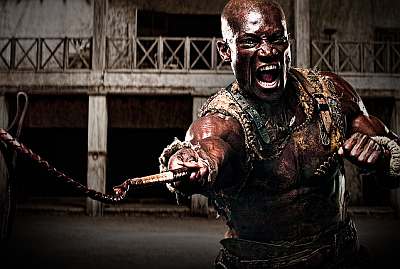
As you might have guessed, In centers on Spartacus (Andy Whitfield), a Thracian who leads a battalion of soldiers supposedly allied with the Romans. But when he ends up inciting a mutiny, he is condemned to die in the arena, and his wife becomes a slave. However, his execution ends up in the death of the four gladiators he faces, and he is sold to Batiatus (John Hannah), who runs one of the local troupes of arena performers, who sees possibilities in the new arrival. The rough edges are hewn to fine precision under the training of Doctore (Peter Mensah), but the rising fame of Spartacus makes him an enemy in current champion Crixus (Manu Bennett). Meanwhile, Batiatus and his wife Lucretia (Lawless) are angling to use Spartacus’s popularity to enhance their own standing with the local nobles, who currently despise the gladiator’s owner as beneath them.

spartacus2

It’s marvellously excessive soap-opera: perhaps its nearest cousin would be the WWE, with Hannah playing the role of Vince McMahon, manipulating those beneath him for his own ends, as they fight for the amusement of the masses. It’s really his show, perhaps more than Spartacus, with he and Lawless splendidly slimy and hedonistic, yet honourable on their own terms and deeply devoted to each other. It’s a bit of a shock to see the star of the Mummy films, or Four Weddings and a Funeral, dropping F-bombs and yelling “By Jupiter’s cock!” at people – though I feel life would be enhanced if we all used such colourful expletives in moments of stress. Similarly, Lawless shows a good deal more skin here than she ever did as Xena, and is wearing nicely into her forties.

In contrast, Whitfield is a little less memorable: the first episode is somewhat dull, until Batiatus shows up, and for the first half of the series, he is rather too single-minded, caring about nothing save being reunited with his wife. That’s how Batiatus gets him to agree to fight in the arena, by promising to re-unite Spartacus with his one true love. His master delivers – but in a twisted fashion that sets in motion the train of events which eventually hits the buffers in the final episode of the first season, with Spartacus’s rebellion kicking off in arterial fashion. I trust I am not spoiling this for anyone, since it’s historical fact. Whitfield does have his moments, not least when forced to battle his best-friend for the amusement of a teenage boy.

It is, however, the violence which really makes this stand out from the pack of historical TV series cluttering up the airwaves of late [hello, The Tudors]. It “glories in slaughter” (to borrow a quote from Dennis Healey about Mrs. T) in a way unmatched by any TV show I’ve ever seen, and only rarely reached by movies e.g. Shogun Assassin and Bad Taste, for my money going well past anything Eli Roth or other alleged “torture porn” directors have ever done. While it’s almost all CGI, the limb-lopping, blood-spatter and finishing moves worthy of Mortal Kombat (the game, of course) are done with deep affection and impressive style – why else bother having digital blood splashing on the camera lens?

spartacus3

Morally, you could certainly argue that there, the series is on dodgy ground. It portrays slaughter as entertainment, for our entertainment: the underlying feel is “Tsk, tsk – weren’t the Romans terrible people? Now, stay tuned, as we’re going to show you just how terrible they were…” But it’s just such unashamed fun to watch. Hannah and Lawless are superb, and it’s hard to see how the second series – commissioned before the first episode had even been screened – will be able to cope without one or perhaps both of them. Which as about as much as I can say without getting seriously spoilerish.

However, there may be bigger problems. Star Whitfield was diagnosed last month with Non-Hodgkin lymphoma, a form of cancer. It was caught early, and the prognosis for recovery is good, but it has already delayed filming, with discussion being directed towards a possible prequel series instead. That would be a shame, and I hope the disease is just another in the line of enemies soundly-defeated by our Spartacus. There’s nothing else like it on TV, and we’ll miss our weekly dose of ultraviolence until it returns.

Going Home: A Temporary Return to Scotland

They say you can’t go back. And for a long while, I didn’t. I hadn’t been back to Britain, since we were married in July 2002. It was a combination of factors: kids, jobs, exchange rates, etc. I hadn’t seen my parents either: I had explained to them that planes fly West as well as East, but they preferred to spend their holidays in Sri Lanka and Thailand, rather than Arizona. [I reckon they are actually senior citizen agents for MI6, because wherever they go somewhere, internal turmoil seems to follow] But 2010 was their 50th wedding anniversary, and when we got the invite, filial loyalty kicked in: time off work was booked, plane and train tickets booked and arrangements made to handle dogs, kids and mother-in-law left behind.

scotland1

It seems like the gods were hurling obstacles, both natural and man-made, at us as we tried to head to the UK. During the weekend before the departure, there was an earthquake, measuring seven on the Richter Scale, with the epicentre 210 miles from Phoenix. Both British Airways and the rail unions were engaging in industrial action that threatened to leave us hitch-hiking our way to Scotland (which might have been tricky on the Atlantic). And we just got back home when Iceland blew up, sending all airspace over Britain into an unprecedented complete lock-down.

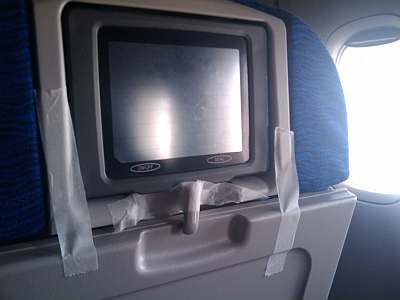
But the unions and Mother Nature got their act together and cleared our way to London on British Airways. This was despite a nasty moment when I sat down in my chair and discovered the pin holding my tray-table locked and in an upright position, as they say, was broken clean off. Those of you who have seen Final Destination will understand why this triggered some moments of trepidation, but you’ll be pleased to hear the plane did not plummet to the ground in a fireball immediately after take-off. The stewardess brought some tape from the first-aid kit, and an emergency repair was done, which fell into the “not pretty but practical” category.

We arrived in London and made our way through the labyrinthine Tube system to our hotel. That was an experience; never realized quite how many stairs there are in the Underground. Poor Chris was reduced to tears at one point, due to an escalator malfunction which left us making our way down a very long set of steps, laden with suitcases, as a stream of rude Londoners pushed brusquely past. It was at this point that I realized, with some horror, that we had become what I had always despised while living here, e.g. “fucking tourists.”

We arrived at our hotel near Bayswater, and discovered our tiny but mostly-functional room. The only way you could have swung a cat, would have been if it was a short-tail variety and you kept your arms tucked in by your sides. Still, it was functional enough, and we had little intention of doing much more than sleeping there. Shame about the leaky tap in the bathroom, which did nothing more than drip weakly for the duration of the stay. Oh, my mistake: that was the shower. Water-pressure. It’s vastly over-rated… While lounging, we discovered that no sooner had I returned to the country, than Prime Minister Gordon Brown had called an election. I felt like President Aquino returning to the Philippines. Without the whole assassination thing, obviously.

scotland3
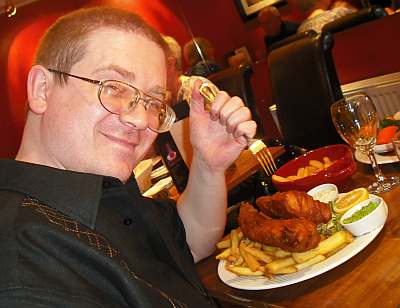
I prepare to harpoon a nutritious (Scottish) meal

The original plan was London for a couple of days, but maternal “concerns” cut that short. We did get to hang for the evening with the old TC crew: it was great to see everyone. and startling to realize how little people had changed. I think our cultural interests must keep us young. Quizzed them on how Britain had changed in the last decade: not much, was the consensus, though this may be because it’s harder to tell from the inside than when you come back after years away. Two things stood out to me, both media-related. When I left, most people had only five channels of terrestrial television, but now, there is, if not reaching the American level, a lot more “choice” [quotes used advisedly]. You also still see people reading newspapers, especially on the Tube: that’s an almost lost culture in the US, where newspapers are going the way of the dinosaur.

The next day, we took the train to Scotland, through countryside that seemed remarkably green after a decade in a desert, where the only green is on the golf-courses. I amused myself thanks to the train having wi-fi, Chris amused herself by yelling, “Look! Sheep!” every time we passed a flock. Which was a lot. She thinks we need a lamb as a pet, to keep the yard free of weeds, but I convinced her that, much like pit-bulls, while the young are adorable, the adults are only tolerable when chopped up into meal-sized portions and placed in the freezer. Yep, I don’t like pit-bulls much: the wasps of the canine world. Chris made do with a tuft of wool picked off a barbed-wire fence later in the trip.

Home in Scotland, where my parents picked us up and we headed back to the house – they’ve lived in the same place for almost as long as they’ve been married. It was built in 1815, which is kinda cool – but, inexplicably, the builders at that time failed to take wi-fi into account when putting it together. The three-foot thick walls basically meant the only way to achieve an Internet connectivity was to hold the laptop, at about shoulder-level, while standing directly in front of a window. However, my parents had at least installed central-heating since my previous visit: I recall some winter trips where, rather than getting out of bed, you would pull your clothes into the bed with you, wait for them to defrost, and dress under the covers.

scotland2

The next four days were largely of interest only to members of the McLennan family. At times, I felt like I was on some kind of state visit, as a parade of relatives marched through the house, to meet the now-overseas branch of the family. I occasionally had to “translate” for Chris, when the accents of some members reduced her to a stare of blank incomprehension – this consisted of me repeating the statement in the form of a question e.g. “Oh, so you’re just back from holiday, are you?” There was also a lot of food eaten, culminating in a 16-ounce deep-fried haddock fillet at a local restaurant, which went on the menu by the name of “The Whale.” By the end of the trip, I realized that when someone says something like, “You’re looking well,” that this is Scottish for “Who ate all the pies?” In my defense, by the end of the trip, I was feeling like the Hindenburg, all traces of my normal, gluten-lite diet having been flushed from the system by a tidal-wave of sugar and lard.

Otherwise… Well, the highlight was probably getting to see the new Doctor Who while we were there – mostly because it provoked the intense jealousy of our son. [Brief opinion: he’ll do nicely, and is surprisingly similar to the much-loved David Tennant] The 50th-anniversary party itself is worth mentioning, however, since it took place in the local masonic hall, which they rent out for parties – kinda defused the theory of the Freemasons being the master behind the New World Order, in my opinion. Some of my cousins are masons, I think including one who is among the top cops in Glasgow – my maternal grandfather was as well. But this was the closest I’ll get to being an “insider,” and peering at the memorabilia and wondering what the grave-shaped trapdoor in the floor was for, occupied some idle moments.

The journey back started the next evening, and took approximately 32 hours in total, from the time we left the house in Scotland, to the time we arrived back in Phoenix. Car, sleeper train, walk from Euston to King’s Cross, Tube from there to Heathrow, about six hours hanging around there, and then the flight back to Phoenix, where our daughter was waiting. To be honest, it didn’t feel much like a “holiday” in the true sense of the word. Especially when the jet-lag kicked in, around 5am the next morning, and continuing for much of the remaining week. But seeing my parents was worth it, and we vowed that it will not be another eight years before we head back to Scotland again. But this time, hopefully for an actual break

Wrestlemania 26: An eye-witness review

If, as previously argued, wrestling has the potential to be art, then Wrestlemania is its Hermitage, Louvre and Guggenheim all rolled into one, except far more popular. The 26th incarnation of this wrestling extravaganza, with eleven matches in total, was held in Phoenix over the weekend. To give you some idea of the scale, it drew more people to the University of Phoenix stadium (confusingly, located in Glendale, not Phoenix), than when the Superbowl was held there in 2008, and setting a gate receipt record of $5.8m.

Along with 72,217 other people, Chris and I were in attendance, and after the jump, you’ll find our eye-witness review of the sports entertainment spectacle. But if you want to save time, we agreed that next year we’ll watch it on pay-per-view…

It was my first time inside UoP Stadium. From the outside it’s not exactly spectacular – it looks like someone dumped a white spare-tyre right in the middle of the desert. But when you go inside, you appreciate you just how large a venue it actually is. I’ve been in bigger venues – the Rose Bowl in Pasadena holds over 90,000, the Berlin Olympic Stadium capacity was 110,000 when I visited it in the 1980’s – but those are both outdoor venue. Seeing 70,000 people with a roof over their head is quite something else [the roof is retractable, and they opened and closed it several times during the course of the event, for no readily apparent reason. Not so impressive: having to pay $20 to park at the stadium. Glendale has little public transport to speak of, so there was basically no alternative. When you are paying an average of eighty bucks for a seat, that should include a parking spot.

Now, there are large-screen TVs...
There are large-screen TVs, and there are LARGE-SCREEN TVs…

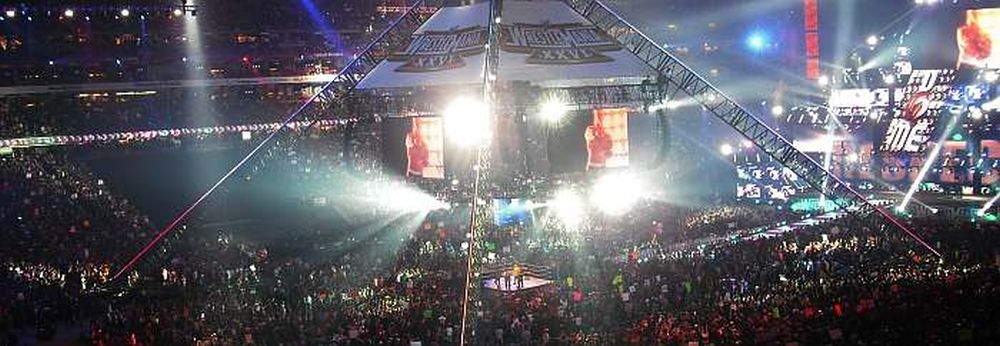
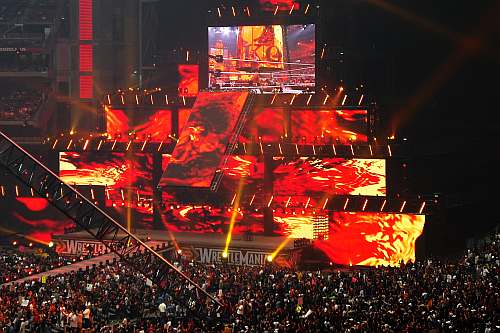
The main issue – and why we won’t be back – was the seats. “Did you bring the binoculars?” said Chris when we saw where we were sitting. We had actually paid more than average, but were still amazingly-far from the action. The pic headlining the article was taken from our seats – it may take you quite some time to find the ring. The screens around it did show the matches in progress, but if you’re just going to watch the event on television, that does somewhat dilute the point, no? Having been attending local wrestling shows for more than a decade, both here and in London, there’s an inverse-square law in effect, with regard to the impact the matches have – it drops off sharply with increasing distance. Pro-wrestling, like striptease, needs to be experienced close-up for the best results.

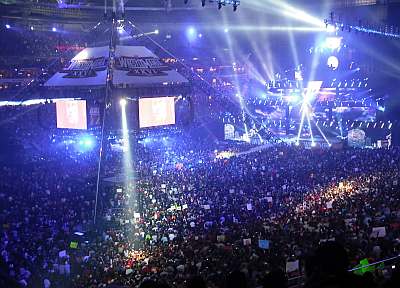
That said, the rest of the spectacle on view was undeniably impressive, with the arena turned into a massive cathedral of wrestling, filled with pyrotechnics, lights and really, really big video screens. The seats were also more comfortable than we expected – no bad thing, as we were in them for nearer five hours than four – and there was plenty of space just outside the section, if you wanted to chill, and get a drink or a souvenir. Though you had to be pretty quick with the latter: WWE seemed to have underestimated the demand for merchandise, and the T-shirts for the event were gone before about half-time. Though, I suppose, better to sell out than be left with 10,000 unused, and of limited appeal, after the show.

However, the main purpose is, was and always will be, the matches. Wrestlemania is where all the storylines which have been set up in the preceding months come to a conclusion – it’s like the series finale of all your most-loved shows, rolled into one night. At least, that’s the theory: particularly in a dull first half, there was very little to generate significant excitement in the crowd, either with the quality of the matches, or their emotional impact. Our major interest was seeing people we’ve worked with at the local events, like Mike Knox and ring-announcer Justin Roberts. Otherwise… Well, the opening match screened saw the tag title defended in less than four minutes: one wonders what the point of that contest was.

There was a brief uptick in the middle, when fan-adored Rey Mysterio beat straight-edge heel CM Punk. That had actually had a decent back-story, Punk having reduced Mysterio’s daughter to (disturbingly genuine-looking) tears during her birthday celebration some weeks previously, understandably incurring the wrath of her father. Both men are among the most gifted technical wrestlers in the business, and the heat they generated in the crowd reaction certainly surpassed anything we had seen previously. However, once more, the actual match was over in six and a half minutes: it deserved far more, and felt more like a warm-up contest than anything putting a full-stop on the feud between the two men.

wm2604

And then there was Bret Hart vs. Vince McMahon, chairman of the WWE. This one had its origins in 1997: Hart told McMahon he would leave the WWE for another company, but they agreed Hart would go out as champion. However, McMahon changed the script, unknown to Hart, and Hart lost the title in what became known as the “Montreal screw-job”. After the match, Hart spat in McMahon’s face, and the two were enemies – genuinely- for more than a decade. However, this year, Hart was brought back as a guest host, and from there developed the storyline which led to him facing McMahon at Wrestlemania.

The chairman brought out Hart’s family, announcing he’d bought their loyalty, but Hart said he knew that – his family had taken the cash with no intention of selling out. The entire family then proceeded to beat up McMahon. For eleven minutes.  Now, Hart had a stroke in 2002, and has hardly wrestled since (there were apparently insurance issues, with Lloyds having paid out ‘permanent disability’ to him), but this was just an embarrassment. McMahon has been the bad guy forever, but by the end, the crowd were just sitting in uncomfortable silence: I actually felt sympathy for Vince, which was hardly the intended outcome. The only thing worse was the tag-team women’s match: even as a fan of women’s wrestling, this was an abomination which should have been struck from the record. The widow of Eddie Guerrero – middle-aged and having never “fought” until her husband died – got the winning pinfall.

At this point, the show had been undeniably disappointing. Fortunately, the final two matches basically saved the event. John Cena has been WWE’s most popular wrestler for what seems like ever – an eight-time world champion, coming in – but the crowd appears to have grown increasingly-tired of him. The monstrous Batista, whose neck has to be about the size of my waist, was the adversary, and was the reigning champion, the heat helped by having herniated a disc in Cena’s neck in 2008. What really helped this match was the crowd being into it on both sides, trading chants for both men, etc. In the previous contests, it had either been obvious who they supported, or they just didn’t care. Not so here, and that amped up the intensity significantly. Cena finally won: make that a nine-time world champion.

Finally, it was Undertaker vs. Shawn Michaels, a sequel to last year’s contest, almost universally acknowledged as the best match of the year. It was set up that the defeat led Michaels to become obsessed with beating the Undertaker, who was 17-0 in Wrestlemania events [yeah, when the results are predetermined, that’s not as impressive, but simply being capable of taking part in that many Wrestlemanias is a feat in itself], which destroyed his partnership with Triple-H, costing them the tag titles. Michaels eventually got his rematch, after making the Undertaker lose his heavyweight crown – but the stipulation was, if he lost, it would end his career, so it was that against the most-fabled streak in professional wrestling history.

wm2603

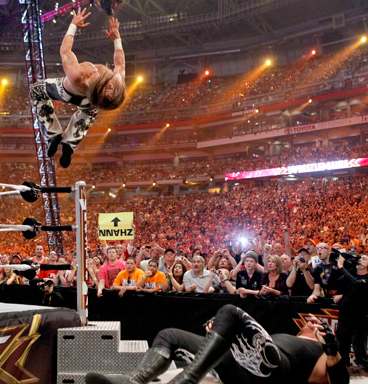
At last. The gap between bad art and good art has probably never been more starkly-demonstrated in my experience, as the final match lived up to all expectations and hype. Again, the crowd were a huge part of the experience, with dueling rhythms of “Un-der-ta-ker!” and “H-B-K!” [Michaels being known as the Heartbreak Kid] filling the cavernous space, as the two legends battled, back and forth. Even knowing the final result was predetermined didn’t matter: we avoid “spoilers”, preferring to be surprised, and genuinely had no idea of how this would turn out. The two men, both born before I was, threw everything they had at each other, up to and including a back-flip by Michaels off the top rope onto Undertaker as he lay prone outside the ring on the announcer’s table (left).

Right until the end, it seemed one man would prevail; then the other. Michaels just wouldn’t stay down, and the Undertaker seemed at a loss of what he could do to defeat his opponent. He seemed on the verge of showing mercy, but Michaels pulled himself up and slapped his opponent across the face, bringing him back. Undertaker delivered another Tombstone Piledriver – if you don’t know what that is, it’s what it sounds like – and that was it. The streak survived. Michaels’ career was over. However, the winner left the ring first, leaving it to Michaels, with both sets of fans now united in their vocal appreciation for what they had witnessed.

Of course, wrestlers have a habit of never “retiring”, and even if would devalue what happened in Phoenix on Sunday night, I’d not be surprised to see Michaels back in the ring eventually – as he said afterward, he’ll probably drive his kids nuts, after three weeks of him hanging around the house. But for now, it was an epic moment, one which almost redeemed the mediocre nature of what had gone before. We’re glad we went, and wouldn’t exchange the experience of that final match for anything. But next year… Even if it was in Arizona again (and it isn’t), we’d just buy the pay-per-view and stay at home with  some friends and a few beers.

The Art of the Remake

remake

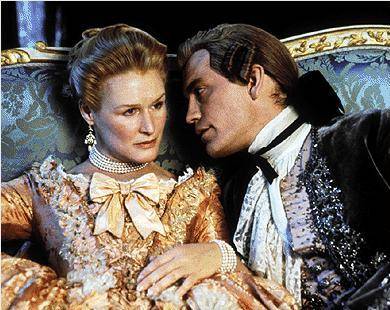
It’s remake week here at Trash City, so as well as reviewing a few examples of the “genre”, figured I might as well put together a few philosophical notes on the topic. Remakes tend to come in for a lot of flak, but they are something of a double-edged sword. Some of my favorite films have been remakes, and you might be surprised to learn that highly-regarded movies as diverse as Dangerous Liaisons, The Maltese Falcon, Against All Odds, Fatal Attraction and A Fistful of Dollars, all fall into the category to some extent. It is a somewhat nebulous group: technically, every film version of Hamlet ever made is a “remake,” but we’ve got to draw the line somewhere – so if it’s in the public domain, it’s fair game.

That said, there do appear to be certain guidelines which influence the remakes that are successful, from those that are regarded as cinematic abominations. After the jump, here are some thoughts on these rules.

1. Remake movies where there is room for improvement.
The better the original, the less point there is in remaking it. Any remake is always going to be compared to the original, and the better this was, the more likely your version is going to be found wanting. No matter what you may think, you are not Martin Scorsese. You are not Steven Spielberg. And you are definitely not Albert Hitchcock, Gus Van Sant, please note. This is where remakes like The Blob can hardly fail, because the original was not exactly viewed with reverence. Same with Piranha 3-D. The lower the bar was initially set, the less chance of failure. I still reckon a Creeping Terror remake could kick ass, because, to quote John Huston:

“There is a willful, lemming-like persistence in remaking past successes time after time. They can’t make them as good as they are in our memories, but they go on doing them and each time it’s a disaster. Why don’t we remake some of our bad pictures – I’d love another shot at Roots of Heaven – and make them good?”

2. Bring something new to the party.
There’s no point in doing something that’s a slavish remake, otherwise, what’s the point? Sometimes, there is an aspect which was obviously missing from the original, for reasons that made sense at the time – in the original Cat People, the sexual tension had to be underplayed, even though it was obviously a major theme, because of the censorship climate. Paul Schrader took that aspect, turned it up to eleven and made it in your face. Same with David Cronenberg and the body-horror aspect of The Fly.

3. The times, they are a-changing…
It should be obligatory for every horror remake to include a scene in which a character waves a cellphone above his or her head, and mutters, “Dammit! No service!” To steal from another song, Fings Ain’t Wot They Used T’Be: so if you’re bringing your remake into the current day (as almost all do), you can’t pretend it’s still the seventies. People are now more connected than they were, and the ceaseless march of technology potentially affects not only horror movies but thrillers and even romantic comedies (You’ve Got Mail updated The Shop Around the Corner with email replacing letters). But some things just won’t translate. For some reason, this seems to affect movies based on remaking TV shows in particular: Wild Wild West, The Mod Squad and The Avengers all failed miserably to work in the present day, regardless of whether they retained the period setting or not.

remakes2

4. Some things are sacred.
Even contemplating a remake of Casablanca should be grounds for flogging [unless, of course, you’re going to make it star Pamela Anderson and call it Barb Wire. In which case, go right ahead] As a general rule of thumb, if you want to remake movie X, you need first to have proven that you can make your own film as good as movie X. So, if Tim Burton wants to remake Planet of the Apes or Willy Wonka, that’s fine.  When Scott Derrickson wants to remake The Day the Earth Stood Still, and his track record extends no higher than The Exorcism of Emily Rose… Not so much. Just because you can remake a classic, doesn’t mean you should.

5. The world is shrinking.
Stop with the foreign remakes. Sergio Leone could get away with producing knock-offs of Kurosawa movies, because just about no-one outside of Japan had seen them. Nowadays, thanks to an unholy combination of the Bays [and I mean E- and The Pirate, not Michael], any half-decent movie is available anywhere in the world, usually within a few days of release. Some genres are particularly on the ball here: anime and horror, for example. Do not expect fans to be enthusiastic about your remake of a film they have already seen and either a) know and love, or b) don’t think is very good to begin with. Gore Verbinski’s The Ring has a lot to answer for in this area: namely, the line of inferior J-horror knock-offs foisted upon the American public.

6. Show some respect for the original.
It won’t help your cause to have the creator of the movie on which you’re basing your work, sniping from the sidelines. Witness the spat between Abel Ferrara and Werner Herzog over the latter’s “reimagining” of Bad Lieutenant. Ferrara said “I wish these people die in Hell. I hope they’re all in the same streetcar, and it blows up,” and Herzog – a man who had some epic battles with Klaus Kinski, of course – replied “Wonderful, yes! Let him fight…I have no idea who Abel Ferrara is.” That kind of thing is likely to alienate the people who most liked the original, and they could be your core audience.

7. Why are you remaking this?
The reason behind the remake is probably the crux of the matter. There are times when it’s obviously little more than sheer laziness: there’s no need to bother coming up with a new story, when there’s a script here which already proved (more or less) successful before? So is this because you think you have something new you can add? Because the original had a great plot, but the FX of the time weren’t up to the necessary level? Because the old story now has a new resonance? Or because it’s a job, given to you by a studio intent on raping its back-catalogue of titles for a quick buck?

Like anything else – adaptations, sequels, etc. – remakes are a tool, and as such can be used for good or evil cinematically. Into which category the results fall probably depends more on the talents of those involved in the project than anything else. But knowing this won’t stop me from calling in an air-strike on Hollywood, if the mooted remake of Blade Runner ever comes to pass.