Google (not necessarily-so) Instant Search

If you use Google – and, let’s face it, who doesn’t – you’ll have noticed the new Google Instant feature. Previously, nothing would happen as you typed in your search terms, until you hit ‘Enter’. Then, you got the results. Now, if you have the feature enabled [and, personally, I’ve turned it off], as soon as you start typing, the rest of the page fills up with search results. So, if you were typing in “Trash City” say, here are the top results you get:

  • T – Target.com
  • Tr – Travelocity.com
  • Tra – Travelocity.com
  • Tras – The “Trash” entry on Wikipedia
  • Trash – The “Trash” entry on Wikipedia
  • Trash C – TrashCanCentral.com
  • Trash Ci – Ah, there we are! [Well, our bead store, anyway.]

However, there are quite a number of topics on which Google Instant Search refuses to express an opinion…

As 2600.com put it, “Somewhere within Google there exists a master list of “bad words” and evil concepts that Google Instant is programmed to not act upon, lest someone see something offensive in the instant results.” Here’s an obvious example. Type in “dog” with a space after it, and you get many helpful suggestions on naming your dog. But do the same thing with “bitch”. You go through Bank of America, Bing, Bittorrent and Bitcomet – but as soon as you type that H, Google Instant does the cyber-equivalent of screaming and running away.

I can kinda see the point. You’re looking for information on sextuplets, and three letters into your search, you’re heading off in an entirely different direction. Except, that one doesn’t actually work. You have to go from Sears, into the Sex and the City homepage and the Wikipedia article on sexting, before mercifully, you hit the U and can enjoy pieces on multiple bir… What? Where have the search results gone? Yep. Google remains dumb for “sextu” and “sextup” before finally kicking back in at “sextupl.” I guess it’s then clear what you’re looking for – y’know, as opposed to all the other words beginning “sextup”.

The obvious response was made by Google, that it’s “to protect the children” – the longtime rallying cry of irrational censorship advocates everywhere. Certainly, I imagine that typing rude words into the search engine is part of growing up, in the same way that looking them up in the dictionary used to be. But, really, after you type in v-a-g-i, where exactly does Google imagine you are going? And, of course, the results Google deem too horrific to show you in real time, are available at any point with a click of the enter button.

Some of the results are amusing. “Latino” is ok; “Latina” is not. Neither is “lesbian,” but “homosexual” is fine. Apparently this is not because the words themselves are bad, but what previous Google users typically follow them up with, leads to results deemed inappropriate for display to maiden aunts. This makes sense, albeit in a “thoroughly pointless” kind of way. However, some of the other cases of censorship are just completely baffling. Type in “rul” and Google has nothing to offer as an instant search, and I can’t imagine anything offensive that could follow it. I guess the owners of Google must have had a horrific experience at the Irish pub in Tempe I know, Rula Bula.

There are a lot of political and religious implications, and it’s interesting where Google draws the line.  It has nothing to offer if you type in “Catholics are” – but type in “Protestants are,” and they have a lot to say. Indeed, all the topics offered as auto-completions could be seen as offensive: Protestants are wrong, going to hell, heretics and not Christians, according to Google’s helpful suggestions. If those are deemed to be okay, I’m not sure what the “Catholics are” completions could be. “Black power” is okay. “White power,” however, is not.

Sometimes, it flat out contradicts itself. Type in “how to kil”, and the search results are there, Google helpfully suggesting at the top, “Did you mean how to kill”. However, add another l, and the search results vanish, as soon as Google realizes that, yes, you did mean “how to kill”. Even more bizarrely, type a space – going on with your original query, about how to kill time – everything returns to normal, the search results beginning with hints on getting rid of scorpions. Ah, so it’s just generic killing Google objects to. As long as you’re specific about it, no problem. And from what, exactly, are Google trying to protect a child who is typing “how to kill” in?

It’s so lame that it probably doesn’t even qualify as censorship, since you are no more than a click away from seeing all the results Google won’t show you. It’s just the equivalent of a momentary stab of parental disapproval, to remind you that you probably shouldn’t be typing that into the search engine, before Google relents and shows you all that stuff you were looking for anyway. Perhaps the most amusing thing is that, somewhere in its labyrinthine lair, they have an employee tasked with ensuring the world is kept safe from accidentally typing in the Japanese word for “hermaphrodite”…

Here are ten of my favorite terms that are blacklisted by Google Instant Search, and return no results:

  • futanari – just so you don’t accidentally type in the Japanese word for hermaphrodite. Never say this wasn’t a learning experience. The English word for hermaphrodite? Perfectly acceptable by Instant Search.
  • Phillip K Dick stories – “dick” appears to be the problem here. See also – or rather, don’t – “Dick van Dyke” or “Dick Barton.” Dick Cheney is okay though.
  • Pamela Anderson – merely the most-downloaded celebrity on the Internet, but as far as Instant Search is concerned, she doesn’t exist.
  • Twinkie – Add Hostess Snack Cakes to the list of those who have offended the almighty Google. Yes, I know there is another meaning of the term, but is it actually more prevalent than the creme-filled confection?
  • hooker – escort is also blocked. Curiously, “prostitute” is just fine, as is the considerably-less PC “whore.”
  • women rapping – “men rapping” is fine. On the other hand…
  • men wrapping – “women wrapping” is fine. The only thing I can think of, is that Google is protecting the really. really bad child spellers of the world from themselves.
  • Smells Like Teen Spirit – speaking of music, one of the classic songs of the 90’s is blacklisted. Contrast Wikipedia, where “Smells” is enough to get the song to the top of the list. Mind you, Instant Search blacklists pretty much “teen” anything, though I’m surprised “spirit” is covered.
  • Octopussy – yeah, it wasn’t a very good James Bond film, but still…
  • Google suc – wonder what they’re thinking people are looking for here?

Feel free to check out the entire blacklist discovered so far. NFSW due to language – well, duh

Torrenting. You’re Doing It Wrong

Curiously, a couple of days after our article on ethical piracy, we got a cease-and-desist letter from our Internet service provider, telling us that they had received a complain regarding copyrighted material being shared from our IP address. Hmmm… Coincidence? Or something more sinister!!!!?!?! Actually, no, I think it was just coincidence, as the files in question actually were our son’s responsibility. We had to have The Talk with him, expressing our severe disappointment that he had been busted; and, in particular, that it was for episodes of Eureka. Sheesh. I think we’d have preferred it to have been German scat porn.

Naturally, we are complying with our ISP’s request, because sharing copyrighted material is bad, m’kay? But, if we were still doing so, here are a few simple steps we would probably be taking, to avoid incurring the wrath of the entertainment industry.

1. Avoid the obvious stuff. The MPAA, RIAA, etc. are driven by money, and they naturally concentrate their anti-piracy efforts on what is driving their revenue stream. That means movies that are still in cinemas, TV shows currently in their first run, newly-released CDs, etc. These are what they are monitoring for, so should generally be avoided. There’s enough interesting stuff out there, you shouldn’t need to be obsessed with getting the “latest” films.

2. Sharing is not caring. Leeching – downloading without uploading – is a good deal safer. ISP’s act on complaints from copyright holders, and it is relatively easy for them to tell who has a file available for sharing, compared to working out who has downloaded it. Once you’ve grabbed a file, remove the torrent so that it is no longer accessible by others online. Selfish? Yep. Safer? Definitely.

3. Make things somewhat tricky. It doesn’t take much, like the proverb says. You don’t have to run faster than the bear, just faster than the guy next to you. Simple steps like encrypting your torrent connection will help make things tougher, rather than operating an open door policy for anyone who wants to waltz in and see what’s in your Download directory.

4. Use Peerblock. This is an application which has an updated list of IP addresses belonging to the “bad guys” (from your point of view, this means media companies, Internet service providers, and so on) and will block them from making connection attempts to your PC. While, not fool-proof, and it can occasionally interfere with accessing things like newspaper websites, the application makes it tough enough the watchdogs will generally go after some other, lower-hanging fruit.

5. Use an intermediary. For about ten euros a month, you can buy yourself a “seedbox” – a share on a standalone computer, which you can use as the torrent box. It does all the downloading, rather than your PC, and since it’s not your IP address, your ISP won’t care. When the download is finished, you connect to the seedbox and retrieve your content over http, just like accessing any other website. If that’s too much effort, use a free service like torrific.com – you give them the torrent file, and they download it onto their server. No more torrent traffic.

6. Private trackers. These are sites where, to access the torrents, you need first to login. The torrent has additional information attached to it, that means only other members can see and share it. Generally these sites are themed, specializing in say, British TV, cult movies or Asian films, and some are invite only. There’s nothing to stop the MPAA from signing up for a membership, but there’s enough people using public trackers like The Pirate Bay, that it’s not worth the hassle.

7. Open All Hours. It seems a reasonable assumption to make that those hunting you down – both on the copyright holder’s side and at your hosting company – are doing so as a job, and thus likely work business hours, i.e. 9-5 Mon-Fri. There is therefore less chance of being nabbed if you kick your Torrent application on late on a Friday night, and then switch it off Sunday evening, or otherwise use non-peak hours.

8. Hide in plain sight. Don’t just Torrent illegal stuff. There’s plenty of public-domain movies, music and software out there that are perfectly legal to share over a Torrent. If you are doing that on a regular basis, then this will provide a background hum of legitimate traffic that will be less likely to draw the attention of your ISP. You may never watch that copy of Atom-Age Vampire, but it can still serve a purpose.

9. Stick to trusted sources. One recent trick used by authorities is to become seeders themselves, announcing a great-quality torrent of hot new release X. But anyone who connects to this gets their IP address immediately harvested, and passed on to their provider for action. As mentioned before, avoiding “hot new torrents” will help, but sticking to torrents posted by users who have a previous good history is even better.

10. Move out of the UK. Sorry, guys. The Digital Economy Act, passed by Parliament shortly before the election, is a scary piece of legislation, that gives the government wide-ranging powers to cut off Internet access to broadband users accused of file-sharing, and also block access to sites that are “likely to be used for or in connection with an activity that infringes copyright.” You guys have fun with that…

Nineteen Eighty-Four in 1954: The BBC TV adaptation

Dir: Rudolph Cartier
Star: Peter Cushing, Yvonne Mitchell, André Morell, Donald Pleasence.

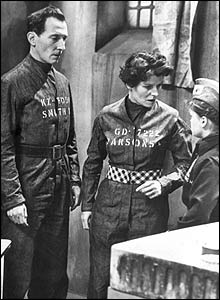
It’s hard to appreciate the impact the BBC adaptation of George Orwell’s Nineteen Eighty-Four had on the country at the time. The first of the two broadcasts, in December 1954, triggered an enormous furor, with motions proposed in Parliament criticizing “the tendency, evident in recent British Broadcasting Corporation television programmes, notably on Sunday evenings, to pander to sexual and sadistic tastes.” When the performance was repeated the following week, needless to say, it got the biggest television audience in the country since the Coronation of Queen Elizabeth II. [Some things don’t change!]

That was not a repeat of the original screening, as both broadcasts were largely performed live, with some filmed inserts to allow for scenery, costume, etc. changes. Fortunately, the second showing was recorded; this being the days before video-tape (which would become available a couple of years late), the process basically involved filming a TV monitor, and the resulting picture quality leaves more than a little to be desired, especially when you start watching it. However, the brain adapts, and the grainy, ghostly quality of the images eventually ceases to matter.

It’s important to put the broadcast into the context of the time, in a post-war Great Britain, where rationing, such as of meat, had still been in place up until as little as six months previously. The Cold War was entering perhaps its chilliest phrase, following the death of Stalin in 1953, with the Korean War also fresh in everyone’s mind. Indeed, even the book itself was freshly-published rather than a cobwebby cornerstone of Eng. Lit. courses everywhere, having come out only five years previously.

What we have here, is a pretty straightforward retelling of the novel, with Winston Smith (Cushing) revolting against the authoritarian world of the Inner Party and its leader – who may or may not exist – Big Brother. He falls for another rebel, Julia (Mitchell) and seeks to join the underground resistance, of which Inner Party member O’Brien (Morell) is a member. Except (and I trust this hardly counts as a spoiler), O’Brien is no such thing, and Smith ends up arrested and undergoing tortures both mental and physical, culminating in his experience in Room 101, all with the aim of getting him to love Big Brother as he should.

The adaptation was written by Nigel Kneale, one of the most-renowned British genre scriptwriters of all time – in his field, easily as important as Dennis Potter, with his work including the Quatermass serials (as well as Quatermass and the Pit) and The Stone Tape. The film also lucks into a main star and a supporting actor who were little known at the time, but would go on to become horror icons of the highest order, in Cushing and Pleasence. The former is sublime, and his Smith is definitive in a way of which John Hurt could only dream, and goes alongside Cushing’s portrayals of Van Helsing, Baron Frankenstein and, arguably, Sherlock Holmes. Pleasence is his usual solid self as Syme, promoter of Newspeak, who is eventually “disappeared,” like one of the words he is striving to erase.

The supporting cast is not much less familiar. Morell gives a brilliant performance as O’Brien, delivering the film’s signature line with the perfect mix of deadpan menace and absolute certainty: “If you want a picture of the future, imagine a boot stamping on a human face— forever.” He and Cushing would team up, in a more friendly way, in Hammer’s Hound of the Baskervilles, where Morell played Dr. Watson to Cushing’s Holmes. Also present are Wilford Brambell, who’d go on to renown as Steptoe, and antique shop owner Mr. Charrington is Leonard Sachs, who compered variety show The Good Old Days for thirty years.

A couple of things stand out about how this was made. The budget was reportedly just £3,249 – even allowing for inflation, it works out to less than £70,000 in today’s money. It’s an astonishingly low sum, especially considering things like the live orchestra which played the music during the performances. The special effects, depicting the bombarded city of London, though sparse, are certainly effective. Again, you have to bear in mind, this was shown barely a decade after Hitler’s V-2’s were falling on the nation’s capital. Depicting the resulting rubble would have had much the same emotional resonance for the audience here, as the Twin Towers falling does for today’s viewer.

The adaptation being performed live is also remarkable – something that was common at the time, but hardly ever happens for dramas nowadays – a 1958 Armchair Theatre performance, during which one of the actors died, didn’t help [One of the survivors said of that incident, “We could see him coming up towards us, but we saw him fall. We had no idea what had happened, but he certainly wasn’t coming our way. The actors started making up lines, ‘I’m sure if so-and-so were here he would say’…”] In the case of Nineteen Eight-Four, 22 sets were used and it’s almost impeccable. You can see what appears to be the shadow of a boom-mike early on, otherwise it seems near-perfect, and it’s hard to tell this isn’t a multiple-take production.

The black-and-white cinematography, though not a stylistic choice at the time, captures the grim, depressing reality of a hardcore totalitarian regime beautifully – the eighties version was originally intended to be shot in b/w too. As a necessary contrast to the soulless society depicted here, the performances, particularly Cushing and Mitchell, imbue things with humanity, and provide a tinge of hope, even as things go downhill for Smith, with relentless grimness – the moment where Smith sees his reflection in a mirror is not one easily forgotten. It’s a combination, when added to the mix of past and future, that makes it easy to tell why its reputation persists.

And it does: in 2000, it was ranked #73 in the BFI’s list of the greatest British TV shows of all time. It was the earliest program honoured, and put Nineteen Eighty-Four between Walking With Dinosaurs and The Fall and Rise of Reginald Perrin. The film has only been shown three times on television since the original broadcast, most recently as part of the celebrations for Orwell’s centenary. However, the fifty-year copyright term on the show expired at the end of 2004, allowing it to enter the public domain, so it’s now available on Youtube. I’d certainly recommend checking it out.

One Missed Call: The TV Series

Having not exactly been impressed with the original Japanese feature film, and even less enthusiastic about the pointless and uninteresting American remake thereof, it’s no surprise the DVDs of the TV series sat on the shelf for quite some time. They’d been acquired before we saw either movie, and the prospect of sitting through the equivalent of about five more feature films of the same kind of nonsense, didn’t exactly fill us with enthusiasm. However, when we eventually could be bothered to slap them in the player, we were pleasantly surprised – this Asahi television version, which came out a couple of years after Takashi Miike’s movie, is actually the best version of the bunch.


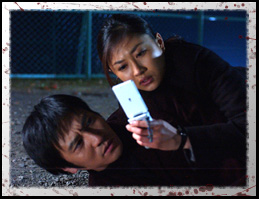
The story centers on Yumi (Rei Kikukawa), a magazine researcher, who becomes involved after witnessing the fiery death of a schoolgirl – apparently the victim recently received a voice-mail, apparently from herself, foretelling her own demise. Her investigative efforts get her banished to the basement at work, where she is sent to join the staff of Tokumei Watch, best described as her publisher’s version of the late, lamented Weekly World News. However, Detective Sendo (Ken Ishiguro), is also investigating the case, and it soon becomes clear that the schoolgirl is not the only victim of the apparent curse.

Initially, it seems that events are tied to an incident in the past, when a hiking trip went badly wrong. But the more our heroes dig into things, the more they uncover. Not the least of which, is that there also appears to be a tie to Yumi’s school, where her sister vanished ten years ago on Christmas Eve – and tradition dictates it’s time for another victim to disappear. Will the case allow Yumi to achieve closure? And why does there seem to be a lot of pressure on both her and Sendo to stop the investigation?

To some extent, this is a stretched-out version of the movie, and it uses some of the same elements. For example, as in the film, one victim gets doorstepped by a TV crew, who get her to agree to come to the studio at the time of her demise, for a “live exorcism.” That goes about as well as you would probably expect. But the extended room available here – the series runs ten 45-minute episodes – gives the makers the opportunity to develop the storyline and characters in greater detail, and that’s where the show really scores over its cinematic cousins.

For instance, the investigation does not proceed in an entirely linear fashion. There are dead-ends and red herrings, such as the hoax “one missed call” which succeeds in diverting attention for a while. The two main plot-threads, of the hiking trip and the school with a dark secret, proceed in parallel – some episodes, one takes precedence, while in others, both are developed. After about three or four parts, I was wondering how they could possibly keep things going, and it’s an impressive juggling by the script to keep both balls in the air until almost the end, revealing information at just the right pace to keep the interest level up for the entire time.

The characters are, more or less, pleasant to spend time with. I say “more or less,” because as things develop, it turns out one is more than a couple of sandwiches short of a picnic, though you wouldn’t know it on first impressions. Yumi has a good handle on the “plucky girl reporter” thing, and Sendo has endearing quirks: the ringtone on his phone is, I kid you not, a wailing police-siren. The staff of Tokumei Watch are also an amusing bunch of eccentric geeks and freaks, such as the magazine treasurer who insists everyone travel by public transport when on company business.

I am not entirely sure that everything makes complete sense, viewed from the end of the show. However, it’s churlish to look too closely at the plot of a show which is about cursed phone calls from the future. There don’t appear to be any major holes we could spot, and the journey provides a more than adequate number of creepy moments, which in the final analysis, is what matters. Fans of shows like Fringe or Haven could do a lot worse than tracking down this as a Japanese take on the genre.

In Support of Ethical Piracy

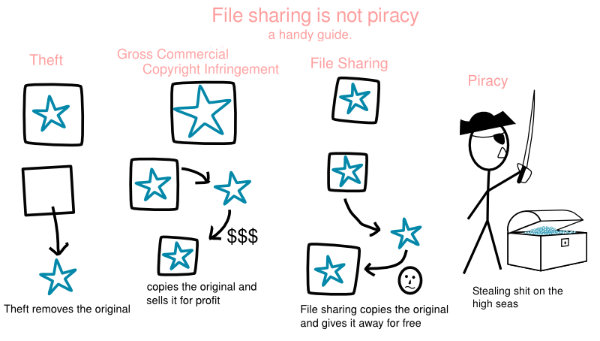
My name’s Jim, and I am an ethical pirate. The music and film industry would have you believe that downloading “their” material is wrong, an approach best summed up as “Piracy is stealing, mkay?” But, the reality of it is, that the morality is a great deal less clear-cut. Here, courtesy of an interesting series of articles, well ahead of the curve, from David Pogue are some hypothetical scenarios, all of which describe what is technically piracy. How many of them do you think are morally wrong?

  • I own a certain CD, but it got scratched. So I borrow the same CD from the library and rip it to my computer.
  • I have 2,000 vinyl records. So I borrow some of the same albums on CD from the library and rip those.
  • I buy a DVD. But I’m worried about its longevity, so I make a safety copy.
  • I meant to record a movie – perfectly legal – but my recorder malfunctioned. My buddy recorded it, so I copy his DVD
  • I meant to record a movie, but my recorder malfunctioned and I don’t have a buddy who recorded it. So I rent the movie from Blockbuster and copy that.

Before getting into the ethics of the topic, let’s nail a few myths. First, the one that piracy is somehow destroying Hollywood. In 2009, total US box-office was the highest ever, exceeding ten billion dollars for the first time, and outpacing the previous mark by almost 10%. Even the raw number of tickets sold – thus removing the effects both of inflation and high-priced 3D screenings – was the highest since 2004. And that’s despite the fact the 12% fewer movies were released than in the previous year. Doesn’t exactly sound like an industry in crisis, does it?

That’s in part because the movie business learned some things from the horrific errors of their musical brothers, who sat around with their thumbs up their asses, refusing to adapt and embrace legal downloading, or accept the realities of the new marketplace. Physical CDs were deemed untouchable until it was too late. The result? “U.S. album sales in 2009 declined for the eighth time in nine years,” and even including digital downloads, overall numbers dropped by 8.5% on the 2008 number.

And no wonder: the CD is basically the same now, as it was when they were introduced in 1982, no better or cheaper. In contrast, the movie industry has vastly improved the theatrical experience with things like Dolby, THX and now 3D [though Chris might argue whether “improved” is the right word for the last!]. The “added value” means that going to the cinema still remains an entirely different experience from downloading a film and watching it at home; there’s no such separation between a bought and downloaded CD.

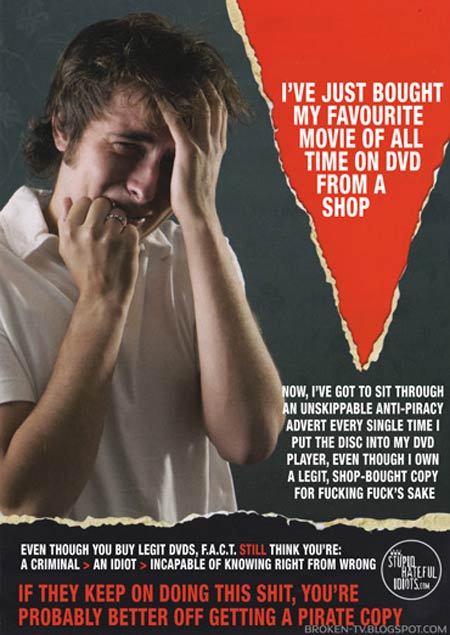
Not that the process has been without its flaws.  For instance, regional coding of DVDs, intended to protect copyright has actually done quite the opposite. There are many DVDs out there that are unavailable in NTSC, Region 1 format, and so are not compatible with my system. If I want to see these movies, the only options are black-market providers of one kind or another. This means that rather than one rights owner – albeit, perhaps not the geographically “correct” one – getting payment for the work in question, nobody does. Well done, movie industry! Would you like to reload and try for the other foot too?

If you look at DVD sales, there has been a recent dip, dropping 13 percent from 2008-09 to $8.73 billion, down from $10.06 billion. Interestingly, this drop almost exactly balances the increase at the cinema, meaning that overall movie spending remained almost static last year – an impressive feat given the ongoing economic issues of recent times.  The DVD drop may also reflect that the stock of older movies people actually want to see has now largely been mined out – #1 on TCM’s list of “classic” movies unavailable on DVD is now So Big, a 1953 Jane Wyman vehicle which I don’t give a damn about, and am pretty sure you don’t either.

However, I note there is little or no resistance to other methods of films being seen, which also result in no payment being received by the creators or distributors. For instance, ever watched a DVD borrowed from a friend? Or perhaps, rather than buying a new copy of a movie, instead opted to buy a cheap, second-hand DVD? For that also “robs” the studio of income they would have had. Among the biggest culprits there are Blockbuster and their massive piles of ex-rental DVDs [well, assuming you can find a branch that hasn’t shut down, anyway…], but no-one claims this is “financing terrorism.”

Which brings me naturally to the dubious claims of the MPAA and its associates that video piracy equates to organized crime and terrorism. I’ve no doubt that organized crime use it as a fund-raiser: it’s a low-risk and potentially lucrative trade, so merits no more than a “Well, duh…” response there. But the sweeping generalization connecting the two is laughable. The vast majority of people who download movies are not organized criminals or terrorists, and the near-hysterical attempts by the business to label them all as such, are manna for parodies, such as the one below from The IT Crowd.

YouTube Video

The key difference between myself and large-scale, commercial pirates – I should stress, I have no problems with the industry going after them – is that I have basically zero interest in downloading Twilight: Eclipse or The Last Airbender. My interest in downloading material is limited to two areas: replacement and obscurities. And it’s here that we enter the realms of “ethical” piracy – the unofficial downloading of material, that technically breaches copyright law but is, to an extent, morally justified. Let’s go into each of these categories in more detail, starting with format replacement.

Take Blade Runner. I have, over the years, bought it on: VHS tape; letterbox VHS tape; laser-disc; DVD; and DVD box-set. All told, I have probably spent about a hundred quid or so, on just a single movie, to keep up with the format changes imposed on my by the industry, with most of my copies now being completely obsolescent. Downloads provide a credible and, to me, entirely legitimate, alternative to this. It’ll remain that way until Hollywood lets me trade in my DVDs for the Blu-Ray version. Contrast music: if I buy a CD, I can rip it to my computer, rather than needing to purchase the MP3 from Itunes.

The need for this became clear during the recent re-view of the TC Top 50, as I found a significant number of movies listed were no longer accessible to me. We don’t even possess a video-recorder of any kind these days, let alone one that can handle PAL tapes – as a result, almost all of our VHS tapes became landfill fodder during the Great Leap Sideways of 2009. I view my replacement of these with digital copies as closer to a basic human right, rather than the threat to the fabric of civilization as we know it, which the MPAA would have you believe.

The last thing I downloaded was a 1982 TV version of The Woman in White, which I remember fondly from my youth, and which had apparently vanished without trace since. It was hardly high-quality, having apparently been ripped from a VHS print. Even viewed on a computer, it looks grainy and choppy: on a big screen, I suspect it would resemble a game of Tetris in period costume. But, still – I was delighted to have it. Of course, after spending gigabytes of bandwidth on that, I discovered days later that it was getting a UK DVD release. Oh, well…

Still, this does illustrate the basic principle, and I have few qualms about downloading material which is simply not available in a legitimate fashion. It’s more than a bit like the VHS-trading community which flourished among the horror community in the late 80’s and early 90’s, when James Furman and the BBFC were in full-on Stalinist mode [“What? Nunchakus?”]. More hi-tech, of course, and a good deal simpler too. No buying of VHS tapes by the box, or kicking off dubs using your two VCRs: by default, when you download a file through BitTorrent, it automatically becomes available for others to share.  Very democratic.

You can also use it to cover unforeseen circumstances, such as when a TV schedule change screws up your recording. We had this just this weekend, when for some reason, MI-5 didn’t start at the scheduled time, which meant our Tivo of it cut off with five crucial minutes remaining – and it’s not on Hulu or any of the other official sources. However, courtesy of the marvellous thebox.bz, a repository for British TV shows, we were able to see the missing chunks immediately. It’s hard to conceive of even the copyright holder truly objecting to this.

If I do have any sympathy, it’s with the group who made the PSA below – porn stars. The Internet was once an open money-pit for the adult entertainment industry, but things have now reached the stage where, if your tastes are for straightforward heterosexual fun at least, you’d be an idiot to pay for it. Still, it’s an industry that has always been on the cutting-edge of technology: VHS, the Internet, home camcorders, etc. so I’m sure they’ll adapt and survive. Maybe the next thing will be 3D-porn? Hey, bet you didn’t see that coming… Er, as it were…

YouTube Video

And that’s the way the entertainment industry operates. TV was supposed to kill off the movies, which were supposed to kill off live theatre, which was supposed to kill off… I dunno, gladiatorial combat or something. It didn’t happen. The media which deserve to survive will do so. They may need to change, but even if the impetus for that is morally-doubtful activities such as piracy, can we really say that is a bad thing? Online downloading is a door the industry may not want to open, but there’s a battering ram coming, driven by the 16.7 million seeders currently present at The Pirate Bay. Get in the way if you dare.