Raising Arizona Wilder

Born Jennifer Ann Greene, Arizona Wilder first came to prominence with the release of David Icke’s The Biggest Secret, as rare “evidence” (quotes used advisedly) for his theory that the world is dominated by shape-shifting reptilians from other dimensions. The book’s index has the entry, “Wilder, Arizona – see Mother Goddess”, and she describes human sacrifice rituals involving the Pope, the Clintons, the Reagans, both George Bushes, various members of the Royal Family, and, er, Bob Hope. These summoned “snarling, hideous creatures” – how they distinguished them from participating politicians is unclear.

Here’s her description of the Queen: “I have seen her sacrifice people and eat their flesh and drink their blood. One time she got so excited with blood lust that she didn’t cut the victim’s throat from left to right in the normal ritual, she just went crazy, stabbing and ripping at the flesh after she’d shape shifted into a reptilian. When she shape-shifts, she has a long reptile face, almost like a beak, and she’s an off-white colour.” [David Icke, The Biggest Secret, p.455]

You can get a videotape of an interview with her, but for those not willing to contribute directly to her finances, an opportunity to see Wilder speak occurred at the 2003 Conspiracy Con in Santa Clara. I went in sceptical, but with an open mind – despite a desire to give her the benefit of the doubt, unfortunately, I came out convinced that her claims have no basis in objective fact. Though if any of it is true, her life has been a harrowing one. She was born with her destiny as a cult figurehead already predetermined, and was ritually abused as part of her indoctrination. This included trips to Moscow as a young child, where she was immersed in cold water to bring on near-death experiences which would awaken her latent psychic abilities, and her chief handler was Nazi scientist Joseph Mengele.

A lizard, preparing to add
garnish to a light snack

These creatures who rule our planet can’t enter our dimension on their own; they need to be anchored here with a sacrifice, and need adrenalchrome to keep them in human form. This chemical only comes into the blood when the victim has been tortured and traumatised – Arizona’s job was to preside over the ceremonies and act as a conduit for the reptilians.

In her role as a “mother goddess”, she was scheduled to be killed at the age of 52, by her daughter, who would then take over the role. [Does this mean Arizona killed her mother? I suspect not – must be some kind of reptilian loophole there. Handwave, handwave…] But after Mengele’s death in the 1980’s, the psychological noose around her neck loosened, and she escaped the cult’s clutches, going into therapy. [Another warning sign, given the ability of therapists to make anyone believe anything] Subsequently, she’s been harassed, beat up, and even drugged – a test showed positive for cocaine even though she claims never to have taken it.

Well, where to start? The complete lack of corroborating evidence she provided, to begin with – for example, the alleged beatings become less significant given her admission that she has engaged in self-mutilation. You might think that with so many years operating at the highest levels of the global conspiracy, she would have some proof: photos, documents, anything. No. Not even a shape-shifting paperclip. We have only her testimony to go on. My rule of thumb is that the more outrageous your claims, the more I require to back them up. Wilder rates a 10 for outrageousness, but there’s more convincing support for pixies and unicorns than for her view of the world.

Is this the man who abused Wilder?
No, it’s Gregory Peck playing Mengele in The Boys From Brazil. But Peck was probably involved too…

She claims to have been one of only three mother goddesses in the world. This, and how she was trained by Joseph Mengele himself (though could she tell us with any degree of authority what he looked like?), reminds me of the way that mentally ill people always believe themselves to be Napoleon, never Napoleon’s boot-boy. Given Wilder herself puts the number of ‘programmed’ individuals in the United States alone at ten million, the odds of her being such a high-ranking figure are ludicrously high.

Of course, the programmed include her parents and sisters – presumably a defence against anyone tracking them down and hearing their denials. Tied in with her supposed high-level role, her family are no commoners either, but “bloodline” – related (illegitimately, naturally – any ‘proper’ connection could be easily investigated) to the Rothschilds, and originating from the South of France. Yes, throw some Holy Blood and the Holy Grail into the mix, though you may be forgiven for feeling Wilder’s universe is closer to Monty Python and the Holy Grail.

I’m far from the only doubter: former Icke associate Ivan Fraser wrote in an article that, “her facts were either regularly wrong, or so full of spin that she was hardly credible.” He also mentions Wilder’s claim that the royal lizards change back when they sleep, which must have made Prince Charles’ time at Gordonstoun public school and in the armed forces very entertaining for those sharing his sleeping quarters…

‘Control freak’ Cathy O’Brien, with her minder, Mark Phillips

The most charitable explanation is that she was indeed abused horribly as a child, and her psyche has latched on to Icke’s reptilians as a way to rationalise her suffering. Under this hypothesis, she truly believes what she says. Slightly less kind, she could merely be an attention seeker who loves the sympathy of an attentive audience, and finds making outrageous claims a good means to that end. Worst of all…well, if someone out there actually is engaged in mind-control work (and that is not as far-fetched as you’d like to think), what better way to cover it up? Make wild, ludicrous claims, linking the topic to trans-dimensional aliens, Nazis and Satanists, and the general population will eventually believe it to be the domain of cranks and kooks.

In this light, I am particularly curious about Wilder’s minder, the unseen “Miss Pinky”. What is her precise role? Wilder isn’t the only one to have such an associate lurking nearby – Cathy O’Brien, another alleged mind control victim, is rarely seen outside the company of ex-intelligence agent Mark Philips. Another figure of interest is Brian Desborough, who may have directed David Icke towards the reptilian theory, and subsequently introduced Wilder to him, a convenient “witness” to back up the facts. Perhaps significantly, Desborough has written articles on mind control.

By writing this piece, I probably become part of the conspiracy against her, and my claim to be merely a sarcastic, sceptical Scotsman should be viewed with scepticism. However, she claims to be serving her purpose and destiny, and so I guess I’m just doing the same thing by treating her story with the suspicion it deserves. Her presentation at Conspiracy Con was entitled Deceived No More – but does that more accurately apply to the speaker or the audience?


A reader writes:

“I ran into your page about Arizona Wilder – I recently had the ‘extinct’ honor or working with this mentally ill person, she was my Charge Nurse on a psychiatric unit. [I call it extinct because I no longer work there – I’m a nurse as well.] The second day I knew her, she was telling me and other co-workers her history with the so-called Illuminati… She turned out to be one of the most annoying people I have spent 8 hours a day with. I am now free of Arizona’s interactions and that snake pit. I am thankful every day I didn’t end up an appetizer for the queen of England!”

Web of Conspiracy Con 2003

Santa Clara, CA
24th-25th May, 2003

Every year, it seems, more and more conspiratorial cracks appear in the landscape. This year, the war against Iraq, looking for those pesky – and apparently, non-existent – weapons of mass destruction, showed once again that politicians have absolutely no problem deceiving the electorate when they feel the need. Bringing this to the attention of the public is where events like Conspiracy Con come in, though the topics covered were far broader – and, being honest, covered the entire range of plausibility too.

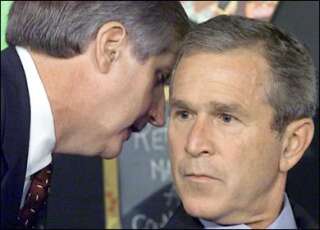
Despite the Gulf War, the most frequently-referenced topic was the events of 9/11. That our government should have known about it in advance seems certain, but the question now being probed is whether they did. There is certainly evidence, such as the remarkable delay in sending up interceptors, which suggests the possibility. And if you’ve seen photos of the moment when George Bush was supposedly told of the attacks, his reaction seems closer to “tell me something I don’t know already” than the shock and horror you might expect.

We preceded the event with a couple of days in San Francisco. If you go there, do yourselves a favour and leave your car at home. Driving is a nightmare, and parking is worse: our hotel charged us $25/day for the use of their garage. There is plenty of transport around the city, but they’re rather more vague about how you get into the centre. It was a relief to leave (albeit at a snail’s pace, onto the Bay Bridge) for the wide-open spaces of Santa Clara – even if we’d spend the majority of the next two days in the hotel, save the odd hunter/gatherer trip to the local curry house [And can I just say in passing that putting cloves into keema naans is an idea we hope does not catch on…]

Stan Monteith – There was something old-fashioned about the opening speaker, who traced the New World Order back to Cecil Rhodes, tying him to various occult-influenced secret societies. This kind of thing seems more than slightly antiquated these days, enhanced by Monteith’s fondness for quoting poetry (Tennyson’s Locksley Hall being a favourite). He did have some interesting points, in particular a plausible idea that Jewish involvement in the Bolshevik Revolution was a reaction to the Tsar’s anti-Semitism, as shown by his support for The Protocols of Zion. Monteith also suggested the recent extension of copyright law was partly an attempt to suppress information, but he was probably just worried about lawsuits, since his book seemed largely to be a collection of photocopies lifted from other publications. C-

Arizona Wilder – I took more notes during Arizona Wilder’s presentation than any other speaker. I was also less convinced of the veracity of what she said, than by any other speaker. This contradiction in terms really requires explanation at length, so here’s a separate article, all about Ms. Wilder. Here, we’ll just cut to the chase, and give the grade for a presentation whose only real value was as entertainment. D-

Jerry Smith – Smith replaced the hospitalised Vance Davis, and while a lack of preparation was obvious (Smith had only been called the day before), this was still a fascinating talk on HAARP, the High Altitude Active Auroral Project. Last year, Dr. Nick Begich covered the same topic to good effect, but Davis concentrated here on the potential uses, both benign and malign, of the technology, which include everything from mind control to deflecting ICBMs. He covered its origins in the work of Nicholas Tesla (and his obsession with pigeons!), and looked at whose agendas it might further. I’ve had his book, HAARP: Ultimate Weapon of the Conspiracy, sitting on the shelf since last year’s event: I think it’s now on the fast track to being read. Double plaudits for providing such an engrossing presentation at very short notice. B+

Jordan Maxwell – He spoke at 2001’s convention, and his theme this time was similar, probing into words to find their hidden meaning. Refreshingly, while many conspiracists see ominous iconography on a dollar bill, Maxwell finds it less disturbing, using historically sacred symbols worthy of respect. He looked into the origins of Christianity and its hijacking of earlier religions; for example, “Solomon” being a compound of Sol-Om-On, three words related to sun-worship. His weakness was a tendency to make a point, then pound it home by giving far too many examples; this got repetitive, but he also delivered the best quote of the convention. “Always trust the seeker of truth. Never trust the one who claims to have found it.” B-

There was another workshop, but you had to pay $40 to see Richard Hoagland, of “Face on Mars” fame – a feature now revealed (right) as no more than coincidental shadows. If I were in Hoagland’s shoes, I’d be more concerned about trying to regain some degree of credibility, and less about getting cash out of the public. We, needless to say, did not pony up to see him. Inevitably, this conference attracted some odd individuals, who had perhaps got out on day release. A couple of these showed up at the Q&A session, but others, unfortunately, chose to sit near us (attracted by Chris’s “psycho magnetism” – hey, she married me!). There was Ilsa, She-wolf of the Auditorium, to whom the slightest sound seemed to cause immeasurable pain. There was the Bag Lady, who demanded we clear off chair space…so she could put her possessions there. And there was the individual who, on hearing my British accent, demanded to know who’d killed Princess Diana. There was some disappointment at my response – know little, care less – and I wish I’d fabricated some (in)credible plot instead.

Jim Marrs – Is there anyone out there who really believes that Kennedy was killed by Lee Harvey Oswald, acting alone? If so, they should have been present for Jim Marrs’ informative and enjoyable ‘J.F.K. Assassination 1.0.1’ talk. Beginning with a slide showing a dubious character at Jack Ruby’s Carousel Club, a month before the shooting – who turned out to be the young Marrs! – he performed an efficient demolition job on the findings of the Warren Commission. This is, admittedly, like shooting fish in a barrel, but it’s always good to be reminded of the wild implausibilities in the “magic bullet theory”. Who arranged it, is harder to say. As Marrs pointed out, Kennedy had angered virtually every violent faction operating in America: Mafia, CIA, miltary-industrial complex. Perhaps, like Murder on the Orient Express, they all did it. Regardless, the effect was a coup d’etat that to this day remains unacknowledged. A

Carol Brouillet & Ken Jenkins – Although most speakers referred to the events of 9/11, this pair were the only ones to make it a focus. One can’t doubt their commitment as activists, but as speakers, Carol in particular seemed way out of her depth with lengthy moments of uncomfortable silence. The best part of the presentation was a lengthy chunk of video asking some pointed questions about the events of that day, which need answering, but beyond this, they seemed to have little to offer but shallow sloganeering and edited highlights from Oliver Stone’s JFK. In terms of raising awareness, tools such as their ‘deception dollar’ (below) are potentially excellent, but we attend the convention for more than sound-bites. Anthony Hilder’s demands for a standing ovation beforehand were wise, since they didn’t deserve one afterwards. D

Kenn Thomas – Thomas, as editor of Steamshovel Press has been one of the leading lights in conspiracy research for years. With his friend, the late Jim Keith, he has been investigating “The Octopus”, a cabal that supposedly killed journalist Danny Casolaro when he got too close to them. This was a little too self-publicising for our tastes, with a bunch of plugs for Steamshovel publications and footage of Thomas appearing on TV. He talked about mysterious clusters of deaths, such as the one that plagued Marconi scientists in Britain a year ago. But the truth is, if you’re a conspiracist, no matter how you died, it’s suspicious. Just put the cause of death in quotes – “cancer”, a “heart attack”, in a “car crash”, “suicide” – and there you are, instant conspiracy! C-

Michel Tsarion’s genitals…

Michael Tsarion – Freud said, “Sometimes a cigar is just a cigar”, and Tsarion would do well to listen. It’s conceivable the media uses sacred symbols, for example in advertising; I’ve always wondered about Bacardi’s bat. But Tsarion takes the concept to ludicrous extremes, interpreting everything this way. For example, Kraft, as in Foods, refers to Masonic craft – not James L. Kraft, who started a Chicago wholesale cheese business in 1903? Glad we sat at the back, as our sniggers (Volvo = Vulva!) would’ve disrupted proceedings. Factually wrong – Spica is not the brightest star in the sky – he also claimed the Arc de Triomphe was a phallic symbol. Now, I don’t know what his penis looks like, but there are better candidates in Paris, not least at the other end of the Champs Elysees. I think we finally lost it when he claimed “Sears” was an anagram of “Aries”. Guess he can’t spell either. However, it is an anagram of “ARSES”. Now that’s symbolism… E+

After the second part of Hoagland’s workshop (see above), it was time for the Q&A. This is always entertaining, for the wide range of topics covered and views aired, both by the panellists and the audience – at one point, I thought a fight was going to break out over whether it was the limo-driver who shot JFK. Perhaps the most interesting question asked for predictions of what to expect: Monteith reckoned a major biological attack was possible, but Hoaglund and Tsarion (who came over much better as a panellist than as an individual speaker) predicted the assassination of George W. Bush. Hoaglund pointed out that both The West Wing and 24 have had storylines depicting the vice-president taking over…

We remain amazed at the breadth and depth of the program Brian Hall and his team put on, and with commendable efficiency, everything running to schedule. While not every speaker was convincing (to say the least!), it was nice to learn our bullshit detectors are still fully functioning. We left, refreshed in our belief that whatever appears to be going on in society, is not necessarily what actually is happening. That alone makes our attendance at Conspiracy Con 2004, a foregone conclusion.

More information

Legal Alien

I’m finally a legal inhabitant of America – or at least, as legal as I’m likely to be for the next couple of years. Being now married to an American, I’m going through the process of applying for status as a permanent resident, rather than the visiting worker which I arrived as. The current waiting list for an interview to determine whether I’m eligible is 28 months – and we can’t really blame 9/11 for much of that, it’s just the wheels of American bureaucracy, grinding exceeding slow.

Generously, while your application is being processed, they allow you to work, and also to leave the country – and, perhaps more importantly, come back into it as well. Mind you, you still have to leap through a bunch of hoops in order to work at Starbucks and go to Cancun, though the actual process involves a lot less leaping, than sitting around in waiting rooms with a lot of Mexicans. Bring a book – you rapidly discover that a 10 am appointment, doesn’t actually mean you’re going to get seen at 10 am. It really just means you start waiting at 10 am. Bring a packed lunch, too.

It does give you plenty of time to contemplate the alternatives; it’s clear why so many people choose to bypass all the tedious form-filling, and simply come in, live and work illegally. It helps that the government shows little or no interest in prosecuting the employers, who are delighted to pay below American minimum wage to people, who are delighted to earn less than American minimum wage, since it’s still a lot more than they would get at home. Everybody wins.

Or so the liberal commentators would have you believe – the ones who refer to “undocumented” rather than “illegal” immigrants. Speaking as a documented, legal immigrant, I’m not quite so convinced; given they’ve shown such a flagrant disregard for American laws in coming here, why should we think they’re otherwise going to be law-abiding citizens once they get here? For example, they can’t get driving licences – and rightly so, since if we make it easy for the illegals, what’s the point of having a legal process, which makes it most unlikely they’ll bother with car insurance. If one of them hits you, all you’ll see is likely a tattered pair of Nikes making off at top speed on foot.

It’s a point of particular interest, given the unemployment figures here are at a long-time high. Sure, a lot of the jobs taken by illegal immigrants are not those you or I would want to do, but how can anyone compete with desperate people, from a nation barely beyond a Third World level of development? It becomes a self-fulfilling prophecy: illegal immigrants do the work cheap, thereby ensuring that legal residents (also much more likely to have to pay tax and other deductions) simply can’t afford to take the jobs. And all the while, the government wrings its hands, unwilling to interfere with pure capitalism in action.

Say what you like, at least illegal immigration was never a problem in the Soviet Union…

After the War is Over

I’ve been carefully biting my tongue for the past month, careful not to impose my opinion of the war on you, but now that things have calmed down, think I can poke my head over the parapet. There are a few things worth pointing out at this stage.

Just because we won, doesn’t make it right. [This is, of course, using “we” in its broadest sense, as a Brit living in America. It never was my war to begin with] Going by the crowing of “told you so” from conservative commentators, it seems as if might now equals right. The outcome was never really in doubt, but part of me was hoping it would be tough enough to dissuade America from thinking it could ride rough-shod over every regime it dislikes. Or at least long enough for trashcity.com to flog all the yellow ribbons on which we stocked up.

It’s always nice to see a bully get punked – the only problem is, here we had two of them going toe-to-toe. Sure, the world is a better place without Saddam…but did the end justify the means? On the plus side, America’s ability to ignore the UN and take unilateral action should hopefully quiet the conspiracists who reckon the United Nations is being queued up to become a one-world government.

Where are those pesky weapons of mass destruction? This was the main justification for going – that Saddam posed a threat to his neighbours by having these evil devices – but as yet, nothing has been found. Surely our leaders couldn’t have been (gasp!) lying to us, could they? Don’t be stupid. Of course they could. And going by the way the contracts to rebuild Iraq are being handed out, the WMD are looking more and more like an excuse. This season of 24 features a war created for economic purposes. Life imitating art, or what?

Oh, but now Hussein was in bed with Al-Qaeda. So says a document conveniently found in the rubble of Iraq’s intelligence service. This was found by The Sunday Telegraph, part of a group often rumoured to have intelligence links. Also, odd how the US soldiers guarding the place – who presumably would have searched such an important site – managed to miss the document. Pardon my paranoia, but this could hardly smell more of a plant if it tried.

Where’s Saddam? And what now? Looks like we’ve had as much success finding him, as we have with Osama Bin-Laden. One suspects he’ll be quietly forgotten about, unless he does something dumb like check into the Ritz under his own name. He’s served his purpose. The acid test of this New New World Order will be how America deals with North Korea which, like Iraq, is a country ruled by a brutal dictator who supposedly has weapons of mass destruction. But – and this may be important – he is not sitting on 14 billion barrels of oil.

Interesting times, indeed…

It’s a Baseball World After All… The growing global appeal of the US national sport

Like drive-ins and line-dancing, baseball seems a quintessentially American icon, a facet of the culture that has never quite caught on elsewhere. Yet the sport is more global in nature than might be suspected, and the international aspects have been around for almost as long as baseball itself. The origins are lost in the myth and mists of time, but legend has it that the first Mexican game took place at Jalapa in 1847, when American soldiers celebrated victory, using the artificial leg of defeated general Santa Anna as a bat. As early as 1878, Cuba had a league, with the proceeds funding rebels fighting for independence from Spain.

The spread of the game has largely been driven by American influence; for example, gold propectors brought Australia the game in the 1850’s. Due to this, baseball is most popular in areas with ties to the States: Central America, the Caribbean and the Far East. However, the record attendance for a game took place outside these strongholds, in Berlin, where over 120,000 people watched a demonstration match-up at the 1936 Olympics. More currently, the International Baseball Federation now boasts affiliates in 110 countries.

As well as exporting the game, America also imports players, drawn both by high salaries, and the opportunity to test their skills – the major leagues are universally regarded as the best in the world . Some deride the notion of a “World Series” involving only Canadian and American teams, but more than a quarter of the players currently in the major leagues were born outside the US, including natives of Australia, Germany, and even Englishman Lance Painter. This is not a modern innovation. Even in 1871, the first officially recognised season, history records ten players born in the British Isles, and Liverpudlian Tom Brown took part in more than seventeen hundred games while Queen Victoria was still on the throne.

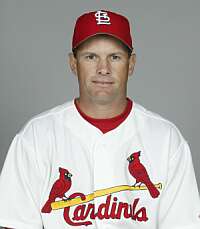
Lance Painter
St. Louis Cardinals pitcher
Born: Bedford, England

Those in charge of the sport are aware of its international potential. “Baseball was born in America, but now it belongs to the world,” said commissioner Bud Selig, and the 2003 season was scheduled to start in Japan until the invasion of Iraq took place. The Montreal Expos are also playing several “home” series in Puerto Rico, pending a decision on where the team should go. Further down the road, plans have been floated to play in Europe at some point, probably in Italy, where there’s already a semi-pro league whose games are shown on regional television.

The task is not without pitfalls. Witness the failure of soccer to achieve mass popularity in the States, its place in public consciousness largely defined by Brandi Chastain’s post-penalty strip-tease. A quick straw poll revealed that many Americans are unable to name a member of their men’s soccer team, proving that people are averse to being told which pastimes to enjoy. Pure hype can work only in the short term. The London Monarchs won the 1991 World Bowl of American Football in front of 61,000 fans at Wembley Stadium; seven years later, barely five thousand watched the Monarchs’ final game.

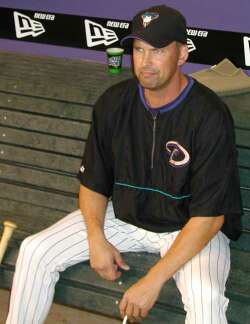
Mark Grace on world baseball:
“I would love that.”

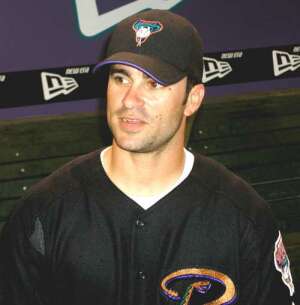
Despite the potential for failure, the Arizona Diamondback players we spoke to all supported the idea of playing worldwide. It wasn’t just the rookies either: “I would love that,” said Mark Grace, a player now in his 16th major-league season. Similar opinions were echoed elsewhere – typical was infielder Craig Counsell’s reaction, “It’d be a fun experience.” Despite such enthusiasm, there were some doubts expressed as to whether baseball could displace soccer in European hearts, and reliever Mike Myers raised the possible financial implications, especially for small-market teams. But the challenges were still felt worth the risk.

There was less consensus over the best aspects of the game: how do you sell baseball, in a market where people aren’t familar with it? Most commonly mentioned was the strategy involved, and certainly, that’s part of the attraction for me. Both beautifully simple – throw the ball, hit the ball – and deliciously complex, “It’s a thinking person’s sport,” said Counsell, and David Dellucci described it as, “A chess match, with the manager using the players as pieces.”

Other factors came up: “No clock, and no ties”, was Mark Grace’s view. Counsell feels it’s a sociable sport, in that it can be a link between parents and their children, with time within the game for interaction and relaxation – “You can enjoy a beer and a hot-dog,” agreed Delluci. Mike Myers appreciates the way centimetres, and even millimetres, can be crucial, plus the uncertainty of the outcome until the very last pitch. Or as the immortal Yogi Berra said while managing the New York Mets, “It ain’t over, till it’s over.”

Catcher Chad Moeller brought up the importance of building interest from a young age. He enjoyed soccer as a child, so has an appreciation of the tactics and skills: “Good soccer players, like good baseball players, have been playing all their life.” Attracting kids is certainly significant, and perhaps Major League Baseball should consider building from the bottom up, rather than sending teams to countries which can’t fully appreciate them. It is possible to come to the game late and still love it – I didn’t see my first game until I was in my thirties – but if you grow up alongside baseball, the chances of enjoying it as an adult are much greater.

Dellucci on one attraction of baseball:
“You can enjoy a beer and a hot-dog”

Moeller isn’t the only major league player with additional sporting talent. While growing up in the Dominican Republic, Sammy Sosa’s first love was cricket – had things been slightly different, he could be knocking balls out of the park for the West Indies team, instead of the Chicago Cubs.

Baseball is a wonderful sport, and there’s no reason why it can’t become as global as soccer. Perhaps eventually we’ll see the London Lions facing the New York Yankees, for a true ‘World Series’ place against the Hanshin Tigers. However, recent history cautions us that it’s best not to rush these things, organic growth offering the most secure route forward – anything driven solely by publicity is likely to leave the baseball cap as the game’s only contribution to international culture.

[Thanks to Susan Webner, Arizona Diamondbacks media coordinator, for her help with this piece]