The news the other day that Amazon now sells more e-books than physical one didn’t come as a surprise. I got a Kindle for my birthday, and it has quite rejuvenated my reading habits. I’d slowly fallen away from the written page since moving to Arizona, in part because I was no longer commuting on the train to work and around town on public transport. That was a perfect opportunity for a book, also helping to ensure you never committed the ultimate faux-pas of making eye contact with your fellow travellers. But in Phoenix, the car is king, and it seemed terribly rude to ignore Chris and bury my nose in a tome on our way somewhere.
Also, let’s face it, my tired old eyes aren’t what they used to be, especially given the time since my last eye exam (I’m not saying it was a while ago, but the eye-chart started sphinx, ankh, sphinx, pyramid). They can focus at computer screen and TV set distance – just don’t expect them to switch with any degree of rapidity faster than a mid-80’s camcorder (and about as much grinding and whirring). Indeed, they also function about as well as said camcorder in low light conditions – and by “low”, I mean anywhere not appropriately lit for brain-surgery. Standard book text in standard conditions where I want to read e.g. our bedroom, is legible, but only with enough squinting to take the fun out of it.
The Kindle, however, lets you adjust the print size to whatever you want. It’s also supremely easy to use. Two buttons: one to go forward, one to go back – they’re duplicated on each side so you can operate it with either hand, depending on circumstance. There’s a small QWERTY keyboard, that I hardly ever use, and some menu and setting buttons. Loading up content is a snap. Connect to your PC, it appears as an external drive, and you just drag and drop your e-books or other documents, and you’re good to go – it’ll sort through them and automatically list them by title, author, etc. Select a title and start reading; it even automatically keeps your place when you shut it off. Marvellous.
Of course, you then have to find stuff to put on it: that Kindle User’s Guide isn’t exactly great literature [while the plot is quite interesting, the characterization leaves a lot to be desired…] There are two ways you can approach this. You can painstakingly assemble a collection of e-books, paying out for another copy of books you already own and effectively rebuilding your entire library from scratch. Or you can find a nice fat torrent collection of e-books in the appropriate format, and download it. I have surprisingly little guilt over saying I did the latter.
I certainly object to having to cough up multiple times for the same content, especially when, as with e-books, there is no discernible difference. It’s not as if you get a better experience, as with, say, VHS < LD < DVD < Blu-Ray. Indeed, the Kindle is specifically designed to imitate the reading experience as closely as possible – sensible since, after all, it has been perfected over several millennia of the human experience. Buying a book, then being expected to pay for the e-version is like buying a CD, and then having to pay extra for the MP3 so you can listen to it on your iPod. I’d be more concerned about authors and publishers getting nothing if it weren’t for the existence of a) publicly-funded libraries, and b) second-hand book-stores. If I get a book from either of those, neither receive any additional recompense.
Taking the moral justifications as read (for the moment), I found and downloaded a nice torrent of e-books, in a format suitable for Kindling. It wasn’t that big, about 1.4 Gb, which is roughly the size of two standard movies. But it was only when I whacked it onto the Kindle, that I realized what a kick-ass device I had – and how far storage capacity of modern devices has out-paced the written word. My Kindle, previously a barren wasteland of emptiness, now contained 1,425 titles. Even excluding the Kindle User’s Guide, that meant that, if I read a book every week, this small device still contained enough to keep me going until approximately the end of the year 2039. When I’ll be 73. Odds are, given a more credible reading rate, I’ll die, with books on it left unread.
Of course, I can’t say that I intend to read every book on there. While the titles were skewed more than satisfactorily toward the genres I like, let’s be honest – The Color Purple is not exactly leaping to the top of the list. But this is one of the other aspects about such a bulk acquisition, and it’s a positive one for authors and publishers. The first two books I’ve read on it are both by writers I would almost certainly not have bothered with, under other circumstances. Admittedly, the two books in question have been a bit of a mixed-bag. A.J. Jacobs clunkily-named The Year of Living Biblically: One Man’s Humble Quest to Follow the Bible as Literally as Possible is sporadically amusing, but comes over as mostly self-righteous preening. He comes to the conclusion that the only way to follow the Bible is to pick and choose which bits, since it’s so contradictory. Well, duh. I could have told him that, without needing to live for a year without mixing my fibres [Deuteronomy 22:11].
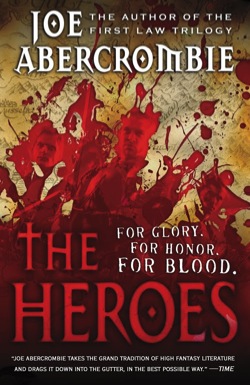
However, Joe Abercrombie’s The Heroes reminded me of why I love reading to begin with. It’s a lovingly-crafted story of a war in a fictional medieval-ish world, between the Union and the North; what makes it particularly interesting is it’s told from multiple viewpoints on both sides. You get to see things unfold as seen by a career fighter, who is fed up with the whole thing, and also the scheming wife of an officer on the opposite side, plotting advancement for her husband. It would make a great, epic movie with its gritty battle scenes that you can see unfolding in your head, particularly the one that starts off following one character, until he dies, then moves on to follow his killer, until he, too, pop his clogs, and so on.
It’s great stuff, which I’ve been reading everywhere from the bathroom to the projection booth at our film festival, and has certainly got me interested in reading more by Abercrombie. Enough to pay cash for his other books? Probably, actually. But even if there’s only a (say) 20% chance of such a purchase, that’s 20% higher than it would otherwise have been. But to finish by going back to the moral aspects, is this kindling – hohoho! – of my interest in an author, any different from borrowing the book [electronic or regular version] from a friend? I’m largely unconvinced that it isn’t exactly the same.
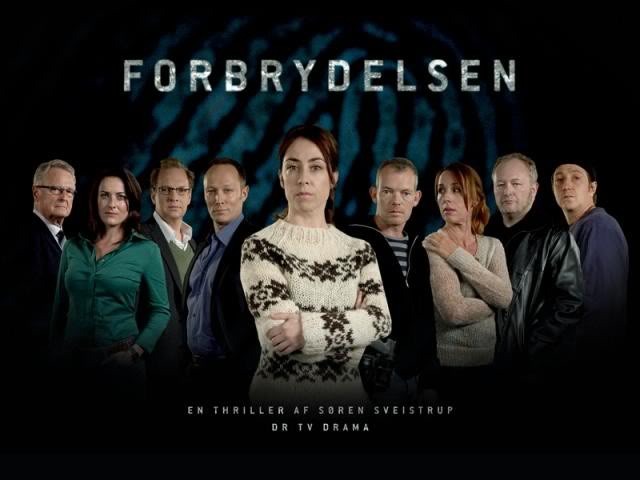
Denmark in general, and Copenhagen in particular, does not have the reputation of a hot-bed of crime. I travelled through the country on a number of occasions in my student, Inter-railing years, and the things that come to mind when you think about the country are stuff like Hans Christian Anderson, Legoland and Victor Borge. The most disturbing thing to come out of the country is probably Lars Von Trier and…well, he needed to come out of the country to express his weirdness. Otherwise, crime seemed limited to drunken students removing the head from the Little Mermaid statue. And then came Forbrydelsen – literally “The Crime,” more loosely translated as The Killing. Danny Kaye must be spinning in his grave
A teenage girl goes missing, and her corpse is found in the trunk of a car belonging to the campaign of a Copenhagen mayoral candidate. But the main difference between the show and just about every other police procedural on TV – not that, as we’ll see, Forbrydelsen is simply this – is its pacing. Normally, a case gets opened, investigated and closed in a single episode, which means you gallop through clues, suspects, red herrings and solutions in 45 or so minutes. Not so here, where the crime is painstakingly investigated over twenty 55-minute episodes. Police attention at various times targets the victim’s classmates, a teacher, the candidate, her secret boyfriend, and it looks bleak for each of them in turn.
But this aspect is only maybe one-third of the show. Just as important is the depiction of the family’s grief, as they go through the process of burying their daughter, and trying to come to terms with the unexpected lightning-bolt that has struck their family. An aspect almost entirely buried in other genre shows, is depicted here in unflinching detail. The parents (played with an aching level of intensity by Bjarne Henriksen and Ann Eleonora Jørgensen, right) are damaged, on a very core level: he sets out for revenge on a suspect, she is even more unable to cope.
The political angle centres on candidate Troels Hartmann (Lars Mikkelsen), who finds his aspirations of office potentially derailed – rightly or wrongly – by his proximity to the case, and who has his own secrets, irrelevant to the case, which it may end up exposing. His attempts to keep his campaign rolling, in an atmosphere of suspicion and intrigue, are another key facet, as alliances are formed and destroyed, while loyalties are tested (and often found wanting). Albeit it’s one that may pose confusing problems to the overseas viewer, unaware of the internal machinations of Danish politics. Is there any difference between the “Liberals” and the “Moderates”? Can we get some kind of scorecard?
The focus, however, is Sophie Lund (Sofie Gråbøl – it rhymes with “trouble”), who is up there in the pantheon of great female TV detectives, alongside Detective Superintendent Jane Tennison, and..er, Cagney and Lacey? She is fully committed to the task at hand, even though it starts on what was supposed to be her final day on the job, before moving with her son and boyfriend to Sweden. However, something about the case resonates with her, and she puts everything aside, pursuing the truth with admirable determination and tenacity. While her bosses may believe the truth has been found, she won’t stop picking away, until all the layers of misdirection have been erased.
It would have been easy for the show to fall into the standard “female police officer” clichés: sexual tension with a colleague, struggling to balance work and family life, etc. However, the show doesn’t bother with either: Lund is so single-mindedly devoted to the task as hand, as to be a borderline sociopath. She doesn’t so much deal with people, as tolerate them, and in that way resembles the other Scandinavian heroine of recent note, Lisbeth Salander. There are some exceptions – Lund does have more sympathy for the victim’s family than some of her colleague, trying to keep them informed when it might be best not to. On the whole, though, as her son notes, she’s more comfortable dealing with the dead, and as the series progresses, her isolation from those around her becomes near-complete.
I also have to mention her Faroese sweater, a swatch from which (or a Lund-alike) is at the top of this piece. It’s almost a character in itself: just like Colombo’s grubby raincoat. We expressed concern when it was badly wounded by a knife-wielding attacker (with no sense of dress sense), and were pleased to see that it made a full recovery, and was back, good as new, in later episodes.
Then there’s Meyer, the man who will replace her – just as soon as Lund leaves, which gets postponed more often than a James Cameron release date. He initially seems a bit of a dick, an abrasive ‘bad cop’, but there are moments where his humanity shows through, such as his wife turning up at the police station bearing bananas and his fibre pills. He has his moments too, and by the time we reached the final few episodes, we were warming to Meyer, and his odd loyalty to Lund, even as she ploughs on her own trail, without as much as the courtesy of bothering to inform him of her intentions.
The show originally came out in early 2007 and was a huge hit in Denmark – one-third of the entire population watched the final episodes. The BBC bought the rights, but despite its success, both at home and elsewhere in Europe, hadn’t screened it. The success of Wallander, and I suspect, word of of a US remake (more on which below), eventually convinced them to show it, albeit buried on BBC Four. It became an unexpected hit there: unlike most shows, the ratings actually grew over the course of its airing, in 10 double-eps, reaching over 600,000 for the finale, compared to less than 450,000 for its debut. To put that into context, it’s higher than Mad Men on the same channel. The BBC will be screening the second series later this year, and we can’t wait: we’ll need to find something to fill the the gap in our televisual schedule. Spiral sounds promising.
Gråbøl may be slightly familiar, if you have an encyclopaedic memory for obscure European movies. If so, you may recall a 1997 Ewan McGregor film, Nightwatch, playing a student who takes a job as a night watchman at a morgue, only to be implicated as a serial killer. It was a remake of a Danish film of the same name, three years previously, which I saw at the time. Gråbøl was the student’s girlfriend – Patricia Arquette in the remake. S’funny how, 17 years later, she is now involved in another Danish crime thriller deemed worthy of a remake for the America market, with AMC now screening their version of the story, with Mireille Enos taking on Gråbøl’s role. as “Sarah Linden”. We rewatched it recently, and it’s just…wrong seeing her a) young, b) blonde and c) generally happy.
We’ve been watching that as well, and it’s solid if entirely unnecessary. This version does compact the story down, into 13 x 45-minute episodes, relocating it from Copenhagen to Seattle, and thus far has increased the “political shenanigans” angle, which is probably my least favorite aspect. There is certainly potential for confusion: at one point, Lund discovers a crucial piece of evidence hidden in a globe. We wondered why she was going back in there, until we realized that it was Sarah Linden we’d seen find evidence there – something which happened in Week 3 of the US version, took place about ten episodes later in the Danish version.
We’re curious to see if they change who the killer is in the AMC series – executive producer Veena Sud told said, “We are kind of diverging and creating our own world, our world of suspects and, potentially, ultimately who killed Rosie Larsen.” Maybe they can then sell it back to Denmark?
End of the month time, so I checked the stats for the site, see how many people have been stumbling across my deathless prose – or, more likely, doing a Google Images search for dubious pictures [Hey, hits are hits, right?] Normally, there’s about 200-300 per day, not really varying too much. But then I looked at the graph for February…
One of these things is not like the other…
WTF?
That’s not a mistake. On February 21st, we got 254 visitors. On February 22nd, we had 20,276. That would be a 7,883% increase over the previous day. To put the total into some kind of context, we had just over 17,100 in the entire last quarter of 2010. Now, we suddenly had that many in a single day. WTF. No, seriously: WTF?
My first thought was that we’d been hacked, and that someone had injected some kind of mass phishing scam into our page content, harvesting credit-card details for the Eastern European mafia – and without even the courtesy of a percentage or two in kickback. However, nothing seemed to have changed on the site. It took a little bit of detective work, but I was finally able to track down the piece responsible for the massve spike in traffic. However, this simply raised as many questions as it answered: why was our Incredibly Bad Film Show review of Thunder and Mudsuddenly a hot topic on the Internet?
The reason appears to be, because that piece was one of the top searches on Google at the time for Jessica Hahn. If you’ve forgotten who Hahn was, she was the model/actress/whatever who, in 1987, brought down televangelist Jim Bakker, then head of The PTL Club, by alleging that Bakker had drugged and raped her a few years previously, when she was working as a church secretary, and had been paid off by Bakker to keep quiet. Big thing at the time – Hahn parlayed the notoriety into a Playboy pictorial, an appearance on Married With Children and… Yep, as one of the hosts in the combo heavy-metal/mud wrestling extravaganza which was Thunder and Mud.
Fast-forward 13 years, and we post our review; fast-forward a further eight, and it suddenly becomes relevant, as Hahn turns up again on The View, a morning talk-show on ABC hosted by, among others, Barbara Walters. The two women spar, with Hahn pointing out her relationship with Bakker wasn’t an “affair”, and trying to contrast it with Walters’ relationship with married U.S. senator Edward Brooke. A fair point – not that Walters was having any of it, of course. Let’s go to the tape…
There you have it. Boom. 20,000 visitors to the site, triggered by that. It probably didn’t even count as 15 minutes of fame; probably nearer 2-3. But it’s a powerful example of how the Internet [or, at least, Google] never forgets; things can lie dormant in its tubes for years, before suddenly being relevant, albeit very briefly. Our article blazed a burning trail across the information superhighway, before fading back into the obscurity from whence it came, and our site goes back to serving a couple of hundred visitors per day. Kinda cool.
[And this article continues to be the gift that keeps on giving (page views, at least!). A slightly smaller spike – a mere 3,500 visitors in a day, about ten times normal traffic – showed up on October 22, 2012. Not quite sure of the reason for this one. If I’d to guess, it might be a result of the scandal surrounding the CIA chief, but that’s just a guess.]
If you don’t know who Uwe Boll is, a Google search will enlighten you. After the obligatory IMDB, Wikipedia and Rotten Tomatoes pages, the next links go to a New York Times article, which opens, “Uwe Boll is often referred to as the worst filmmaker in the world,” the now-defunct StopUweBoll.org, an online petition against the man with over 350,000 signatures, and an unpleasant exchange of emails with Wired over their unfavourable review of Postal. If you need more, both House of the Dead and Alone in the Dark are firmly ensconced in the IMDB bottom 100.
It’s no coincidence that both these are video-game adaptations. as are most of Boll’s most critically-panned works, e.g. Bloodrayne and In the Name of the King: A Dungeon Siege Tale. Hell hath no fury like a video-game geek irked, and they’re usually tech-savvy enough to shriek endlessly about their nerdrage online, to other video-game geeks. And actually getting a reaction from him puffs up their egos: he’s a lot more accessible and open about his feelings than. say. Michael Bay. Boll doesn’t seem to mind criticism, per se: in interviews, what he has railed against is hypocrisy – those who tell him to his face they like his movies, then bash it – or those who pre-judge his work. And I can see his latter point in particular: Bloodrayne made it into the IMDB bottom 100 before it was even released, thanks to the work of those I call “the Boll weevils”.
Mind you, I can see his enemies’ point too. While I enjoyed both House of the Dead and Bloodrayne more than most, I wouldn’t call either “good”, while Bloodrayne 2 is pretty close to unwatchable, and Far Cry isn’t much better, even with the godlike presence of Udo Kier. Basic rule of thumb: when Boll makes movies based on video-games, the results are likely to be uneven, and that’s putting it mildly. While those represent his bread-and-butter, his career his covered other territory too. We previously reviewed Heart of America, which is unspectacular but certainly not deserving of vitriol, and below, we look at some of Boll’s recent output, both in and outside of the genre for which he is best-known.
Darfur
Star: David O’Hara, Hakeem Kae-Kazim, Noah Danby, Sammy Sheik
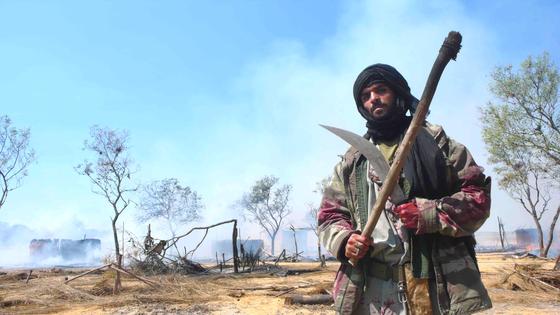
TC Top 10 Film: 2011. This is an extraordinarily fucked-up film, but then, it is about an extraordinarily fucked-up situation. While you’ve probably heard about the situation in Darfur, it’s something that is vaguely “over there”. The harsh reality is that it’s one of the nastiest civil conflicts of recent times, with the Sudanese government supporting, covertly and otherwise, militias who operate against the local independence groups. Both groups are Muslim, but the conflict is loosely between ‘Arab’ and ‘African’ factions, and has lead to the deaths of hundreds of thousands, both directly through fighting, and of disease, starvation, etc. It’s an unholy mess, which I knew little about, until the film provoked me to look into the background – managing that is a rarity, and gives you an idea of its impact.
A group of Western journalists join an African Union patrol of “observers” as they head off to a remote village; on the way, they stumble across a mass grave, evidence of the ethnic cleansing carried out by the Janjaweed militia. While the village inhabitants are poor, and some have horrific tales to tell, they don’t seem in danger – but when the convoy is leaving, a cloud of dust in the distance alerts them to the Janjaweed forces, making a bee-line for the locals. Hoping the presence of cameras and the press will dissuade the militiamen from further atrocities, they head back to the village for a face-off. It doesn’t go as well as they hope.
The DVD sleeve – which also re-titles the film Attack on Darfur, since obviously no-one in America knows what a “Darfur” might be – does the film a massive disservice. Where in the movie are the helicopters it shows? In this case, an accurate depiction would be a massive turn-off, and I can forgive the deception, if it fools a few people into getting their eyes opened. For this is grim viewing, that has a sense of impending tragedy from the opening, and delivers it in full, to the point of being tough to watch. Rape, cold-blooded murder, babies on spikes… No, seriously: babies on spikes. I refer you to my previous, “extraordinarily fucked-up” comment. Kudos to the leads, who handle the largely improvised dialogue with aplomb, and also regular Boll collaborator Jessica de Rooij, who produces a fine, haunting score.
What doesn’t work? Most obviously, the hand-held camera. Yes, it’s done to create a documentary “feel,” even if most actual documentaries these days are much less wobbly. Here, it does more to take the viewer out of the moment, as they’re thinking “Why is the camera shaking so much?” Or, in Chris’s case, have to leave the room entirely due to motion sickness [Dear Uwe; please make a good film with a static camera, so my wife can watch it. KTHXBAI]. The ‘celebrity’ presence as the journos is also somewhat distracting, as you’re forever seeing Max Headroom, Bloodrayne or the kid from T2 in the background.
I am also somewhat uneasy about Boll’s use of genuine Sudanese refugees to play the villagers, who consequently get to relive situations similar to those that drove them out of their country to begin with. At best, it can’t have been much fun, and at worst, it’s exploitation. I’m assuming they weren’t paid standard SAG rates, though the simple retelling of their stories is part of what creates the looming sense of doom. Overall, however, even if the “entertainment” value here is low, there’s no denying this packs an immense wallop, and it should be Exhibit A for those who still associate Boll with nothing more than video-game spin-offs.
B
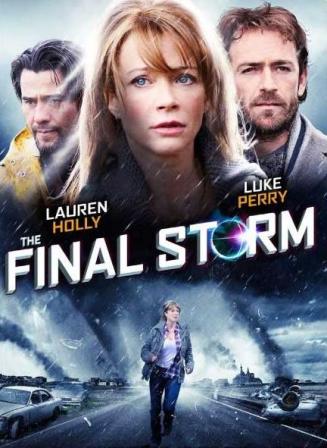
The Final Storm
Star: Steve Bacic, Lauren Holly, Luke Perry, Cole Heppell
I’m a sucker for a good religious apocalypse film. Hell, as my love for The Omega Code will attest, I’m even more of a sucker for a bad religious apocalypse film. This leans more towards the former; both the religious and apocalyptic elements are significant, yet not overpowering: it certainly isn’t 2012-styled disaster porn. Tom (Bacic) and Gillian (Holly) live on an isolated farm with their son, Graham (Heppell), and watch with some discomfort on TV as the cities descend into chaos and the weather goes insane, too. Their concern is disrupted by the arrival on their doorstep during a storm, of a stranger on the verge of collapse.
He is Silas Hendershot (Perry), a polite, well-spoken young man with a fondness for Biblical scripture. Gillian takes to him, and insists he stays until things blow over, but Tom is less impressed, believing there’s something not quite right with their new visitor. However, concerns there have to go on the back-burner, as their neighbours have vanished. And when the family makes it into town, it is almost completely deserted too. Was there an evacuation and they missed it? Or is there something more apocalyptic happening?
Used as I am to Uwe’s more action-oriented works, this was a lot more restrained, especially once you get past the fairly gratuitous sex-scene near the start. If you missed the opening credits, this could be completely unrecognizable as an entry in the Boll filmography. Perry’s performance is solid, and pitched at the right level; while it was clear to me that Silas is a fruit-cake, I tend to think that of anyone who quotes the Bible. Rural isolation + religious fundamentalism = a particularly bad idea, as you’ll know if you’ve seen The Passion of Darkly Noon or Roman’s Bride.
However, I can see why his hosts are somewhat distracted, though I do have some questions, such as regarding the lack of cars in the town? If it’s some kind of rapture-esque event, did everyone have to drive to heaven? I did like that the script didn’t lay everything out for the viewer in simplistic terms, and except at the very end, it’s less about the apocalypse than how people would react to it. Much as in Night of the Living Dead, a theme is that, in the event of an external threat, that might not be the biggest peril – others facing the same threat may be a greater danger. Even an an agnostic, I appreciate the even-handed treatment of religion: both Tom and Seth have faith, in their own ways.
There’s a nice sense of escalation towards the ending, though I wasn’t quite as satisfied with that final reel. Things seem to get a little out of hand, and the movie is at its best exuding quiet menace, not shouting at you as the world goes down the plughole. which, while the jury may be out on whether it works (or even makes sense), is certainly one you’ll remember.
B-
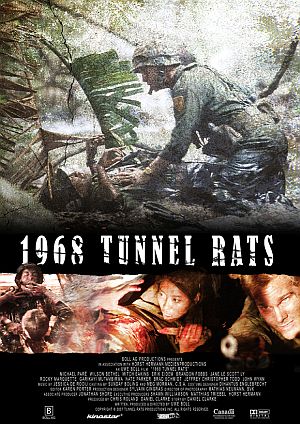
1968 Tunnel Rats
Star: Nate Parker, Erik Eidem, Jane Le, Jeffrey Christopher Todd
In the Vietnam War, the Viet Cong set up and used a massive network of underground tunnels and chambers as bases, from which they could mount attacks on enemy forces. When discovered, the Americans would send in their “tunnel rats”: small of stature, lightly-armed soldiers to kill any lurking Viet Cong, and plant explosives to destroy the tunnels. Needless to say, this was a job fraught with peril, and subject to a high turnover. The latest batch of arrivals in the jungle from America have only a brief time to get to know each other, before going into action: the Viet Cong fight back, both above and below the dirt.
The film is at its best depicting the utterly claustrophobic nightmare of the underground battle, where the enemy might be about to attack from any angle, with booby-traps and flooding other hazards to contend with. The movie also doesn’t just treat the Vietnamese as “the enemy,” but does make some effort to show life from their side as well. For example, after Vo Mai (Le) takes out one of the soldiers with a sharpened bamboo stake [an impressively FM!RT! moment], she goes back into the tunnels and throws up. The final sequence, where she ends up having to team up with one of the Americans after a cave-in, is surprisingly poignant and effective.
The lack of any real “names” in the cast works for it – Boll regular Michael Paré, playing the squad commander, is the only recognizable face, making it harder to pick out obvious survivors. However, the characterization of the US soldiers is badly-handled, perhaps a result of the improvisation used in lieu of a script. The night of their arrival largely consists of them trading cliches with each other about what they’re going to do when they go home, how much they miss their mom’s cooking, and other activities which, from watching numerous war movies, we know are signing their death warrants. And once they get into the tunnels, it’s basically impossible to tell them apart.
It might have been wise if Boll had also not divided our attention between events beneath and on the surface. The latter provide s little we haven’t seen in every other ‘Nam flick, though the horror of an air-strike which arrives at about the worst moment possible is effective. From then on, perhaps because the high mortality rate has winnowed down the characters, the film is a great deal better, and I have to think that sticking with one or character, giving him proper depth, would probably been more effective and memorable.
C
Postal
Star: Zack Ward, Dave Foley, Chris Coppola, Jackie Tohn
Whoever said Germans have no sense of humour? Must be someone who’d watched this largely dreadful exercise in bad taste. It opens with the 9/11 hijackers debating the number of virgins they get after dying, and when they call Osama and are disappointed with the answer, decide to fly to the Bahamas instead – until the passengers charge into the cockpit, causing the plane to crash into the Twin Towers. Oh, hold my aching sides. About the only thing going for it is no-one will accuse the script of being prejudiced: it hates everyone. Rednecks, Muslims, even Germans – it’s nothing if not an equal-opportunity offender.
The story, such as it is, centres on a nameless guy (Ward), who lives in a trailer park with his immense, unfaithful wife, and has a generally wretched life. He goes to see his Uncle Dave (Foley), who is running a scam religion, but needs $1.7 million immediately, to fend off the IRS. They decide to steal a shipment of highly collectible penis-shaped dolls from the Little Germany theme-park, at an event where the special guest is Verne Troyer (a.k.a. Mini Me), unaware that Al Qaeda are intent on using the same dolls as part of a terrorist plot.
I laughed twice. I don’t mind broad humour – hell, I come from the land of pantomime and Carry On films – but this is juvenile to a painful degree; and, worse, just not funny. It’s crude parody, and is so patently trying to be offensive, that it largely fails to do so – for example, Foley straining, at length, to take a dump, while the hero watches and listens, embarrassed, nearby. The yawning gulf between this and truly scathing cinematic satire, such as Mike Judge or the South Park guys, is obvious in almost every sequence.
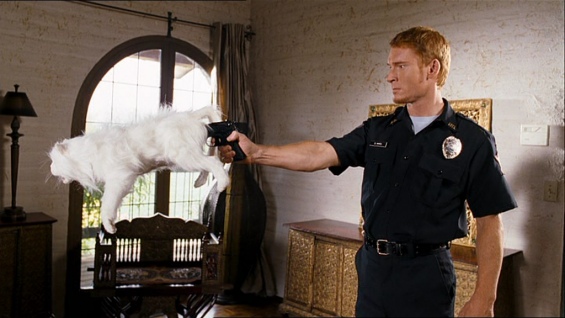
But, for the record, let me detail the two occasions on which I laughed out loud – and, admittedly, that’s more than some Hollywood comedies. The first was when Boll himself, as the owner of Little Germany, told someone critical of his venue, that his grandfather died in Auschwitz – he fell from a guard tower. Yes, it’s a very old joke, but hearing it told by am actual German, with obvious relish, enhances the shock value immeasurably. The other was a throwaway moment, where the hero uses a Persian cat as an impromptu silencer – though no cats were harmed in that particular scene. Even Uwe has his limits, it would appear.
D
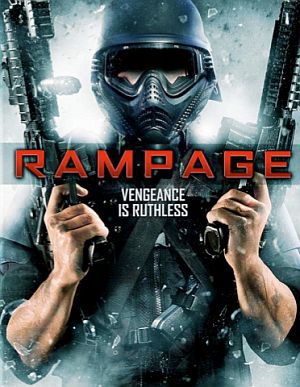
Rampage
Star: Brendan Fletcher, Lynda Boyd, Matt Frewer, Shaun Sipos
Boll’s most critically-approved movie is currently scoring a 6.4 on the IMDB, though not everyone was impressed – I particularly liked the review there which said the film, “WALLOWS LIKE A FILTH ENCRUSTED SWINE DROWNING IN ITS OWN FECES.” And, yes, it was in all-caps. I’m going to use that line one of these days, but it won’t be here, as the film deserves praise for a relentless and unflinching portrayal of a one-man killing spree in a small town. It’s carried out by Bill Williamson (Fletcher), a 23-year old mechanic who has some issues – but, perhaps more interestingly, has a meticulous plan, both for the carnage and how it’s all going to end. He starts of by taking out the local police station, using a van packed with explosives, then picking off the remaining cops nearby, and only then turns his attention to the local civilians…
The film is only peripherally interested in the motivations for his actions. Bill doesn’t have a particularly bad life: he’s not bullied, the biggest problem in his life is his parents (politely) getting him to move out, and he doesn’t even appear to have the obvious cheap cop-out of playing violent video games or whatever. That may actually be one of the movie’s strengths, as any such explanation would inevitably fall short of the mark, so it’s perhaps best not even to bother. His ‘normality’ also makes the slaughter all the more uncomfortable, as there’s nothing obvious to separate and distance the killer from the viewer. Instead, he’s just like us – it’s a bit like Falling Down in that respect, particularly in the ‘bad service’ scene both films share.
Beyond that, however, it does lack much satirical edge, despite a delightful scene where Bill arrives in a local bingo-hall and… things don’t unfold as you’d expect. Mind you, having played that game, what transpires did have me nodding in acknowledgment of its plausibility and pitch-black humour. In contrast, the sequence in the beauty parlour is simply wrong – as an aside, it’s definitely worth hunting down the uncut version of the movie, which runs about five minutes longer, a good chunk of which seems to happen in the parlour. Having seen that scene in both versions, the uncut packs about ten times the wallop: I believe the ending may also be different.
Speaking of which, does the ending, with its twist, ring entirely plausible? No, though I can’t get into dissecting it in depth, for reasons of spoilage. Still, that, along with the overuse of not-very-Steadicam, are probably the biggest weaknesses; at least the shakycam doesn’t have the brutal force multiplier of frenetic editing, to make things even worse. [Chris still declined to view this one] But overall, this goes into a place that not many films have ventured, and contains more than enough scenes which will stick in your mind. It’ll be a while before we can pluck up the courage to suggest that our son moves out…
B
Seed
Star: Michael Paré, Will Sanderson, Ralf Möller, Andrew Jackson
While the DVD came with a copy of a PC video-game, this does not appear to have been based on a game. Still, this closeness may help explain the uneven nature here. There are two highly-memorable scenes – though as we’ll see, not necessarily in a good way – but these are countered by a muddled script that has little logic, even by the light standards of the “serial killers from beyond the grave” genre, and an approach to cinematography too often apparently reliant on a pack of Swan Vestas for lighting.
The villain is Max Seed (Sanderson), a killer responsible for the deaths of over six hundred people in a six-year period. He taunts police by sending them time-lapse footage of the decomposing bodies of his victims, from cockroaches to babies, but is eventually caught by Detective Matt Bishop (Paré). Sentenced to death by electric chair, Seed survives three attempts – according to state law, he can’t be executed again, so Bishop pretends Seed is dead and has him buried in the prison grounds anyway. When the killer digs his way out of the earth and resumes his spree, Bishop has to find the “copy-cat” before Seed takes very personal revenge on the man who sent him to a premature grave.
The flaws in the plot are almost too numerous to list, but here are a sample: * How does Seed have time to take multiple, lengthy time-lapse videos, which must take months to shoot, and still kill about one person every three days? * Why is he allowed to keep his serial-killing mask on, right up until execution? * The guy kills over 600 people – and a “copy-cat” another 60-odd – and Bishop is apparently the only guy investigating? * The “three strikes and you’re free” rule claimed to be “state law” at the start of the film, is complete BS. * Cops will split up, and go off entirely on their own when searching a pitch-black serial killer’s house. And that’s aside from the whole unkillable killer thing; you’d think having his eyes pop thanks to the application of 15,000 Volts might slow you down a bit. Apparently not.
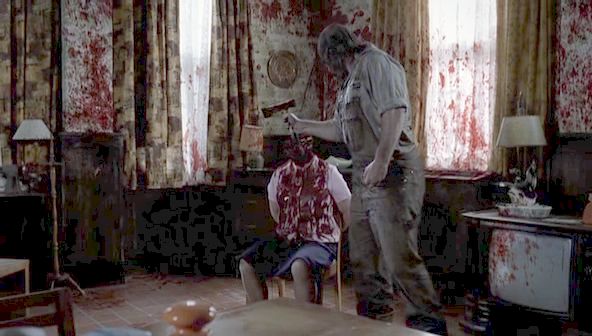
The scenes in the house seem to go on for hours, and you’ll be forgiven if you fall to sleep during these. The film only comes to life and claws its way back from the dead when Seed does. There is one scene which is simply brutal: he has tied up a woman and starts off tapping her with a hammer, but it escalates to an utterly savage bludgeoning – all done, apparently, in one shot. You keep expecting the camera to cut away – but it doesn’t. It goes on. And on. “The point for me was to make a movie that is completely uncompromising,” Boll told Fangoria in October 2006. For that shot at least, it’s a success – qualified only by the fact that we don’t know who the victim is, which limits the emotional attachment. However, the ending is so completely bleak, it also backs up the intent.
The first shot, however… For Boll has used footage of 100% genuine animal cruelty. Sure, he obtained it from PETA themselves, but I really think the justification for it here is pretty slim. Especially as an opening gambit, the result comes across nothing more than a cheap attempt to shock. Albeit a successful one, since the footage is pretty difficult to watch, even if I’m more a cat person, shall we say. But if you’re going to do this, you need to have a clear purpose; simply having your psycho watching it, as here, isn’t enough.
C
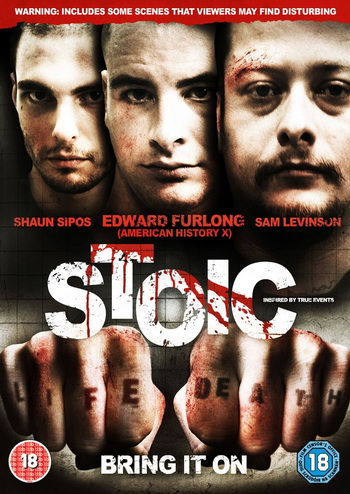
Stoic
Star: Edward Furlong, Sam Levinson, Steffen Mennekes, Shaun Sipos
There’s something about this which feels like a stage production, more or less being one set and four characters. The set is a jail cell; the characters, inmates who start off playing poker. Then a harmless joke bet, to eat a tube of toothpaste, is reneged on by its instigator, Mitch (Sipos). The other three force him to carry out his obligation, and things then quickly escalate from there, particularly after Mitch makes a break for the alarm buttons and tries to alert the guards. Retribution is swift and terrible. Leading the instigation is German skinhead and arsonist Jack (Mennekes), along with scrawny, psychopathic armed robber Harry (Furlong). Reluctantly going along – mostly for fear they’ll turn on him – is the final cellmate, Peter (Levinson), who comes up with the idea of faking Mitch’s death and making it look like suicide…
Boll seems adept at pushing Chris’s buttons: the scene where Mitch is forced to eat his own vomit got her scurrying out of the room this time. A lot of this is certainly difficult to watch, although one wonders what kind of jail it is, where the guards apparently never check on the inmates. The performances are solid, with Levinson coming out best, though Furlong certainly isn’t someone with whom I’d like to be locked up; it appears the dialogue was mostly improvised, and it certainly has a natural flow. While Boll breaks out the hand-held cameras again, at least this time, they aren’t being waved around like Leatherface wielding his saw, and I don’t think this had much to do with my wife’s early exit.
The main problem is that I don’t quite get what the point is intended to be here. People in jail do unpleasant things? Peer pressure is bad? Whatever it was, and even though this was based on a true story from a German juvenile detention facility, the end seems to fall some way short of justifying the sight of Mitch getting a broom handle shoved up…well, his end. It did provoke a discussion with Chris about what we might do in a similar situation, where you are forced to participate, or risk becoming the next victim. While it’s a topic that certainly merits some contemplation, much the same ground was covered, to better effect, in Shellter. The main thought I take away from this, is that I probably wouldn’t do very well in prison.
C+
What do we have? A mixture. Some good films, some bad: from terri-boll to lauda-boll [what, you expect me to get through 4,000 words without a Boll joke?] In other words, pretty much what every other director has produced, from David Cronenberg to Fred Olen Ray, and objective evidence for him being the 21st-century Ed Wood is kinda slim. What I certainly did see, was a director who – particularly when he isn’t adapting video-games – is stretching out beyond the genres with which he is associated, and seems to be making perceptible progress as a film-maker. That’s certainly a great deal more than you can say about many working in Hollywood.
Take his upcoming movies: it’d be hard to find a more diverse bunch. He’s going back to the video-game well (sigh…) for Bloodrayne: Third Reich, doing a comedy about a fat superheroine, Blubberella…and then there’s Auschwitz, which seems to be exactly what it sounds like. He shot that back to back with Bloodrayne, since he already had the sets and uniforms, and according to Boll, “It was an opportunity to make something that nobody would ever finance, but is necessary to make.” After the guard-tower crack in Postal, I wasn’t sure Boll was the right person to do a serious movie, but having subsequently seen Darfur, I’m a good deal more certain he might be able to handle it. There is a big step, however, from a genocide that, unfortunately, few care about, to The Big One. Will Boll be able to make the leap? Stay tuned.
If it weren’t for the expected heady delights of Zach Snyder’s Sucker Punch, it would be quite feasible to imagine a 2011 where I don’t bother going to the movies. We all but abandoned that this year, the previous issues of increasing cost, decreasing quality of cinematic experience and the rise of alternatives, all combining to work against it. With a broad seam of “treasures” from previous years waiting to mined from sites like Cinemageddon, why bother with new movies? The does make the creation of a list like this difficult, since the number of films which qualified as “2010” was probably an all-time low, even with a deliberately-vague rule on what counts. Next year “of” may be be replaced by “watched in”.
The split of how the ten were obtained is interesting. One was seen at the cinema; two were DVD screeners; two were part of our film festival; and the other five were… Well, for legal reasons, let’s just go with “not”, shall we, and I won’t say which was which. As an aside, I note that the most-pirated movie of 2010 was Avatar…which was also the most-bought DVD of 2010, with sales numbers basically the same as the most-bought DVD of 2009. And, even if you reckon every single one of those downloads personally cost Jim Cameron $10, the total amount lost was less than 6% of the film’s worldwide gross. Yeah, piracy really is bankrupting the movie-industry, isn’t it? </rant> And with that, let’s move on, shall we?
Here’s the list of my ten favorites from the year just past. Links go to the appropriate review: titles marked with a * are over on GirlsWithGuns.org, so those reviews will pop open in a new window.
The Shadow Within
10. The Shadow Within I said this quietly understated horror flick “reminded me of Sapphire & Steel,” but I probably should have clarified, to avoid any confusion, that this was a good thing. Most low-budget horror films tend to go for the basics, like slashers, so it was nice to see one that had a spot of invention to give the viewer. Summary: “Managed to overcome the obstacles and deliver something that’s generally successful and occasionally quite chilling.”
9. Harry Brown This Michael Caine vehicle likely got some quality rub-off from having watched Get Carter earlier in the year, as it feels like an unofficial sequel: Jack Carter, forty years on, now an OAP, yet still capable of being an ultimate bad-ass when necessary. Caine is always a pleasure to watch; like Sean Connery, he is now such an iconic figure, he really doesn’t need to bother. But, unlike Connery, Caine still does. Summary: “Shallow, fearmongering exploitation with a heart”.
8. Inception The jury is still someone out on this one: when I get round to seeing it again, it’s possible the film could move up the list, if I appreciate its depths, or drop off entirely, as I realize it is pretentious bollocks. It was certainly nice to see a full-on Hollywood blockbuster that spends $200 million to fuck with the audience’s head. David Cronenberg is wondering where he went wrong. Summary: “Nolan is playing with chess pieces, shuffling them around a board of dreams.”
7. Mutant Girls Squad* Part of the new wave of uber-splatter that has been coming out of Japan: this and last year’s top-10 entry, Machine Girl, share a similar gleeful level of completely mad inventiveness, painted with a firehose of arterial spray. This one plays like a Pythonesque version of X-Men, featuring a hiddem race possessing powers that are largely utterly ludicrous e.g. a chainsaw that comes out of your butt. Summary: “Impossible to take any of it seriously, even as it is played completely straight-faced.”
6. The Countess The most unexpected surprise of 2010 came on the heels of the sub-mediocre Bathory, covering the same historical biography. The difference is that Julie Delpy nailed it with her performance, playing a character often depicted before, but never really portrayed. One of the biggest serial killers of all time becomes almost sympathetic, which is quite an impressive feat. Summary: “While not exactly soft-pedalling the brutality, it’s more of a tragic love-story than anything else.”
5. SexyKiller* And speaking of amiable serial-killers, here comes Barbara, part-time bubble-headed student of medicine and dedicated follower of fashion, part-time cold-hearted psychopath. But just when we’re getting used to that, the whole thing becomes a zombie film, in what must be the most abrupt right-turn since From Dusk Till Dawn. Summary: “I just loved the unashamed nature of it all: Barbara is perfectly comfortable with who she is, and is in no need of redemption.”
4. La Horde The zombie movie truly is international, and this French entry got back to basics: a bunch of ill-fitting companions, thrown together in a confined space, thanks to and having to deal with the presence of ravenous hordes of undead. If slightly too derivative of Romero’s original [especially at the end], I thoroughly appreciated the stripped-down approach. Summary: “Drawing the characters efficiently, in a few short brush strokes, and then getting on with the horror and action.”
3. You, the Living One of those films which largely defies description, this makes Inception look like two hours of webcam footage, in terms of interconnected narrative. Scenes start in the middle, stop in the middle, and link into each other with the kind of logic that only appears in dreams. It should be enormously irritating as a result, yet there’s a genuine sense of human warmth pervading it. Summary: “When it works, it works beautifully, with a deadpan sense of dark humour that feels similar to Aki Kaurismäki
Bitch Slap
2. Bitch Slap* Chris bailed entirely on this, 20 minutes of sarcasm e.g. “Would you rather watch this alone?”, into this grindhouse beat-em-up, with the throttle stuck open. It’s closer to Faster Pussycat than anything else, as three women head out to the desert for a stash of treasure, only for their relationship to fall apart in brawls and treachery. Summary: “Alcohol will probably help the neurons go in the correct direction, as will an encyclopaedic knowledge of pop culture, and tolerance for trash at an industrial concentration.”
1. Shellter If you look at our number ones for the past couple of years – Martyrs in 2009, and 2008’s Sick Girl – you’ll notice both are hardcore horror with a philosophy, and Shellter is cut from much the same cloth. It doesn’t pull its punches and is often difficult to watch; yet it forces you to confront uncomfortable realities about humanity in general, and yourself in particular. How far would you go? Summary: “It’s probably no coincidence that the director has a master’s degree in psychology – and that’s why I say the film has a philosophy. This is what lifts it up above its retarded cinematic cousins.”